
01
A stew cooked in the middle of the table
Iron pot stew is a stew you sit around, cooked in a pot built into the table.
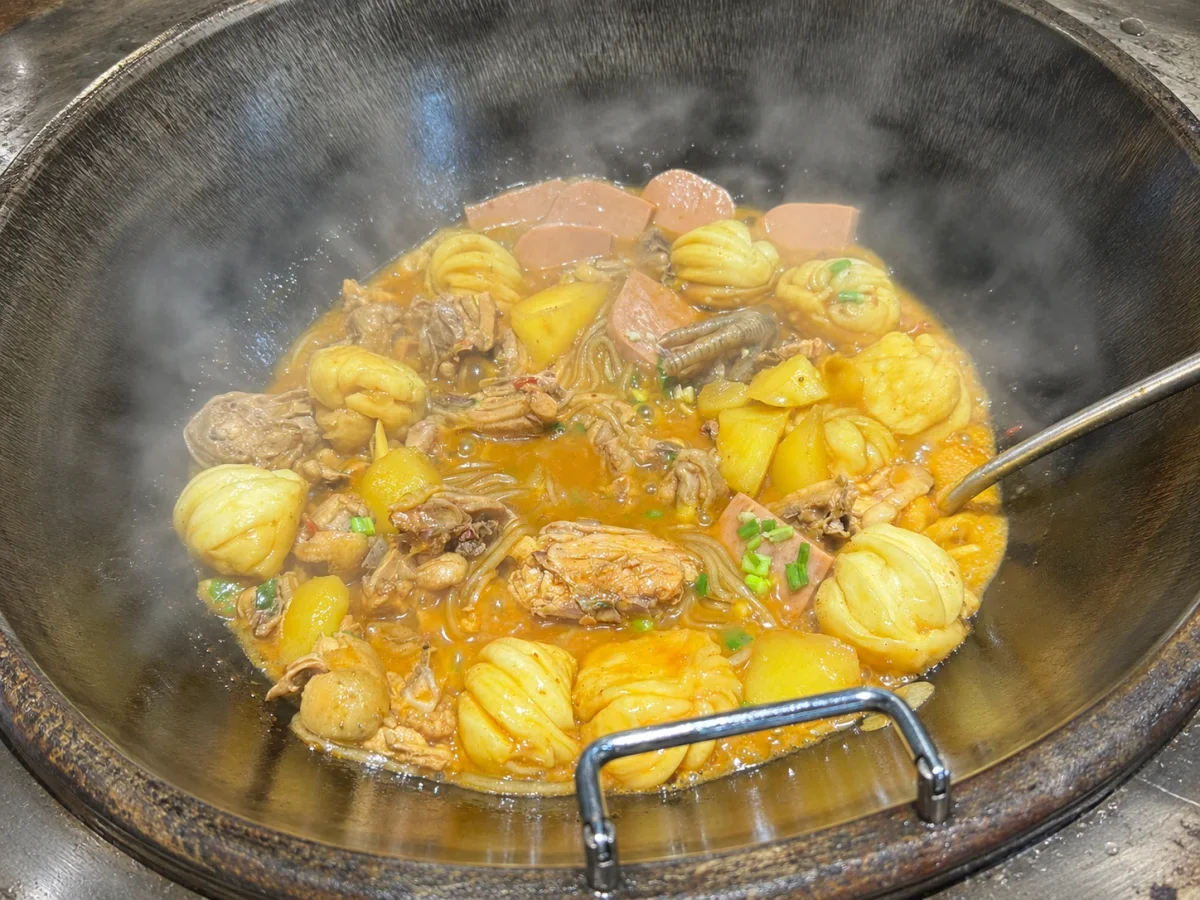
The pot sits right under the diners’ noses. Chicken, duck, goose, fish or pork, you can see how fresh it is, watch every seasoning go in, and follow the oil, the frying and the stock from start to finish, with nothing hidden in a kitchen.
Compared with hot pot, the idea is the opposite. Hot pot boils raw ingredients briefly, each diner cooking their own; iron pot stew slow-cooks everything together over low heat in an enormous wok, and the kitchen does the seasoning. The result is hearty rather than delicate: chewy meat, soft vegetables and rich, soy-dark flavors, clearly salty and sweet at once, the food of a region where winter averages minus 20°C.
When the timer goes and the lid comes off, the steam carries a heavy smell of soy and spice, and the sauce has cooked down thick enough to cling to the meat. Goose stays firm and chewy, and cold-climate birds stew up tender rather than stringy, getting more fragrant after two hours or more. The potatoes and dried beans, cooked soft, have soaked up the sauce, and the corn cakes baked on the rim are fragrant with it.
02
The pot, the stove and the fire
In a traditional iron pot stew room, the table is the stove.
The pot sits in a brick stove built into a private room, with a flue running up the wall and a ledge around the pot wide enough for everyone’s bowls and glasses.
The format belongs to old Northeastern houses, where the kitchen stove was connected to the heated kang bed, so a single heavy cast-iron pot cooked the day’s meals and heated the house in winter. Harbin restaurants still claim three traditional steps: simmering over firewood, reducing the juices in the iron pot and baking grain cakes on the rim. In cities, though, the fire is usually a gas or electric burner set into the table.
03
Chicken with hazel mushrooms, goose with sauerkraut
Iron pot stew is not a free-for-all: each main usually comes with a set vegetable.
Iron pot stew is not 东北乱炖, the Northeastern “anything-goes” stew. In Guosong, a village near Changbai Mountain in Jilin with more than twenty restaurants, the combinations are fixed: chicken goes with hazel mushrooms, ribs with green beans, goose with sauerkraut, river fish with wide starch noodles and forest frog with potatoes. “The portions are big and there are lots of ingredients, but the pairings are precise,” Xu Juan, who runs one of the village’s iron pot restaurants, told Xinhua; she was selling nearly fifty pots a day. Elsewhere the rules bend: at Shanhetun in Harbin, the goose pot mixes potatoes, dried beans and mushrooms.
Along the rivers, fish is the usual choice. A Zhaoyuan fish pot holds crucian carp, catfish, yellow catfish and small “cow-tail” fish, all put in live. There is also an iron-pot version of 杀猪菜, the pig-slaughter stew.
| Main | Goes with |
|---|---|
| Chicken 小鸡 | Hazel mushrooms 榛蘑 |
| Pork ribs 排骨 | Green beans 豆角 |
| Goose 大鹅 | Sauerkraut 酸菜 |
| River fish 江鱼 | Wide starch noodles 宽粉 |
| Forest frog 林蛙 | Potatoes 土豆 |
04
Corn cakes on the rim, buns in the steam
The staple food cooks in the same pot as the stew.
At a fish pot in Zhaoyuan, on the north bank of the Songhua in Heilongjiang, split firewood is already crackling in the firebox when the guests sit down. Live fish go in, and within a quarter of an hour the smell of fish is pouring out of the pot. Once the stew has been going for a while, a waiter brings a bowl of cornmeal dough, lifts the lid and slaps a ring of large flat cakes onto the upper wall of the pot, then sets an aluminium rack in the middle with a tray of steamed flower rolls, puts the lid back on and feeds more wood into the fire. The cakes, 贴饼子, bake on the hot iron as the stew cooks, a style the Northeast calls 一锅出, “a whole meal out of one pot.”
05
Iron-pot goose
Goose is the best-known iron pot, and the one to try first.
The best-known version is goose with potatoes and pickled cabbage, eaten in the first snowy days of winter. The ideal bird is free-range, fed on grass through the summer and on bran and corn once the snow starts. When Harbin’s winter tourism took off, visitors from the south took especially to iron-pot goose.
At Shanhetun, a Harbin chain with about 180 shops in 2024, the goose is fried hard to render its fat, then seasoned with sauce, scallion, ginger and spices until it colors; potatoes, dried green beans and wild hazel mushrooms go in, then water, and it simmers covered until a timer goes off. Geese are bought fresh and cut up whole, the sauce contains more than fifty herbs and spices, and by one rough estimate the chain’s Harbin branches cook about a thousand geese a day in high season. The trade standard Harbin’s restaurant association is drafting goes further: 55 pieces to a goose.
06
From the farmhouse stove to Harbin’s restaurants
The pot is old; the restaurant is new.
Origin stories are easy to find and impossible to check. In one, a wounded Li Shimin, the future Tang emperor, is nursed back to health by an herb gatherer who feeds him pheasant and hare stewed in an iron pot. Another ties the dish to the Chuang Guandong, the long migration of settlers from Shandong into the Northeast, when newcomers learned from their Mongol and Manchu neighbors to cook a whole meal in one pot. Others involve the early Manchus and the Kangxi emperor. None is documented; what is clear is that stewing in a big iron pot was everyday rural cooking across the Northeast.
The restaurant format is much more recent, dating from the 2010s, as small restaurants from cities down to market towns opened iron pot stew rooms. Harbin claims it: the city’s first iron pot stew restaurant, local reporting says, opened in Daoli district in 2012, adapting the farmhouse stew for city diners, and the chairman of the city restaurant association’s iron pot committee calls Harbin the only birthplace of the modern business. By mid-2026 there were more than 500 licensed iron pot stew restaurants in urban Harbin alone.
07
The Harbin winter of 2023–24
Harbin’s tourism boom turned a regional habit into a national fashion.
When Harbin became China’s most talked-about winter destination at the end of 2023, iron pot stew went with it. One Harbin restaurant went from 40 or 50 tables a day to between 80 and 100, and in January 2024 a Shanhetun branch in Beijing had an hour’s online queue and another twenty minutes’ wait at the door.
The business is still, in the phrase of the restaurant analysts Hongcan, “a category without brands.” The chain with the most shops then, Tieguo Niandai, had more than 300, mostly in Zhejiang, Jiangsu and Anhui, far from the Northeast; Shanhetun had about 180, mainly in the three Northeastern provinces. Harbin’s restaurant association set up an iron pot stew committee in 2023 and began drafting a trade standard covering ingredients, method and service. Behind the boom is a large goose industry: Heilongjiang raised more than 70 million geese in 2025.
08
Ordering an iron pot
Iron pot stew is ordered by the pot, sized by the number of people.
Menus sell set pots by headcount. In early 2024 a Shanhetun branch in Harbin charged 249 yuan for a goose pot for six and 198 yuan for a rooster pot for four, under 50 yuan a head; in Beijing the same chain’s goose set for two or three was 198 yuan, and across the chain the average bill was about 76 yuan a person. Pick the main and the restaurant will usually supply its partner (see the pairings above). In busy places it is worth booking: one Beijing restaurant takes orders by WeChat and starts the pot before the guests arrive.
| Where | Pot | Price |
|---|---|---|
| Harbin, Shanhetun | Goose, for six | 249 yuan |
| Harbin, Shanhetun | Rooster, for four | 198 yuan |
| Beijing, Shanhetun | Goose, for two or three | 198 yuan |
Order by headcount
Sets run from two or three people up to six; tell the staff how many of you there are.
Wait for the lid
At chains like Shanhetun the pot stays covered until a timer goes off. Fish is quick; goose takes far longer.
In Zhaoyuan
Fanrong Liudui (繁荣六队铁锅炖) is the well-known fish-pot restaurant in Zhaoyuan, where local hosts took visiting guests in 2023.
09
Iron-pot goose at home
A wok or heavy lidded pot is enough for the stew itself. Farm geese take far longer than the 40-minute versions suggest.
These quantities are for half a goose of about 3.5 kilos, a farm bird close to two years old; a younger, smaller bird needs less time. If you want dried vegetables in the pot as Harbin restaurants serve it, soak dried potato slices and dried green beans in cold water for three to four hours first and add them with the potatoes.
Half a goose (about 1.75 kg), chopped small; ginger; 1 large spoon rice wine for blanching and 1 for frying; 50 g white sugar; 2 bay leaves, 2 star anise, a piece of cassia, a few dried chilies, a pinch of Sichuan pepper, a handful each of scallion and garlic; 3 spoons light soy sauce, 2 dark soy, 2–3 oyster sauce; 2 large bottles of beer; 2 large potatoes; a handful of starch noodles; salt.
- 1. Blanch
Put the goose in plenty of cold water with ginger, bring it up over high heat and add a spoon of rice wine as it heats. Skim, lift out the goose and keep the clear stock from the top.
- 2. Caramel
Warm oil in a wok over medium-low heat, add the sugar and stir until it turns the color of sesame oil and small bubbles rise, then add the goose and turn it until coated. Stop before the sugar darkens, or it turns bitter.
- 3. Season
Splash rice wine down the side of the wok and fry for a minute, add the spices, scallion and garlic for another minute, then the three sauces.
- 4. Stew
Pour in the beer and enough of the blanching stock to cover generously, all at once. Bring to the boil, cover and stew on low for two and a half hours, or about 20 minutes in a pressure cooker.
- 5. Finish
Salt to taste, add the potatoes in big chunks and the noodles, cover and cook five minutes on high, then uncover and boil the sauce down until it is thick enough to cling.
Restaurant pots add corn cakes made of cornmeal, wheat flour and soybean flour, slapped on the rim for the last ten minutes with the lid on, and finish with chopped garlic, scallion and coriander.
10
More Northeastern stews
Other Northeastern dishes on the atlas.
Chicken and mushroom stew
Chicken with hazel mushrooms, a pairing that often goes into an iron pot too.
Read about chicken and mushroom stew →Pork and vermicelli stew
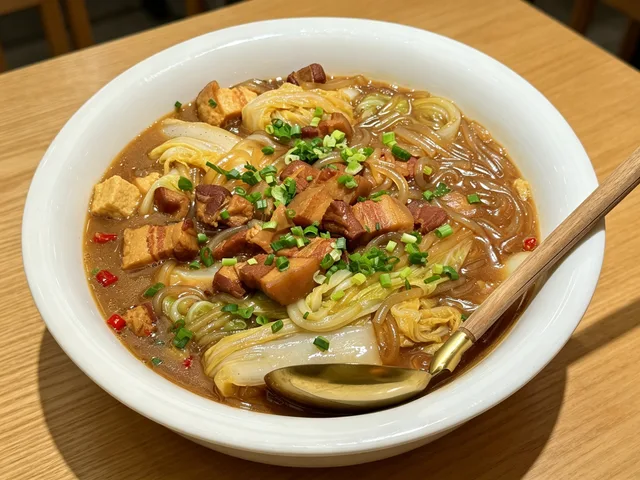
The other great Northeastern winter stew.
Read about pork and vermicelli stew →Guo bao rou
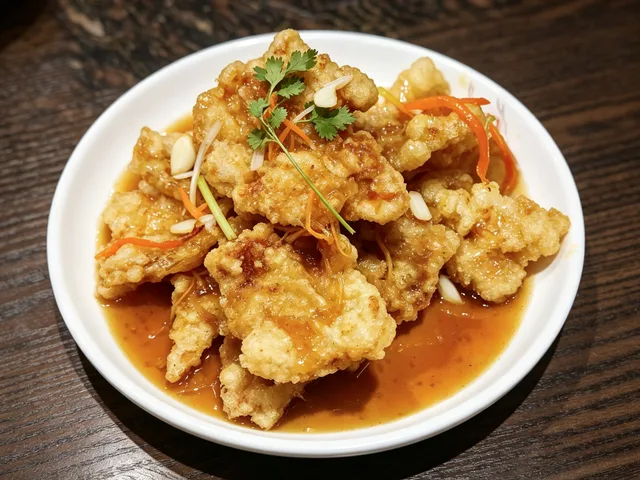
Harbin’s crisp sweet-and-sour pork, often ordered alongside.
Read about guo bao rou →Northeast China classics
- Guo Bao Rou
Pork main dish · Shared lunch or dinner
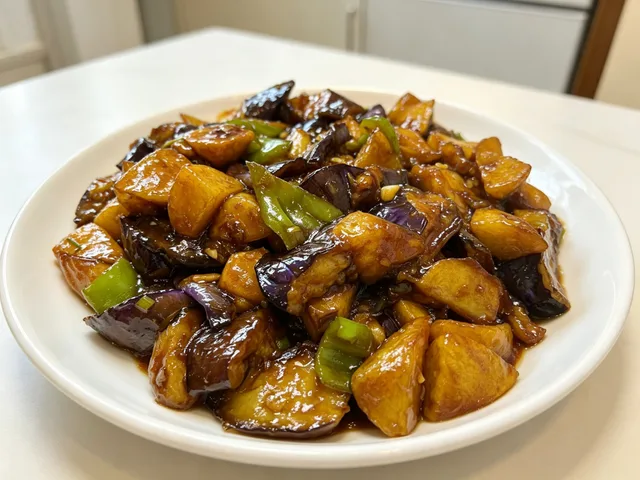
- Di San Xian
Vegetable stir-fry · Lunch or dinner, with rice
- Pork and Vermicelli Stew
Stew · Winter meal, with rice or buns
- Northeastern Sauerkraut Dumplings
Dumplings · Winter, at home or in dumpling shops
- Grilled Cold Noodles
Griddle snack · Street snack
- Chicken and Mushroom Stew
Stew · Family dinner or for guests
FAQ
Questions about Iron Pot Stew
Which iron pot stew should I order first?
Goose is the best known, usually with potatoes or sauerkraut. Chicken with hazel mushrooms and river fish with wide noodles are the classic alternatives.
How many people is one pot for?
Pots come in set sizes, usually from two or three people up to six; tell the staff how many of you there are and they will pick the size.
How long does it take?
Expect to wait. The stew cooks covered on the table, and chains time it before the lid comes off. A fish pot over firewood is ready much sooner than goose.
Where did iron pot stew come from?
From rural stoves across the Northeast. Harbin claims the restaurant version, saying its first iron pot stew restaurant opened in 2012; the many legends about emperors are not documented.
Sources
Sources and further reading
- 1 “Iron pot stew, sticky bean buns and guo bao rou: Northeastern flavors warm the ice-and-snow economy” (铁锅炖、粘豆包、锅包肉——“东北味道”让冰雪经济烟火气更浓) (in Chinese)Xinhua (December 11, 2023) ↗
- 2 Zhang Wen, “Iron pot stew, red hot” (红红火火“铁锅炖”) (in Chinese)Heilongjiang News (April 3, 2025) ↗
- 3 “55 standard pieces to a goose: Harbin’s iron pot goose” (一只鹅标准切块55块,哈尔滨铁锅炖大鹅助威“东北超”) (in Chinese)Shenghuo Bao, Longtou News (July 24, 2026) ↗
- 4 Ji Lai, “Iron pot stew, made famous by Harbin: the first hit of 2024?” (被哈尔滨带火的铁锅炖,成了餐饮业2024年首个爆品?) (in Chinese)Hongcan, via Jiemian (February 2, 2024) ↗
- 5 Tan Yunfei, “Anything Goose in this Classic Northeast Chinese Dish”The World of Chinese (February 6, 2022) ↗
- 6 Iron-pot goose, the home way: half a goose, caramel, beer and two and a half hours (video, in Chinese)A Pang Mianshi (阿胖面食), Bilibili (September 13, 2021) ↗
- 7 Iron-pot goose with a Northeastern cook: dried vegetables, spices and three-flour corn cakes (video, in Chinese)Lao Fan Gu (老饭骨), Bilibili (May 23, 2026) ↗
Last updated November 2026