
01
One small jar, one portion of soup
Waguan tang is soup simmered for hours in a small individual jar, the jars stacked in a charcoal-heated vat.
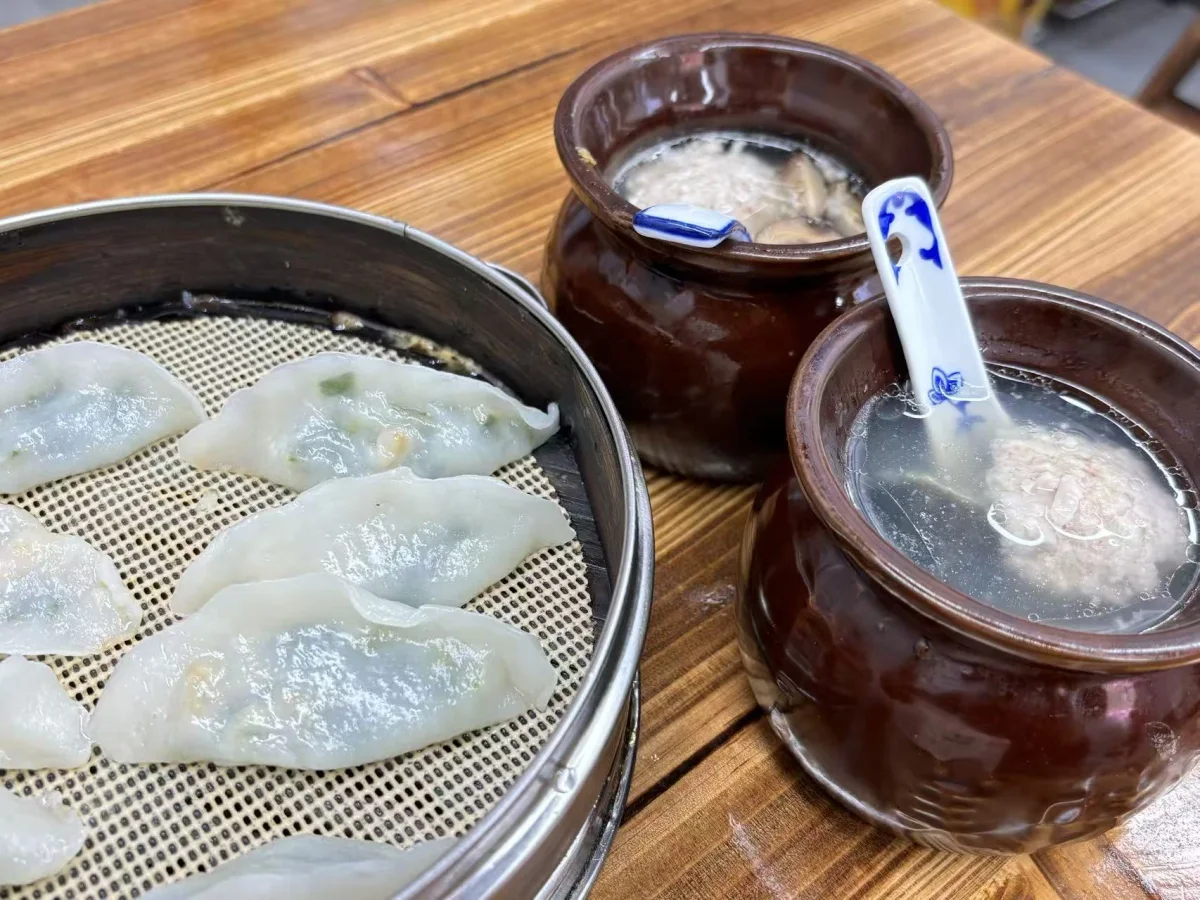
It arrives as a squat, brown-glazed jar about the size of a large mug, steaming, with a porcelain spoon in it. Inside is a clear, pale broth and, at the bottom, whatever you ordered. The most common is 肉饼汤, meat patty soup: a flat round of seasoned minced pork pressed into the base of the jar, which cooks into a soft, juicy cake and gives the broth its sweetness. Variations add an egg cracked into a hollow in the patty, a century egg that half melts into the broth, shiitake mushrooms or tofu. Others are built on spare ribs with sweet corn or radish, old duck with tea-tree mushrooms, chicken, pigeon or pork tripe.
There are nearly a hundred kinds, from poultry, pork, beef, lamb and offal to mountain mushrooms, bamboo shoots and vegetables. Some include Chinese herbs such as angelica, ginseng and red dates, added to suit the eater’s constitution.
02
The vat: charcoal, no open flame, many hours
What makes a waguan tang shop is the vat.
In the shop stands a huge clay vat, about a metre across and as tall as a person. Charcoal burns in the bottom, and the small jars are stacked inside it in layers, around and above the fire, so that the heat reaches them from every side. According to a 2021 report on the craft from China Culture and Tourism, the vat is run at about 160°C for two or three hours, then about 120°C for two hours, then on a gentle fire after that, more than seven hours in all, with no flame touching the jars. Many shops fill the jars before dawn and let them simmer through the day.
A full vat holds about 120 jars and takes four people to lift. Each jar is sealed with foil and numbered so the cook knows which soup is which. The jars are loaded from the bottom layer upwards, with the slow-cooking things, tripe or trotters, on the top and bottom layers, which are the hottest. The charcoal burns openly for half an hour with the lid ajar; then the lid and the air vent are closed to kill the flames, the vent is reopened half a centimeter, and the smouldering charcoal does the rest for at least four hours. A few spare jars of stock stay in the vat to top up any that boil down.
The old method, by the 2021 account, used an earthen stove; the vat heated on all sides came in at the end of the Qing dynasty or the start of the Republic.
03
The jar: really porcelain
The name says clay, but the jars are glazed porcelain.
Waguan means “earthenware jar,” but the jars in Nanchang shops are glazed. A Jiangxi ceramics historian, Professor Chen Lili, argued in 2018 that the dish should really be called porcelain-jar soup: the jars are fired above 1,200°C, absorb almost no water and are glazed inside, so they can be scrubbed clean, unlike porous earthenware. He described the shape exactly: a straight mouth, a pinched neck so that tongs can lift the jar in and out of the vat, a round belly and a flat base, under 15 centimeters tall. The outside is glazed only on the upper half; the bare bottom stands the heat of the fire without cracking.
Chen also pointed to proto-porcelain jars of the Eastern Han dynasty, nearly two thousand years old, dug up around Nanchang and now in the Jiangxi Provincial Museum, which are much the same shape as today’s soup jars. On that basis he argued that the custom took shape in the Han and was established by the Tang. Other dates circulate, from the Neolithic to the Song dynasty’s Jiayou reign in the 1050s; none rests on a recipe of the time.
What is documented is recent: Nanchang listed the craft of making clay pot soup as municipal intangible heritage in 2014, and Jiangxi added it to its provincial list in November 2017.
04
The meat patty
The most-ordered jar is the plainest.
Meat patty soup depends on how the pork is handled. Nanchang cooks use front leg or pork collar, roughly seven parts lean to three parts fat, and prefer to chop it by hand for a coarser, juicier texture. It is seasoned with salt and white pepper, sometimes loosened with water in which scallion, ginger and Sichuan pepper have been steeped, and given a spoon of sweet potato starch. Then it is beaten against the bowl until it turns sticky and springy, so that it holds together for hours in the broth.
A ball of it, 40 to 60 grams, is pressed firmly into the bottom of the jar until it sticks there. For egg soup a hollow is pushed into the middle and an egg cracked in; for century egg soup a peeled preserved egg goes on top, and after an hour of heat it has half dissolved, clouding the broth slightly. The liquid is poured in last, slowly, down the side of the jar or over the back of a spoon, so the patty is not knocked loose. A well-made patty soup comes out clear.
05
Breakfast: mixed rice noodles and a jar of soup
In Nanchang the soup comes with noodles.
The standard Nanchang breakfast is a plate of 拌粉, round rice noodles blanched and tossed with seasonings, chilli and peanuts, and a jar of soup to drink with it, alternating mouthfuls of hot, sticky noodles with spoonfuls of broth. Shops add small cold dishes: spicy lotus root slices, or pork heart and lung in chilli.
It is cheap. At a busy neighbourhood shop in 2024, plain mixed noodles were 3 yuan, a century-egg patty soup 5 and a tofu patty soup 4. In 2025 a Nanchang neighbourhood shop charged 3.5 yuan a jar, and more than 5 yuan a jar is considered too much. Nearly every Jiangxi household owns a few of the jars.
At a popular shop there is a queue at the counter, and people who cannot find a table eat on low stools by the door, using another stool as the table.
06
Wuhan’s clay-jar chicken soup
Simmering soup in clay jars is a habit of the middle Yangtze.
Upriver in Wuhan, the old restaurant Xiaotaoyuan in Hankou was known in the 1960s as the “soup experts” for its clay-jar chicken soup. A 1966 national cookbook gives its method: an old yellow hen from Huangpi or Xiaogan, cut into pieces and fried in lard with scallion and ginger, then simmered uncovered in a clay jar for two hours if young, three if old, until the soup is clear and the meat falls apart. The Nanchang jar is smaller and single-serving, and goes into a shared charcoal vat instead of onto its own fire.
07
Clay pot soup at home
Without a vat, a steamer does the job; this follows the way Nanchang home cooks do it.
For four jars: 250 g pork front leg or collar (about 30% fat), 1 teaspoon salt plus a little more for the water, ¼ teaspoon ground white pepper, 2 tablespoons water steeped with a slice of ginger, a scallion and a few Sichuan peppercorns, 1 tablespoon sweet potato starch (or cornstarch); 2 eggs or 2 century eggs, or a few soaked shiitake; four small heatproof jars or deep ceramic cups with lids, or covered with foil.
- 1. Make the patty
Chop the pork by hand until fine but not pasty. Add salt and pepper, then the flavoured water in two lots, then the starch. Stir in one direction and slap it against the bowl until sticky and springy.
- 2. Press into jars
Divide into four, roll into balls and press each firmly into the bottom of a jar. Push a hollow into two and crack in an egg, or lay a peeled century egg or shiitake on top.
- 3. Set, then add water
Steam the jars, without water in them, for 10 minutes to set the patties. Then pour warm, lightly salted water slowly down the side of each jar until nearly full.
- 4. Steam
Cover and steam over high heat for at least 30 minutes, an hour for century egg, topping up the steamer with boiling water as needed.
The broth should be clear and taste gently of pork. Serve in the jars, with rice noodles or rice.
08
How to order it
Pick a flavour, add noodles.
Start with meat patty
肉饼汤 is the classic; 鸡蛋肉饼汤 adds an egg, 皮蛋肉饼汤 a century egg.
Other jars
Spare rib with corn or radish, duck with tea-tree mushroom, chicken, pigeon or pork tripe.
Add mixed noodles
Order 拌粉 and say how much chilli you want; eat the noodles quickly before they clump.
Know the price
In Nanchang a meat patty jar was 3.5 to 5 yuan in 2024 and 2025.
Mind the heat
The jar comes straight from the vat and stays very hot; use the spoon and wait a moment.
09
More soups and breakfasts
Other pages on the atlas.
Pork rib and lotus root soup
Wuhan’s slow-simmered soup from the same middle-Yangtze habit.
Read about lotus root soup →Congee
China’s other morning bowl.
Read about congee →Chinese breakfasts
What people eat in the morning, city by city.
Explore Chinese breakfasts →Egg drop soup
A quick everyday soup to compare.
Read about egg drop soup →Noodles from other regions
FAQ
Questions about Nanchang Clay Pot Soup
What is Nanchang clay pot soup?
Soup cooked in individual glazed jars, most often with a pork patty pressed into the bottom, stacked inside a large charcoal-heated vat and simmered for many hours; Nanchang eats it for breakfast with mixed rice noodles.
How long is it cooked?
At least four hours, and traditionally seven or more, over charcoal with no open flame.
What is the most popular flavour?
Meat patty soup, with or without an egg or a century egg.
Is the jar really clay?
The name means earthenware jar, but the jars are porcelain, glazed inside and on the upper half outside.
How much does it cost?
In Nanchang about 3.5 to 5 yuan for a meat patty jar in 2024 and 2025.
What goes with it?
Nanchang mixed rice noodles, 拌粉, with chilli; also cold sides such as spicy lotus root.
Can I make it without a vat?
Yes. Press the patty into small heatproof jars, add lightly salted water and steam for 30 minutes to an hour.
Sources
Sources and further reading
- 1 Clay pot soup (wa guan tang) (2019)China Daily, Jiangxi dining ↗
- 2 Yang Xiaojun, Heritage on the tongue: Nanchang clay-jar simmered soup (2021) (in Chinese)China Culture and Tourism (文旅中国), via The Paper (in Chinese) ↗
- 3 Liao Jitang, A Jiangxi professor on Nanchang clay pot soup: the jars are porcelain, not earthenware (2018) (in Chinese)Jiangnan Metropolis Daily, via The Paper (in Chinese) ↗
- 4 Famous Chinese Dishes, vol. 12: Hunan and Hubei (中国名菜谱·第十二辑), p. 137: clay-jar chicken soup from Xiaotaoyuan, Hankou (in Chinese)Light Industry Press (1966), indexed by laocp.tech ↗
- 5 Chinese Cookbook: Hubei (中国菜谱·湖北), p. 165: clay-jar chicken soup (in Chinese)China Financial and Economic Publishing House (1978), indexed by laocp.tech ↗
- 6 Nanchang clay pot soup: a vat of several hundred jin holds 120 jars (video, in Chinese)Wo de Yangzi Pingping Wuqi (我的样子平平无奇), Bilibili (September 2021) ↗
- 7 A Nanchang cook makes clay pot soup at home: meat patty with egg and century egg (video, in Chinese)Yujiang Ai Zuocai (鱼姜爱做菜), Bilibili (June 2024) ↗
- 8 “If clay pot soup costs more than five yuan in Nanchang, go next door”: the patty, the cut and the salted water (video, in Chinese)Yujiang Ai Zuocai, Bilibili (January 2025) ↗
- 9 Three-yuan mixed rice noodles and four-yuan clay pot soup: breakfast in a Nanchang neighbourhood (video, in Chinese)Jun zai Xi’an (君在西安), Bilibili (April 2024) ↗
Last updated November 2026