
01
A plate of fried pork and a bowl of taro balls
Vinegar pork is one of the dishes Quanzhou families cook most often, and the most classic way that southern Fujian, Minnan, cooks meat.
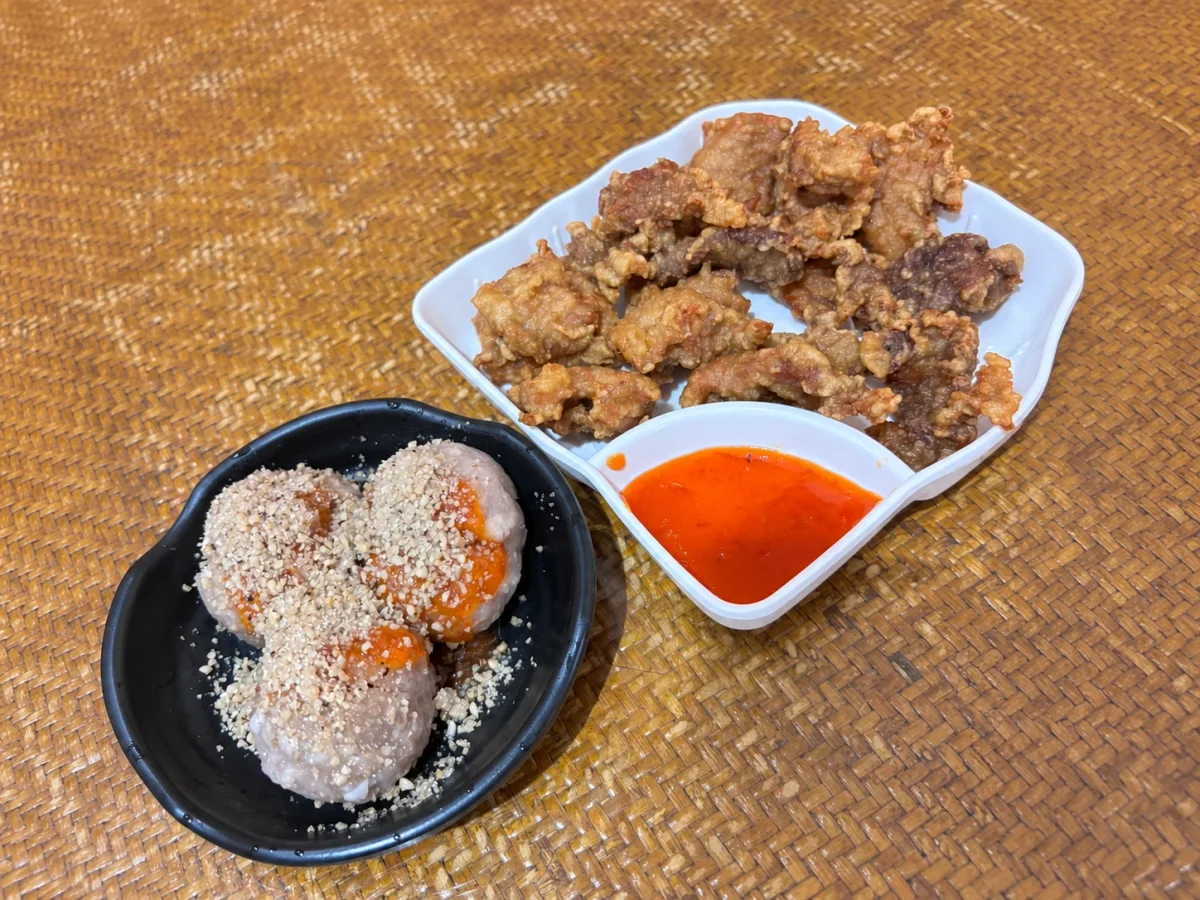
In the photograph at the top of this page the two sit side by side on a woven mat. In a white square dish is a heap of vinegar pork, irregular golden-brown pieces with a craggy, bubbled crust, and a built-in well of bright orange sweet chilli sauce. In a black bowl beside it sit three taro balls, grey-mauve and flecked with strands of taro, buried under crushed peanuts with orange sauce running down their sides.
Vinegar pork is the everyday one: no host would entertain friends from out of town without a plate of it. The taro balls are more local, a speciality of Yakou, a village by the sea in Jinjiang, the county-level city south of Quanzhou, and sold all over the Quanzhou area.
They share a dip. Sweet chilli sauce, 甜辣酱, a thin, sweet, mildly hot orange sauce, goes with both: it is the first dip for vinegar pork, and taro-ball shops spoon it over the balls.
02
Vinegar pork: marinated, then fried twice
The vinegar goes into the marinade, before the frying.
The name means what it says: the pork is marinated in vinegar. Most families use soy sauce and vinegar; street stalls often use vinegar and plenty of garlic; restaurants guard their own mixes. Cuts vary from lean slices to pork belly, 三层肉, “three-layer meat”, cut into thick pieces. After one or two hours in the marinade the meat is tossed with sweet-potato starch, 地瓜粉, with no water added, until each piece is coated in a damp, lumpy layer.
It is fried twice. The first frying, in oil that is moderately hot, sets the coating and cooks the meat until the surface is pale gold; the pieces are lifted out, the oil is heated further, and they go back in until they are golden and crisp. The sweet-potato starch fries into the craggy, bubbled crust in our photograph, crunchier and lighter than wheat batter, and the finished pieces are crisp outside, tender inside and a little chewy. Street stalls use a thin coating on large pieces of belly; the vinegar smell carries well beyond the stall, and eaten hot their pork is not especially crisp.
What makes vinegar pork different from other fried pork is inside. Bite into a piece and the meat is tender and juicy with a sour, garlicky edge, and the vinegar cuts the fat so that a whole plate does not taste heavy. To someone from northeastern China it recalls their own sweet-sour fried pork, guobaorou, with one difference: guobaorou puts the flavour in the sauce on the crust; vinegar pork puts it in the meat.
03
Dipped, in soup, or by the jin
Quanzhou eats vinegar pork dry or in soup.
Dry, hot from the fryer, it is a snack and a drinking dish, dipped in sweet chilli sauce, as in our photograph, or in Worcestershire sauce, 喼汁, or mustard. In soup, the fried pieces are simmered with greens or whatever else is to hand, so that the broth turns faintly sour and the crust softens to a chewy coat.
You can eat it anywhere: it is on the menu from five-star hotels to fast-food canteens, and in Jinjiang it is one of the dishes families expect at New Year; in 2023 a Jinjiang restaurant serving it also had ginger duck and pork thick soup, 肉羹, on the menu. Street stalls fry it in the afternoon and sell it by weight: at one Quanzhou stall in 2019 it was 35 yuan a jin, 10 yuan bought about eight big pieces, each batch of two or three jin took ten-odd minutes to fry, and the stall opened about three in the afternoon and was sold out by eight. The same stall also sold fried chicken cutlets, ribs and sweet-potato balls.
04
Yakou taro balls: taro shreds round minced pork
Quanzhou’s taro balls are a savoury dumpling, not a dessert.
Elsewhere in China, taro balls, 芋圆, are the small chewy dessert balls of milk-tea shops. In Quanzhou the word means something else: a ball as big as a palm, made of shredded taro bound with sweet-potato starch and wrapped round a savoury pork filling, then steamed. Yakou in Jinjiang is the place most associated with them.
The taro is grated into coarse shreds and seasoned with shallots, salt, MSG, sugar, white pepper, five-spice and shallot oil, made by frying sliced shallots or scallion whites slowly until golden. No water is added; the taro gives off its own moisture. Then comes sweet-potato starch, about 100 grams to 350 grams of taro, kneaded in until the shreds cling together. The filling is coarsely minced pork, front leg or belly, seasoned with ginger and scallion water, soy sauce, pepper and five-spice and bound with a little more starch; some makers add water chestnut and shallots for crunch and sweetness.
A handful of the taro mixture is flattened in the palm, a spoonful of filling goes in the middle, and the ball is closed and rolled lightly round. The balls steam over high heat for about half an hour, until the starch turns translucent and the taro shreds soft, and are brushed with shallot oil. The cooked skin is springy and slightly slippery, with the strands of taro still visible, round a juicy meatball.
They are made by hand in quantity. In 2025 one Quanzhou maker used more than 100 jin of taro a day, mixed with sweet-potato starch in a few minutes, and shaped over a thousand balls; older Quanzhou people used to make them at home for themselves, and today they are bought by visitors and carried or sent to Hong Kong and Macau.
05
Peanuts, sweet chilli and a bowl of salty rice
Taro balls are served simply.
At a Yakou taro-ball shop in 2023 each ball cost 3 yuan, the same price that Quanzhou shops were charging in 2021. They come in a bowl, two or three at a time, with crushed peanuts scattered over and a spoonful of sweet sauce or sweet chilli sauce, as in our photograph. At home they are eaten with a bowl of salty rice, 咸饭, rice cooked with pork and vegetables, and a fish-bone soup.
Yakou’s food streets sell the other snacks of the Quanzhou coast alongside: rice dumplings with pork, served here with sweet sauce and garlic, and spring rolls, 润饼. Yakou is about an hour’s drive from Xiamen.
| Vinegar pork 醋肉 | Taro balls 芋圆 | |
|---|---|---|
| Main ingredient | Pork, lean or belly | Shredded taro, minced pork |
| Binding | Sweet-potato starch, no water | Sweet-potato starch |
| Cooking | Marinated, fried twice | Steamed about 30 minutes |
| Served with | Sweet chilli sauce, Worcestershire or mustard | Crushed peanuts, sweet chilli sauce |
| Price | 35 yuan a jin at a stall (2019) | 3 yuan each (2021–2023) |
06
Vinegar pork at home
Vinegar pork is easy; the double frying is the only trick.
For 4: 500 g pork, lean shoulder or skinless belly; 3 tablespoons rice vinegar or Zhenjiang vinegar; 2 tablespoons light soy sauce; 4 cloves garlic, crushed; ½ teaspoon five-spice (optional); about 100 g coarse sweet-potato starch; oil for deep-frying; sweet chilli sauce to serve.
- 1. Cut
Cut the pork into pieces about 1 cm thick and 4 cm long.
- 2. Marinate
Mix with the vinegar, soy, garlic and five-spice and leave for 1 to 2 hours.
- 3. Coat
Add the sweet-potato starch without any water and toss until every piece is coated in a damp, lumpy layer.
- 4. Fry twice
Fry in batches in moderately hot oil, about 160 °C, until pale gold, and lift out. Heat the oil to about 180 °C and fry everything again until golden and crisp. Serve hot with sweet chilli sauce.
Do not add water to the starch: the marinade is wet enough, and the dry, lumpy coating is what fries into the crisp, bubbly crust.
07
How to order them
Both are cheap.
Vinegar pork by weight
At a stall, ask for 10 or 20 yuan’s worth; in a restaurant, order a plate or vinegar pork soup.
Taro balls by the piece
Two or three each, about 3 yuan apiece.
Sauces
Sweet chilli sauce for both; try Worcestershire sauce with the pork.
Where
Yakou in Jinjiang for taro balls; stalls and restaurants all over Quanzhou and Jinjiang for vinegar pork.
When
Vinegar pork stalls fry from the afternoon and can sell out by evening.
08
More from Fujian
Other pages on the atlas.
Quanzhou shacha noodles
Noodles in peanut-rich shacha broth with your choice of toppings.
Read about Quanzhou shacha noodles →Sea worm jelly
Southern Fujian’s cold, wobbly jelly.
Read about sea worm jelly →Taro paste
Fuzhou’s sweet mashed taro dessert.
Read about taro paste →Fujian food
From Fuzhou soups to Minnan snacks.
Explore Fujian →Fujian classics
- Buddha Jumps Over the Wall
Banquet jar soup · Banquets and New Year dinners
- Shaxian Bianrou and Banmian
Wontons and tossed noodles · Any meal, often late at night
- Lychee Pork
Sweet-and-sour fried pork · Family meals and banquets
- Tusundong (Sea Worm Jelly)
Cold seafood jelly · Snack, summer evenings
- Taro Paste
Taro dessert · End of a banquet; snack
- Quanzhou Shacha Noodles
Noodle soup in shacha broth · Any time of day
FAQ
Questions about Quanzhou Vinegar Pork and Taro Balls
Does it taste of vinegar?
Only lightly. The vinegar is in the marinade, so it gives the meat a sour, garlicky edge and cuts the grease.
Are they the same as bubble-tea taro balls?
No. Those are small sweet chewy balls; Quanzhou’s are palm-sized and savoury, with a meat filling.
How much do they cost?
Taro balls about 3 yuan each in 2021 to 2023; vinegar pork 35 yuan a jin at a Quanzhou stall in 2019.
Where can I eat them?
Anywhere in Quanzhou and Jinjiang; Yakou for the taro balls.
Sources
Sources and further reading
- 1 Vinegar pork (醋肉) (in Chinese)Quanzhou Municipal People’s Government, Quanzhou Tourism: local snacks (22 October 2019) ↗
- 2 Pork belly marinated in garlic and vinegar, fried by the handful: 35 yuan a jin in Quanzhou (video, in Chinese)Xueyu Tandian (雪鱼探店), Bilibili (August 2019) ↗
- 3 Vinegar pork, the dish Jinjiang people must eat at New Year (video, in Chinese)Li Wenxi (李温习), Bilibili (January 2023) ↗
- 4 Quanzhou taro balls as big as your palm: how they are made (video, in Chinese)Feng Xiaochu (冯小厨的菜谱), Bilibili (August 2021) ↗
- 5 Quanzhou stuffed taro balls: taro shreds round pork belly and water chestnut, over a thousand made by hand a day (video, in Chinese)Baiwei de Gushi (百味的故事), Bilibili (March 2025) ↗
- 6 Jinjiang’s Yakou: taro balls and rice dumplings worth the drive (video, in Chinese)Lao Yang Te Ai Pao (老杨特爱跑), Bilibili (October 2023) ↗
Last updated November 2026