
01
Glutinous rice, brown sugar and a bamboo skewer
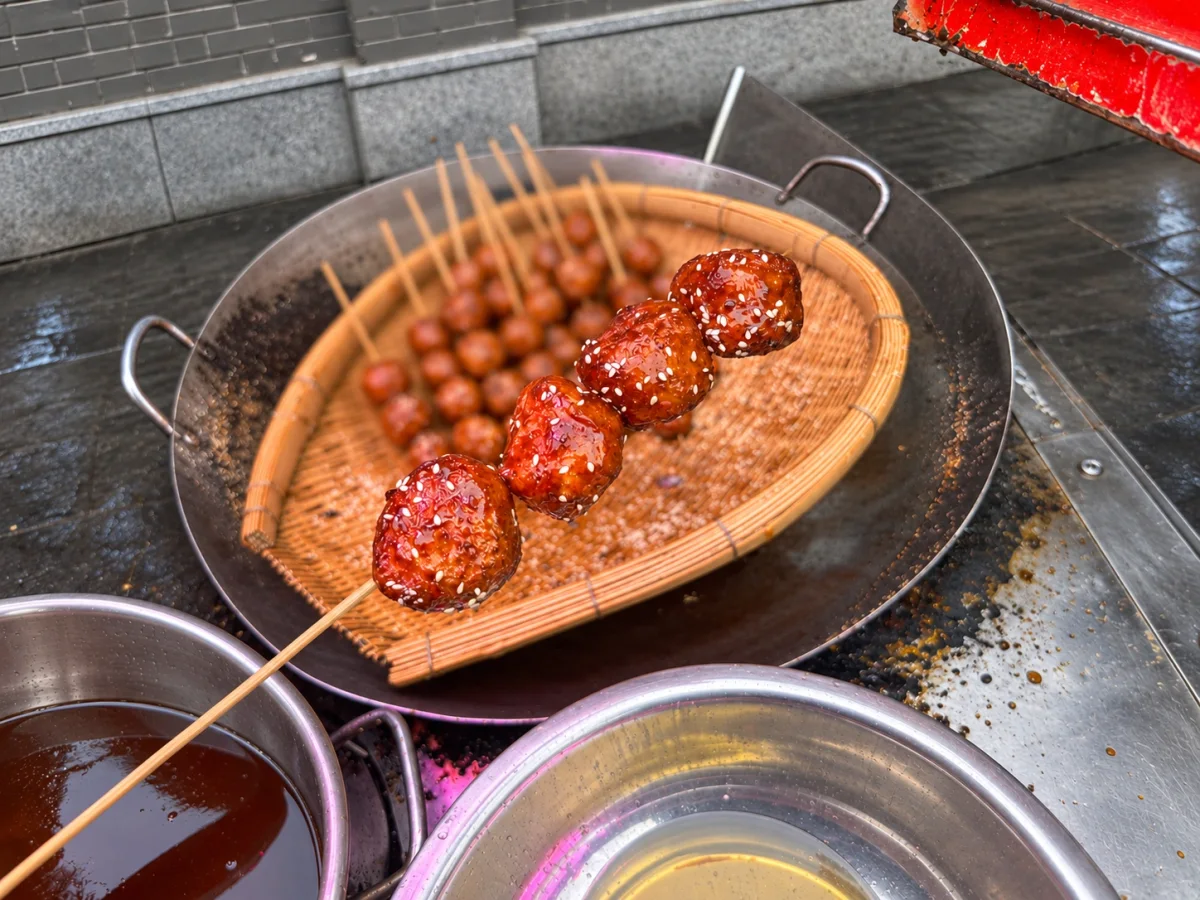
Tangyou guozi start as plain dough: glutinous rice flour mixed with water and rolled into small balls. They go into a wide wok of oil in which brown sugar has been melted. As they fry, the balls swell, the sugar caramelizes onto their surface and the outside sets into a thin, glassy shell. The cook lifts them out, rolls them in toasted white sesame and threads them onto bamboo skewers.
The name simply lists what goes in: sugar and oil, with guozi, “little fruits,” for the balls. Some Chengdu people call them 天鹅蛋, swan eggs, for their round shape. Fuchsia Dunlop, the English writer on Sichuan food, calls them one of the snacks Chengdu children like best after school.
Yan Shiping, whose stall is described below, listed what he looked for as color, aroma, crispness and sweetness. The color should be the natural red-brown of the sugar, not darker. The texture he described as crisp outside and tender inside, soft enough to dissolve easily in the mouth. A ball that is hard all the way through, or oily and limp, has been fried at the wrong heat.
02
Swan eggs in a 1909 street guide
Claims online that the snack goes back to the Song dynasty come without a source. The earliest printed trace is from 1909, when Fu Chongju published Chengdu Tonglan, a guide to the city that lists what was sold on its streets and what each thing cost. Under ordinary street foods it has an entry for 天鹅蛋, swan eggs: “rice flour, fried in oil,” three or four copper wen apiece.
Swan egg is still a Chengdu name for tangyou guozi, though Fu says nothing about sugar or sesame, so the 1909 ball may not yet have been glazed. The same page gives a sense of what three wen bought: tangyuan cost five wen for three, and the morning sellers of fried 油糕 snacks also sold something they called 果子.
03
Sugar in the oil, balls pressed in the wok
The dough decides the result. To Yan Shiping, mixing the dough is the key step, and its feel changes from spring to winter in a way he said could only be learned by hand. Some cooks add a little white sugar. Pure glutinous rice dough slumps after frying; mixing in some ordinary rice flour, about five parts glutinous to one part rice, and scalding the dough with boiling water gave a firmer ball that held its shape and fried partly hollow.
Heat control is the rest. Brown sugar goes into the oil and melts; in a working wok it floats as the oil heats. The balls go in, and the cook stirs constantly and presses them gently with a ladle, which helps them puff up round. Too cool, and the balls stay limp and greasy. Too hot, and the brown sugar burns before the inside is cooked. Some cooks fry the balls first until they set, then add the brown sugar and stir until every ball is coated.
Traditional stalls cooked over charcoal, which gives steady, gentle heat, and changed the oil every night; Yan held that a gas bottle or an electric ring always made the balls a little worse. When the balls turn a light reddish brown, they are lifted out with a big strainer, rolled through sesame and skewered. A ball fried this way is half hollow: the hollow part keeps the shell crisp, and the solid part gives the chewy bite, so it stays round and plump after it cools.
04
A stall that moved twenty-eight times
Chengdu’s most talked-about tangyou guozi came from a stall called 小时候的糖油果子, “the tangyou guozi of childhood.” Its owner, Yan Shiping, learned the trade from an uncle who kept a stall every spring at the flower fair at Qingyang Palace, the city’s old Taoist temple. Yan began running his own shop in 1990 and, by 2017, had moved 28 times. That year he was selling from Wucheng Street in Jinjiang District, working from seven in the morning to seven at night, at ¥4 for a skewer of five balls. At the 2016 Chengdu food tourism festival he was named one of the city’s food craftsmen.
The shop’s last old address, a row of tile-roofed houses near the No. 2 People’s Hospital, drew hour-long queues in its final weeks. On 12 October 2018 Yan hung up a handwritten notice, 倒计时,要洗碗了, “countdown: time to wash up,” and closed for demolition. He sold from another site for two more years, closed again in July 2020 for his health, and in November 2020 Yan and his wife, Xiao Ying, reopened in a 30-square-meter space next to the Caojiaxiang community center in Jinniu District, with help from the district and a community design project. The price was still ¥5 a skewer. The new shop kept the old red-on-white sign, hand-lettered and with a miswritten character, and doubled as a teahouse: covered-bowl tea from ¥5 for the cheapest jasmine, square bamboo chairs, and old snacks such as dried sweet potato, broad beans and fish-skin peanuts.
For Yan, the reopening was less about money than about keeping an old Chengdu craft going.
05
Where to buy them and what they cost
You will find tangyou guozi in Chengdu’s neighborhood markets, outside schools, at small shops that also sell guokui flatbreads, and in tourist lanes. Prices depend on where you are. In 2023 one city shop charged ¥4 a skewer, or ¥1 a ball. A guokui shop in a market at 242 Weiliu Road, Qingyang District, next to a primary school, sold five small ones for ¥1 in 2019, two jiao a ball, and neighbors bought them by the bag, tens of yuan at a time. It also sold brown-sugar guokui and, for ¥6, guokui stuffed with braised pork and preserved mustard greens.
Buy from a stall where the wok is going. The balls are at their best in the first few minutes, when the shell is still crisp and the center is soft.
See the Sichuan food guide for the savory side of the city.
| Order | Price | Setting |
|---|---|---|
| One skewer (five balls) | ¥4 | Yan Shiping’s stall, Wucheng Street, 2017 |
| One skewer | ¥3–5 | Chengdu, 2019 |
| Five small balls | ¥1 | Guokui shop, 242 Weiliu Road, 2019 |
| One skewer | ¥5 | Yan Shiping’s reopened shop, Caojiaxiang, 2020 |
| One skewer, or one ball | ¥4, or ¥1 | Chengdu shop, 2023 |
06
Not the same as Changsha’s tangyou baba
Changsha in Hunan has a snack with almost the same name, 糖油粑粑 (tangyou baba), and the two are easy to mix up. Both are glutinous rice dough cooked in sugar and oil. Changsha’s version is pressed flat by hand into small discs and cooked in the sugar and oil until brown and glossy. Chengdu’s are round, partly hollow, rolled in sesame and sold on a skewer.
They also differ from sesame balls (麻圆), the larger fried balls covered in sesame and often filled with bean paste. Tangyou guozi have no filling and get their color from the sugar in the oil, not from the dough.
The names give the shapes away: baba is a flat cake, guozi a small round snack.
07
Making them at home
Three things go wrong at home: balls that slump flat after frying, sugar that burns before the balls are cooked, and sugar that will not stick. Today’s home recipes mostly work by ratio and sequence rather than by weight, and they agree on three fixes: mix rice flour into the glutinous rice flour and scald it; fry the balls until they set before the sugar goes in; and use Sichuan old-style brown sugar, because ordinary brown sugar powder often refuses to coat the balls. A lighter yellow sugar gives a brighter color.
The 1989 Sichuan volume of Chinese Snacks gives an older Neijiang recipe by weight, for a hundred balls: 3.5 kg glutinous rice and 1 kg ordinary rice soaked for seven or eight hours and stone-ground wet with 500 g cooked rice, then kneaded with 500 g fermented rice wine liquid and 25 g baking soda; a tenth of that makes ten. Each piece is rolled round, hollowed out and sealed, with the wall kept even. In this method the sugar goes in first: 1 kg chopped brown sugar is stirred into rapeseed oil at what Chinese cooks call 40 percent heat, warm rather than hot, and once sugar and oil have blended the balls are slid in from the side of the wok and fried until puffed and yellow-brown, then shaken in a tray with 50 g toasted sesame.
Glutinous rice flour and ordinary rice flour, about 5 parts to 1; boiling water; a little extra glutinous rice flour for kneading; Sichuan old-style brown sugar (or yellow sugar), broken into small pieces; plenty of neutral oil for frying; toasted white sesame.
- 1. Scald the dough
Mix the two flours and stir in boiling water, a little at a time, until a dough forms. Knead in more glutinous rice flour bit by bit until the dough is fairly firm: a firm dough sets its shape faster in the oil.
- 2. Shape
Pinch off small, even pieces, roll them into balls and keep them covered so they do not dry out.
- 3. Fry to set
Fry the balls in oil over low heat, stirring and pushing them apart with a spoon, pressing them gently so they puff round. When they stop growing, raise the oil to medium heat for about half a minute to firm the shell, then lift them out.
- 4. Melt the sugar
Put the broken brown sugar into the oil and heat it gently until the melted sugar floats.
- 5. Coat
Return the balls and keep stirring and turning them until every one is wrapped in a glossy, light reddish-brown coat; take care not to let the sugar scorch.
- 6. Sesame
Lift them out with a large strainer, scatter white sesame over them and toss so each ball is coated. Thread on skewers and eat while the shell is still crisp.
Sichuan classics
- Bobo Chicken
Cold skewers · Snack
- Zhong Dumplings
Boiled dumplings · Snack
- Sichuan Hot Pot
Hot pot · Shared meal
- Mapo Tofu
Tofu dish · Lunch or dinner, with rice
- Dan Dan Noodles
Small dressed noodles · Snack
- Kung Pao Chicken
Chicken stir-fry · Lunch or dinner, with rice
FAQ
Questions about Tangyou Guozi
What are tangyou guozi?
Chengdu’s glutinous rice balls fried in oil with brown sugar, rolled in white sesame and sold four or five to a bamboo skewer. Crisp outside, partly hollow, chewy in the middle.
How much do they cost?
About ¥4–5 a skewer in Chengdu between 2017 and 2023. Some market stalls sell single small balls for a few jiao.
Are they the same as Changsha tangyou baba?
No. Changsha’s tangyou baba are flat discs cooked in syrup and sold loose. Chengdu’s tangyou guozi are round, rolled in sesame and sold on skewers.
Do they have a filling?
No. The center is plain glutinous rice dough. Sesame balls (麻圆) are the filled ones.
What is the best time to eat them?
Straight out of the wok. The shell softens and the inside firms up as they cool.
Where is the famous old stall?
Yan Shiping’s 小时候的糖油果子 reopened in 2020 next to the Caojiaxiang community center in Jinniu District after its old site was demolished. Check whether it is still open before going.
Sources
Sources and further reading
- 1 Fu Chongju, Chengdu Tonglan (1909), “Ordinary foods of Chengdu’s streets” (in classical Chinese) (in Chinese)Wikisource ↗
- 2 Tang you baba: glutinous rice dough flattened by hand and fried in sweet oilHunan Provincial Government ↗
- 3 Chengdu flavors: the tangyou guozi of childhood, also called swan eggs (in Chinese)Sina (January 14, 2019) ↗
- 4 Tasting old Chengdu: Yan Shiping’s tangyou guozi, from the Qingyang Palace flower fair to Wucheng Street (in Chinese)Liu Yao, China Radio International (August 22, 2017) ↗
- 5 A Chengdu tangyou guozi shop open for 28 years reopens, still ¥5 a skewer (in Chinese)Yan Xue, Red Star News (November 1, 2020) ↗
- 6 5 things to try in Chengdu, China’s street food paradiseDaisy Dai, Goldthread (July 31, 2019) ↗
- 7 Fuchsia Dunlop, The Food of Sichuan, Chinese edition, chapter “Snacks” (tr. He Yujia) (in Chinese)CITIC Press, 2020; WeRead edition ↗
- 8 Chinese Snacks: Sichuan (中国小吃·四川风味), p. 74: tangyou guozi, the Neijiang method (in Chinese)China Financial and Economic Publishing House (1989), indexed by laocp.tech ↗
- 9 Five tangyou guozi for ¥1 at a Chengdu market guokui shop (video, in Chinese)Nü Pangpang (女胖胖), Bilibili (2019) ↗
- 10 A Chengdu shop selling tangyou guozi at ¥4 a skewer, ¥1 a ball (video, in Chinese)Jun zai Xi’an (君在西安), Bilibili (2023) ↗
- 11 Recreating childhood tangyou guozi: sugar floating in the oil, pressing the balls as they fry (video, in Chinese)P Laoban Kaifan le (p老板开饭了), Bilibili (2021) ↗
- 12 Getting tangyou guozi right at home: glutinous and rice flour 5:1, scalded dough, frying before the sugar (video, in Chinese)Xiaoman Jia de Wanfan (小满家的晚饭), Bilibili (2023) ↗
Last updated November 2026