
01
Chicken, peanuts and seared chilies, in a sauce that is mostly sour-sweet
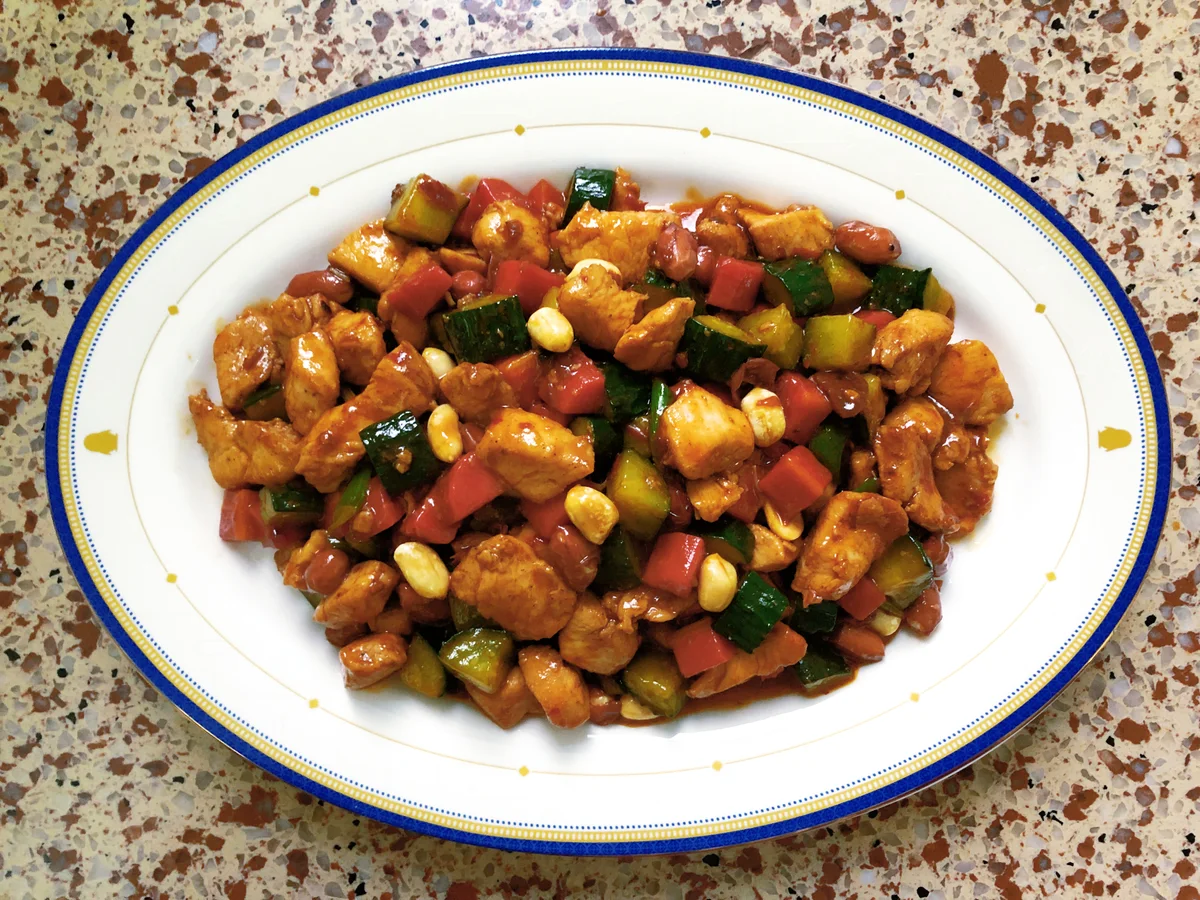
Kung pao chicken is less hot than it looks: the dried chilies are there for their scorched fragrance, and the sauce is sour and sweet before it is spicy.
A good plate is glossy and reddish-brown. Small cubes of chicken, usually from the thigh, are soft and juicy; the peanuts are crisp because they go in at the last moment; short lengths of scallion are cut to the same size as the chicken, a Sichuan rule cooks put as “cubes with cubes, slivers with slivers.” Dried red chilies, snipped into short sections and fried until they darken, and a pinch of Sichuan pepper give the oil a toasty heat and a slight tingle. The sauce, thickened just enough to cling, tastes sour first, then sweet, with salt underneath.
Sichuan cooks call that combination 煳辣荔枝味, scorched-chili with lychee flavor. Lychee flavor has nothing to do with lychees; it is a sweet-sour in which the sour leads a little, like the fruit. Kung pao is the “small lychee” kind, lighter than the “big lychee” of sizzling rice-crust pork. It is a quick stir-fry made in one wok in a couple of minutes, the kind Sichuan cooks call 小炒, small-frying, and in Sichuan it is everyday food rather than banquet food.
The name is written 宫保鸡丁, sometimes 宫爆鸡丁 with the character for quick-frying. Kung pao is the old Wade–Giles spelling of 宫保 that Chinese restaurants abroad have kept; in pinyin it is gongbao.
02
Ding Baozhen, and a title that became a dish
The dish carries the honorary title of a Guizhou-born official who served in Shandong and Sichuan.
Ding Baozhen came from Pingyuan, today’s Zhijin county in Guizhou, and passed the highest civil examination in 1853. He rose to governor of Shandong, and in 1868, when Nian rebels swept toward the capital, he marched north with a thousand horsemen and three thousand foot soldiers carrying five days’ rations; the court rewarded him with the title Junior Guardian of the Heir Apparent, 太子少保. That title was addressed as gongbao, and Ding was known as Ding Gongbao. A year later he had An Dehai, the Empress Dowager Cixi’s favorite eunuch, arrested on the Grand Canal and executed for leaving the palace without authority, the act he is best remembered for.
In 1876 he became governor-general of Sichuan. His biography in the Draft History of Qing credits him with an arsenal, repairs to the Dujiangyan irrigation works and a reform of the salt monopoly that brought in more than a million taels a year. He governed Sichuan for ten years and died in office; the court made him Grand Guardian posthumously and ordered shrines to him in Shandong, Sichuan and Guizhou. A man with shrines in three provinces left three provinces with a claim to his dish.
03
The stories, and what the records show
There are many origin stories and very little paper.
The most widely told version, the one in the standard Sichuan cookery dictionary, says Ding’s household cook stir-fried diced chicken in the Shandong quick-fry manner and brought the method to Sichuan with him. Others say the people of Sichuan presented the governor-general with a dish he liked; that he tasted it in a modest restaurant while traveling incognito and had his cook copy it; that subordinates served it at his welcome banquet; that his cook made it for himself on the spur of the moment; or, in Fuchsia Dunlop’s telling, that the chicken was cut small because Ding had bad teeth. Some point to Li Jieren’s novel The Great Wave, in which Ding goes on eating chicken fried with scorched chilies in Sichuan as he did at home in Guizhou; but Li does not say where the dish came from, and Lan Yong treats the claim as unproven.
The historian Lan Yong points out that the name does not appear in any Qing document. Chengdu tonglan, the 1909 guide to the city, lists a diced chicken with bamboo shoots but gives no method, and the Sichuan cookbooks of the mid-nineteenth century have no quick-fried diced chicken at all. The name and a recipe first appear in the Republican period. Wu Zhengge thought the dish more likely came from a Ding family chicken of Guiyang, or was related to the Shandong dish of chicken diced and fried with bean sauce, and that early versions had no chili. Lan’s own conclusion is cautious: the dish appeared around the end of the Qing, it may well owe something to Ding and to cooking from Shandong, Jiangnan and Guizhou, and dating it to his lifetime rests on stories rather than records.
| Story | What it claims |
|---|---|
| Ding’s household cook | Brought a Shandong-style quick-fried chicken to Sichuan; the most widely told |
| A dish from Guizhou | Ding kept eating his home province’s chicken fried with chili in Sichuan |
| A gift or a find | Local people presented it, or he tasted it in a small restaurant |
| Bad teeth | The chicken was diced small so he could eat it |
| Three versions | Ding created a different dish in each province; called speculation by Lan Yong |
Its later history has its own twists. During the Cultural Revolution the link to an imperial official was enough to make the name politically suspect, and the dish was renamed 煳辣鸡丁, “chicken cubes with scorched chilies,” or 烘爆鸡丁, “fast-fried chicken cubes,” until it was rehabilitated in the 1980s. The 1960 Sichuan volume of the state series Famous Chinese Dishes has no kung pao chicken, though it does have kung pao kidneys: pork kidney with chilies, Sichuan pepper and scallion, in a sauce of almost equal sugar and vinegar. Its nearest chicken dish is 碎米鸡丁, breast of a young hen diced to the size of a chopstick tip and stir-fried with pickled chili and crushed peanuts in a sauce of sugar, vinegar and soy.
04
Scorched chili and lychee flavor
Two flavors meet in one wok, and the cook has seconds to get the first one right.
The first is 煳辣, the scorched-chili fragrance. Dried chilies and Sichuan pepper go into hot oil and are fried until the chilies turn a deep reddish-brown and the oil smells toasty. A few seconds too long and they blacken and turn bitter, so many cooks pull the wok off the heat for a moment. The chilies are mostly not eaten; they flavor the oil, and the oil flavors everything else.
The second is the lychee flavor of the sauce, which is mixed in a bowl beforehand so that it can go in all at once: soy sauce, sugar, vinegar, a little cooking wine, starch and stock. Sichuan restaurant cooks work to about one spoon of sugar to one and a half of vinegar, enough sour that it does not slide into sweet-and-sour, and enough salt underneath; without the salt it is no longer lychee flavor but plain sweet-and-sour.
Kung pao is neither a fiery dish nor a sweet one. A sweet, syrupy kung pao, or one so hot that the chicken disappears, has lost the balance the name promises.
| Dish | Heat comes from | Sauce |
|---|---|---|
| Kung pao chicken 宫保鸡丁 | Dried chilies fried until dark, Sichuan pepper | Sour-sweet with salt, peanuts added last |
| Chicken with pickled chilies 辣子鸡丁 | Pickled red chilies | Salty and savory, with the sourness of the pickle |
| Chongqing chicken with chilies 辣子鸡 | Heaps of dried chilies and pepper | Dry, no sauce; the chicken is fried crisp first |
05
Thigh meat, a pre-mixed sauce and a minute in the wok
Most of the work is done before the wok is hot.
Sichuan restaurant cooks prefer boned chicken thigh, which stays juicy; breast meat is common at home and in many recipes written in English. The meat is lightly scored or pounded with the back of the cleaver so it cooks evenly and takes the marinade, then cut into cubes of about a centimeter and a half and mixed with a pinch of salt, soy sauce, cooking wine and a little starch. Peanuts are fried in oil, or roasted dry, and skinned; the scallion whites, ginger and garlic are cut to suit the cubes.
Restaurant cooks fry in a mix of rapeseed oil and lard. The chicken goes into hot oil and stays only long enough to turn pale and separate, a matter of seconds in a restaurant wok; then the chilies and pepper, the aromatics, the chicken again and the sauce, tossed until it thickens and coats each piece with a sheen of red oil; the peanuts and scallion go in just before the plate. The peanuts go in last so they are still crunchy when the plate reaches the table.
| Step | What happens | Why |
|---|---|---|
| Prepare | Cube and marinate the chicken; mix the sauce in a bowl | There is no time to measure once the wok is hot |
| Fry the chicken | Briefly, until pale and separate; lift out or push aside | Keeps it tender |
| Scorch the chilies | Dried chilies and Sichuan pepper in fresh oil until dark red | Builds the scorched-chili fragrance |
| Aromatics | Ginger, garlic and scallion, then the chicken | Coats the meat in flavored oil |
| Sauce | Stir and pour in all at once; toss until glossy | The starch thickens it in seconds |
| Finish | Peanuts and scallion, a last toss, onto the plate | Keeps the peanuts crisp |
06
The Guizhou and Shandong versions
Each province that claims Ding Baozhen cooks the dish its own way.
In Guizhou the dish is 宫保鸡, gongbao chicken without the word for diced, and gongbao is a whole family. A Guizhou culinary standard published in 2023 says Ding loved the chili-fried chicken of his home province and that the dish took his title there; Guizhou cooks apply the gongbao treatment to diced chicken, pork, chicken giblets, pork sinew, konjac and potato, cut into strips, slices or chunks as well as cubes, usually with green garlic. Instead of the scorched-chili lychee flavor of Sichuan, the Guizhou version is built on 糍粑辣椒, dried red chilies stemmed, washed and pounded in a stone mortar, fried until the paste turns the color of crab roe and joined by sweet bean sauce, for a deeper, saucy heat.
The 1965 Guizhou section of Famous Chinese Dishes prints an older form, already with the pounded chili, the crab-roe color and the sweet bean sauce: a plump young rooster of about 1.25 kilograms, boned and cut into pieces the size of abacus beads, coated with starch, soy and a little salt and stirred briefly in hot lard; then the chili paste and ginger are fried until crab-roe yellow, sweet bean sauce goes in, then the chicken and a pre-mixed seasoning of sugar, salt, scallion and ginger juice. There are no peanuts and no vinegar. The book describes it as crisp-tender and red, the chili clear yellow without black specks, hot but not fierce, with a long finish, and says it must be eaten hot. The same volume notes that Guizhou’s restaurant cooking grew up by absorbing outside cooks, Sichuan cooks above all.
In Shandong the name is usually written 宫爆鸡丁. In Jinan, cooks use chicken thigh cut into thick little slabs rather than true cubes, coated with egg white and starch, and add bamboo shoots, green peas and green and red peppers; the seasoning is the Shandong scallion-and-Sichuan-pepper wine, soy sauce for color, sugar and vinegar, with just a little heat from dried chilies. It is savory first, then lightly sour, sweet and hot.
| Sichuan 宫保鸡丁 | Guizhou 宫保鸡 | Shandong 宫爆鸡丁 | |
|---|---|---|---|
| Chili | Dried chilies fried until dark, with Sichuan pepper | Pounded ciba chili paste | A few dried chilies |
| Sauce | Light sour-sweet lychee flavor | Sweet bean sauce and sugar; no vinegar in the 1965 recipe | Soy, sugar and vinegar, mild |
| With it | Peanuts, scallion | Green garlic; no peanuts in the 1965 recipe | Bamboo shoots, peas, peppers, peanuts |
| Cut | Small even cubes | Cubes, strips, slices or chunks | Thick little slabs |
07
On the table, in Chengdu, Beijing and abroad
A dish for rice, and one of the few Sichuan dishes that most visitors already know.
Kung pao chicken is ordered as one dish among several, with rice: the chicken, peanuts and red oil are spooned over a bowl of rice, which is how many Sichuan people like it best. In 2026 a well-known Sichuan restaurant in Chengdu’s Qingyang district charged 48 yuan for a generous plate. In Beijing, Emei Restaurant, a Sichuan restaurant that made its name on the dish, sold a deluxe version with cashews and almonds for 66 yuan in 2022 and the ordinary one for a little over 40, with a sauce that leaned sour. Fuchsia Dunlop also suggests cashews for a grander version, though peanuts are the tradition.
The dish has relatives. Buddhist vegetarian restaurants in Sichuan serve a meatless kung pao, and newer Sichuan restaurants make kung pao prawns. Kung pao tofu and kung pao pork cubes use the same sauce.
Abroad it is on almost every Chinese takeout menu, usually in a different form. In the United States it is often sweet and gravy-heavy, and the versions cooked in China are nothing like that. If you order it in Sichuan, expect a drier plate with a thin glossy sauce, dark chilies you leave behind, and enough Sichuan pepper to notice.
Mapo tofu
Chengdu’s other world-famous dish: soft tofu, beef and chili bean paste.
Read the mapo tofu guide →Twice-cooked pork
Boiled pork sliced and fried with chili bean paste and green garlic.
Read the twice-cooked pork guide →08
Two minutes once the sauce is mixed
For two, bone one large chicken leg or use 300 g of boneless thigh, score it lightly and cut it into 1.5 cm cubes. Mix with 0.5 g of salt, a pinch of white pepper, 5 g of Shaoxing wine, 1 g of dark soy sauce and 3 g of starch, then a little oil, and leave for five minutes. Cut 10 g of ginger and two cloves of garlic into small slices and a handful of scallion whites into 1 cm lengths; snip 5 g of dried chilies (about ten) into short sections and shake out the seeds; have ready a teaspoon of Sichuan pepper and 30 g of fried or roasted peanuts. In a bowl, mix 15 g of Shaoxing wine, 5 g of light soy sauce, a few drops of dark soy, 5 to 10 g of sugar, 5 to 10 g of black vinegar, a tablespoon of water or stock and a teaspoon of starch.
Heat the wok until it smokes, add a few tablespoons of oil, take it off the heat and add the chicken; stir until the cubes separate and turn pale, then lift them out. Return the wok with a tablespoon of oil to medium heat, fry the chilies and pepper until the chilies darken but do not blacken, add the ginger and garlic, then the chicken over high heat. Stir the sauce, pour it in and toss until it thickens and turns glossy, then add the peanuts and scallion, toss once more and eat at once with rice. More sugar and vinegar make it sweeter and sharper; it should still taste sour before sweet.
09
Dan dan noodles and Sichuan hot pot
Dan dan noodles
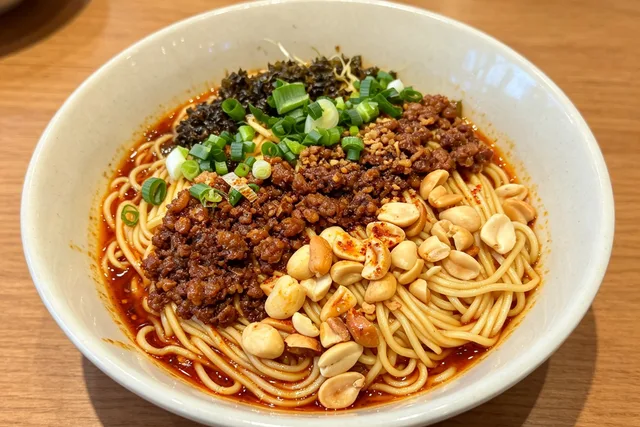
Chengdu’s small bowl of noodles with crisp pork and chili oil.
Read the dan dan noodles guide →Sichuan hot pot
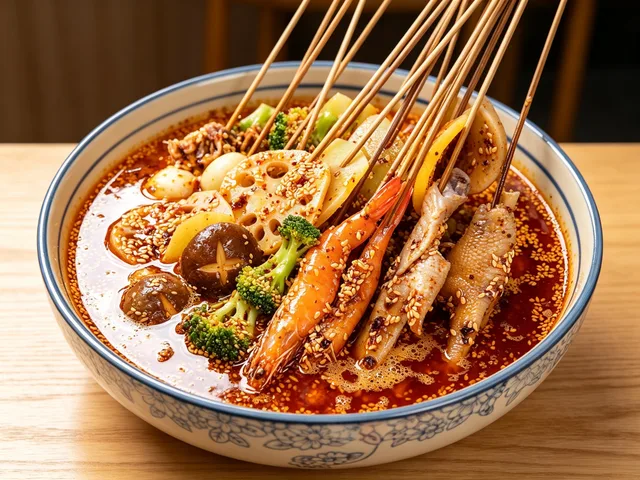
Tallow broth, chilies and Sichuan pepper boiling at the table.
Read the Sichuan hot pot guide →Sichuan food
The flavors, cities and dishes of the Sichuan basin.
Read the Sichuan guide →Sichuan classics
- Mapo Tofu
Tofu dish · Lunch or dinner, with rice
- Yuxiang Shredded Pork
Pork stir-fry · Lunch or dinner, with rice
- Sichuan Hot Pot
Hot pot · Shared meal
- Dan Dan Noodles
Small dressed noodles · Snack
- Bobo Chicken
Cold skewers · Snack
- Sweet Water Noodles
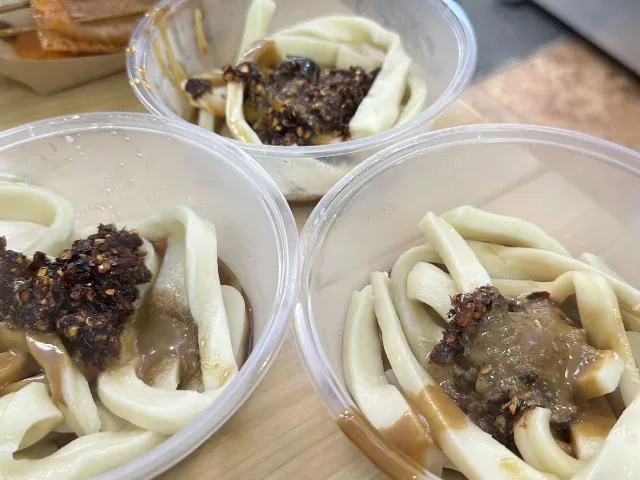
Thick dressed noodles · Breakfast or a snack
FAQ
Questions about Kung Pao Chicken
Where does kung pao chicken come from?
It is a Sichuan dish named after Ding Baozhen, a Guizhou-born official who was governor of Shandong and then governor-general of Sichuan. Guizhou and Shandong have their own versions, and the earliest written recipes date from the Republican period, not his lifetime.
What does kung pao mean?
Gongbao, spelled kung pao in the older Wade–Giles system, was the form of address for Ding Baozhen’s honorary title, Junior Guardian of the Heir Apparent.
Is kung pao chicken spicy?
Moderately. The dried chilies are fried for fragrance and mostly left on the plate; the sauce is sour-sweet, and Sichuan pepper adds a light tingle.
What is the difference between kung pao chicken and Chongqing chili chicken?
Kung pao chicken is a quick stir-fry of tender diced chicken with a sour-sweet sauce and peanuts. Chongqing chili chicken is chicken fried crisp and tossed dry in a mound of chilies and Sichuan pepper, with no sauce.
Peanuts or cashews?
Peanuts are traditional. Cashews make a grander version, and some restaurants charge more for it.
Sources
Sources and further reading
- 1 Land of Plenty: A Treasury of Authentic Sichuan Cooking, pp. 237–39 and 252: Gong Bao chicken with peanuts, and chicken with chilesFuchsia Dunlop, W. W. Norton (2003)
- 2 Fuchsia Dunlop, Chuancai (川菜), Chinese edition of Land of Plenty: the lychee flavor, cutting and small-frying (in Chinese)CITIC Press (2020; WeChat Read edition)
- 3 Lan Yong, Zhongguo Chuancai Shi (中国川菜史), chapter on late-Qing Sichuan cooking: the origin stories of kung pao chicken (in Chinese)Sichuan Literature and Art Publishing House (2019)
- 4 Draft History of Qing (清史稿), juan 447: biography of Ding Baozhen (in Chinese)Zhao Erxun et al. (1928); Chinese original on Wikisource ↗
- 5 Famous Chinese Dishes, vol. 7: Sichuan (中国名菜谱·第七辑), contents and pp. 66, 120–21 and 125: chicken with pickled chilies, kung pao kidneys and suimi jiding (in Chinese)Ministry of Commerce catering bureau; Light Industry Press (1960)
- 6 Famous Chinese Dishes, vol. 11: Yunnan, Guizhou and Guangxi (中国名菜谱·第十一辑), p. 96: Guizhou gongbao chicken (in Chinese)Ministry of Commerce catering bureau; Light Industry Press (1965)
- 7 Wu Maozhao, Liu Qianxun and Yang Bo, Qiancai Biaozhun (黔菜标准), “Technical specification for traditional Guizhou gongbao chicken” (in Chinese)Chongqing University Press (2023)
- 8 Kung pao chicken: a basic Chinese dish, with a recipe from The Woks of LifeYoyo Chow, Goldthread (2022) ↗
- 9 A Sichuan master chef on kung pao chicken: thigh meat, the sugar-to-vinegar ratio and a wok time of seconds (video, in Chinese)Da Shi De Cai (大师的菜), Bilibili ↗
- 10 Kung pao chicken at home: deboned thigh, a pre-mixed sauce and chilies fried until brown (video, in Chinese)Wang Gang (美食作家王刚R), Bilibili ↗
- 11 Shandong-style gongbao chicken in Jinan: thick-cut cubes, bamboo shoots, peas and scallion-pepper wine (video, in Chinese)Lu Cai Xing Zhe (鲁菜行者), Bilibili ↗
- 12 Kung pao chicken at a Chengdu Sichuan restaurant, 48 yuan a plate (video, in Chinese)Da Ge Zai Shanghai (达哥在上海), Bilibili ↗
- 13 Emei Restaurant in Beijing, famous for one dish: a deluxe kung pao with cashews and almonds at 66 yuan (video, in Chinese)Jason Liu Yuxin (JASON刘雨鑫), Bilibili ↗
Last updated October 2026