
01
Fish-fragrant, with no fish
The fish in the name is a flavor, not an ingredient.
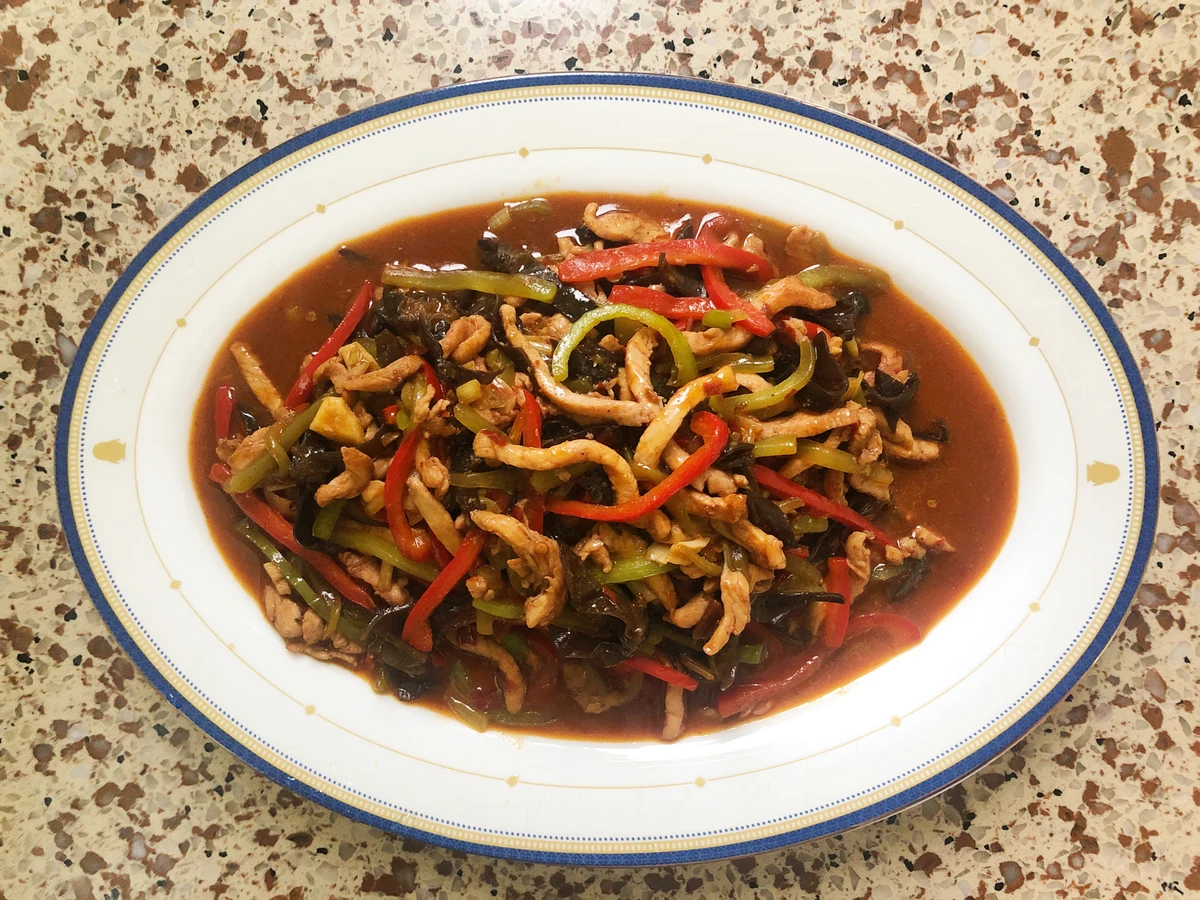
A plate of yuxiang shredded pork is thin slivers of pork loin, tender and coated in a thin, glossy red sauce, mixed with slivers of wood ear fungus and a crunchy vegetable cut the same way. It tastes salty first, then sweet and sour together, with a gentle heat and a strong smell of garlic, ginger and scallion. The color is orange-red, and it is eaten with plenty of rice.
The two characters 鱼香 mean “fish” and “fragrant,” which is why the Sichuan cooking writer Fuchsia Dunlop translates the name as fish-fragrant pork slivers. English-language menus have tried “mock-fish,” “fish-flavored” and even “sea-spice,” which makes little sense for a province hundreds of miles from the sea. The historian Lan Yong counts it among the traditional Sichuan dishes, alongside twice-cooked pork, mapo tofu and kung pao chicken, and dates it to the Republican period. The Chengdu historian Yuan Tingdong argues that when people think of Sichuan food, three dishes should come to mind: twice-cooked pork, mapo tofu and yuxiang shredded pork. It is also on the list of nineteen representative Sichuan dishes in the reference work Zhongguo Shijing (中国食经), which he quotes.
The Chengdu food writer Shi Guanghua puts the fish-fragrant flavor next to kung pao and strange-flavor as the textbook cases of Sichuan seasoning, the dishes a cook has to understand before the rest makes sense. He once wrote that a cook who can do fish-fragrant well can cook for the whole world. He also complains that it has become hard to find: cooks who can stir-fry a decent yuxiang shredded pork, he writes, are now rare enough to be listed as intangible cultural heritage.
02
Why it is called fish-fragrant
鱼香 is the name of a seasoning: the mix Sichuan cooks used for fish, later used on pork.
When Sichuan home cooks braised fish, they used a set seasoning: pickled red chilies, ginger, garlic and scallion, with sugar, vinegar and soy sauce, which together give a sauce that is sour, sweet, salty, savory and gently spicy. That combination was made for fish. Cooks then found that it was just as good on pork, and began using the same seasoning to stir-fry pork slivers. The dish was called fish-fragrant pork slivers because it is pork in the fish seasoning; there was never any fish in it. Dunlop writes that this fish seasoning is where the flavor comes from, and that everyone agrees it grew out of home cooking before restaurant chefs took it up. The Sichuan cooking teacher Liu Guangfu gives yuxiang shredded pork as a standard example of a dish named after its seasoning, as mapo tofu is named after a person.
Fish is still cooked that way. Shi Guanghua describes Sichuan bean-paste fish, braised with chili bean paste, pickled chilies, scallion, ginger, garlic and a sweet-sour finish, and says its taste is close to a broad fish-fragrant flavor. Once the seasoning had its own name, Sichuan cooks used it on pork, eggplant, chicken, eggs and tofu.
Two other explanations circulate, and neither holds up well. One says the pickled chilies were once called fish chilies, 鱼辣子, because live crucian carp were put in the pickling jar; an old Sichuan chef repeats it on camera. Shi Guanghua, who has written a whole book on Sichuan chilies, calls the carp in the jar a gimmick and a half-true legend. He uses the word 鱼辣子 himself, for erjingtiao chilies pickled whole, mainly for fish-fragrant dishes, and argues that what matters is how sour, sweet, fragrant and crisp the pickled chilies are, not a fish in the jar. The other is a story about fishermen who caught nothing in days of rain and fried pork with their fish seasonings instead. It is a story, not a record.
03
Salty, sweet, sour and spicy
鱼香味, the fish-fragrant flavor, is one of the twenty-odd compound flavors Sichuan cooks name and teach.
Lan Yong lists more than twenty such compound flavors, from home-style and numbing-hot to lychee, strange-flavor and fish-fragrant. Liu Guangfu’s textbook defines fish-fragrant as bright red, salty and savory with a mild heat, sweet and sour together, with a strong smell of ginger, scallion and garlic. Dunlop’s description is the same in other words. The core is pickled red chili, which gives these dishes their orange-red color. The difficulty is the balance: no one taste should stick out. Liu puts it as a rule for sugar in every compound flavor: it should round the dish out without the dish tasting sweet.
Liu also fixes the cuts. The pickled chilies are seeded and chopped to a very fine paste. The scallion is cut into “fish-eye” rounds about half a centimeter long, small enough to scatter through the sauce, and he says every fish-fragrant dish must have ginger, scallion, garlic and pickled chili. Garlic outweighs ginger: in his recipe, 15 grams of garlic to 5 of ginger.
| Seasoning | What it gives | How chefs handle it |
|---|---|---|
| Pickled red chilies 泡辣椒 | The gentle heat and the orange-red color | Erjingtiao chilies, seeds removed, chopped very fine; Liu Guangfu allows chili bean paste in their place, while a chef at Beijing’s Sichuan Restaurant says the fish fragrance will not come through |
| Sugar and vinegar | The sweet-and-sour middle of the flavor | Equal weights in Liu’s textbook and in most chefs’ versions; one Sichuan chef’s older version uses sugar to vinegar at five to four |
| Ginger, garlic, scallion | The fragrance | Garlic well ahead of ginger; ginger and garlic fried with the chilies, the scallion added half before the sauce and half after |
| Soy sauce and salt | The salty base | Only a little, in the bowl sauce; the pickled chilies are salty too |
| Starch in the bowl sauce | The gloss | Just enough to make the sauce cling; the oil should show at the edge of the plate and no gravy should pool |
04
The sauce ratio: spoon formulas and a chef’s grams
The question people ask most about this dish is how much of each seasoning goes into the sauce.
Chinese recipe sites answer with number formulas in spoonfuls. The common “1-2-3-4” is one spoon of rice wine, two of soy sauce, three of sugar and four of vinegar. “1-2-3-4-5” adds five spoons of water or stock, though some versions give the numbers to different seasonings, so the formula means different things on different sites. Others circulate “5-4-3-2-1” and “4-3-2-1-1-1.” They are memory aids, and they are not wrong as a starting point, but all of them use far more soy sauce than chefs do.
The chefs’ versions agree on two things: sugar and vinegar in roughly equal weight, and very little soy sauce. In Liu Guangfu’s textbook recipe, 200 grams of pork loin takes 25 grams each of sugar and vinegar but only 5 grams of soy sauce and 2 of salt; the pickled chilies supply the rest of the salt and the color. Equal sugar and vinegar, little soy, plenty of garlic: that is the shape of the sauce. Because vinegars differ in strength, every chef also tastes and adjusts at the end.
| Version | Sugar : vinegar | Other seasonings | For |
|---|---|---|---|
| Liu Guangfu’s textbook | 25 g : 25 g | 5 g soy sauce, 2 g salt, 5 g rice wine, 50 g stock, 10 g wet starch | 200 g pork, 50 g each lettuce stem and wood ear |
| Zheng Shaowu, Sichuan Restaurant, Beijing | 20 g : 20 g | About 8 g soy sauce, 4 g salt, 10 g rice wine | One restaurant plate |
| Wang Gang’s older-style home version | 10 g : 8 g | 5 g soy sauce, 8 g rice wine, a pinch of salt | 200 g pork |
| Online “1-2-3-4” | 3 spoons : 4 spoons | 1 spoon rice wine, 2 spoons soy sauce | Home cooking, by spoon |
| Online “1-2-3-4-5” | 3 spoons : 4 spoons (in one common version) | 1 spoon rice wine, 2 spoons soy sauce, 5 spoons water | Home cooking, by spoon |
05
Wood ear and bamboo shoot, not carrot
What goes in besides pork is where versions part ways.
Zheng Shaowu, who joined Beijing’s Sichuan Restaurant at seventeen and spent his working life there, says the traditional garnish is only winter bamboo shoot and wood ear. The carrot, bell pepper, celery and green beans that many restaurants add hold too much water, and the dish turns watery. Liu Guangfu’s textbook gives the regional rule: in western Sichuan, around Chengdu, the garnish is dried “magnolia” bamboo slices, 玉兰片, with wood ear; across Sichuan and Chongqing it is lettuce stem, 莴笋, with wood ear. His own recipe uses 50 grams each of lettuce stem and wood ear to 200 grams of pork. Whatever is used is cut into slivers to match the pork: as Sichuan cooks say, cubes go with cubes and slivers with slivers.
Elsewhere the dish drifts. In 1997 a Beijing newspaper reporter ordered yuxiang shredded pork at ten small Sichuan restaurants in the city and found six different methods; the most extreme cook said that anything stir-fried with chili counts. Many versions outside Sichuan add carrot and green pepper, and some kitchens use chili bean paste or fresh chili in place of the pickled chilies. The plate at the top of this page is a home-style version of that kind, with lettuce stem, green pepper, carrot and wood ear.
| Western Sichuan (Chengdu) | Sichuan and Chongqing | Common elsewhere | |
|---|---|---|---|
| Vegetables | Magnolia bamboo slices and wood ear; winter bamboo shoot in Beijing’s Sichuan Restaurant | Lettuce stem and wood ear | Carrot, green pepper, celery or green beans as well |
| Chili | Pickled red chili | Pickled red chili | Sometimes chili bean paste or fresh chili instead |
| Sauce | Thin, clinging, oil showing at the edge | Thin, clinging, oil showing at the edge | Often more gravy, which the watery vegetables add to |
| Color | Orange-red from the pickled chili | Orange-red from the pickled chili | Browner or paler, depending on the chili |
06
How chefs make it
This is a quick stir-fry: in Sichuan terms, 滑炒, the meat coated in starch and moved through hot oil. Everything is cut and the sauce is mixed before the wok goes on, because the cooking takes under a minute.
- 1. Cut and marinate the pork
Pork loin is sliced, then cut into slivers about as thick as a matchstick, all the same size so they cook evenly. It is mixed with salt, soy sauce, a little water and wet starch.
- 2. Cut the aromatics
Pickled chilies seeded and chopped fine, ginger and garlic minced, scallion cut into fish-eye rounds; lettuce stem or bamboo shoot and wood ear cut into slivers.
- 3. Mix the bowl sauce
Soy sauce, sugar, vinegar, stock and wet starch go into a bowl in advance, so they hit the wok together.
- 4. Fry the pork
The oil is heated to about 180°C and the pork stirred until the slivers separate and turn pale. Many chefs first heat the wok, swirl oil and pour it out, so the meat does not stick.
- 5. Fry the seasonings
The pickled chilies go in and are fried until the oil turns red, then the ginger, garlic and half the scallion.
- 6. Finish
The vegetables go in until just cooked, then the stirred bowl sauce and the rest of the scallion. Within seconds it thickens; the sauce should be glossy and the oil clear at the edge, and it is plated at once.
Cooks taste before plating, because vinegars differ in strength; if it lacks sourness, a little more vinegar, if it lacks sweetness, a little more sugar.
07
Fish-fragrant, Beijing-sauce or green-pepper pork?
Three of the commonest pork-sliver dishes on a Chinese menu are cooked the same way and seasoned differently.
Liu Guangfu’s textbook lists yuxiang shredded pork, green-pepper shredded pork and Beijing-sauce shredded pork, 京酱肉丝, one after another, all made by the same quick stir-fry of starch-coated pork slivers. What separates them is the seasoning. Beijing-sauce pork is fried with sweet bean sauce and a little sugar, has no vinegar and no chili, and is served on raw scallion slivers; green-pepper pork is simply salty and savory. Only the fish-fragrant version is sweet, sour and spicy at once.
Ordering abroad, the name changes. Many American Chinese restaurants list the dish as shredded pork with garlic sauce, a loose translation that the recipe writer Maggie Zhu of Omnivore’s Cookbook says is the name to look for in authentic Sichuan restaurants in the United States. On other menus it is fish-fragrant pork, fish-flavored shredded pork or simply yu xiang rou si.
| Yuxiang shredded pork 鱼香肉丝 | Beijing-sauce pork 京酱肉丝 | Green-pepper pork 青椒肉丝 | |
|---|---|---|---|
| Flavor | Salty, sweet, sour, mildly spicy | Savory with the fragrance of bean sauce | Salty and savory |
| Key seasoning | Pickled chili, ginger, garlic, scallion, sugar and vinegar in equal weight | Sweet bean sauce, a little sugar | Salt, soy sauce, ginger and garlic |
| Vegetables | Lettuce stem or bamboo shoot, wood ear | Raw scallion slivers underneath | Green pepper slivers |
| Color | Orange-red | Dark brown | Pale, with green |
08
What it costs, and other fish-fragrant dishes
It is one of the cheapest meat dishes on a Sichuan menu.
In 2026 a small back-street restaurant in Chongqing sold yuxiang shredded pork for 14 yuan a plate. When the documentary maker Chen Xiaoqing was a student in Beijing in the 1980s, the snack counter of the Sichuan Restaurant on Xirongxian Hutong charged nine jiao for it, the same as kung pao chicken. Chen also remembers it as a staple of the university canteen. Today it is a standard of canteens, rice-plate shops and lunch boxes across China, often served over rice as a one-dish meal.
The same seasoning dresses other dishes. Fish-fragrant eggplant, braised soft in the same sauce, is the best-known after the pork, and Sichuan menus also have fish-fragrant chicken slivers served cold, fish-fragrant bean curd and fish-fragrant eggplant cakes, slices of eggplant sandwiched with meat and fried. Liu Guangfu’s list adds fish-fragrant eight-piece chicken, fish-fragrant garlic shoots and fish-fragrant “buddha’s-hand” rolls. In upscale restaurants the sauce is now poured over fried prawns and other seafood, a recent addition that came once fresh seafood could be flown in from the coast. Sichuan’s Muslim restaurants, which serve no pork, make the dish with beef as fish-fragrant beef slivers.
09
At home
For two people with rice: 200 grams of pork loin, 40 grams of soaked wood ear, two or three young bamboo shoots or a piece of lettuce stem, 30 grams of pickled red chilies, 20 grams each of garlic and ginger, 30 grams of scallion. Bowl sauce: 10 grams of sugar, 8 grams of dark rice vinegar, 5 grams of soy sauce, 8 grams of rice wine, a pinch of salt and a spoonful of starch in a little water.
- 1. Prepare the pork
Slice the pork thin, then into fine slivers. Rinse and squeeze dry, mix with a pinch of salt, a little rice wine and soy sauce and half an egg white, stir in one direction for two minutes, then add dry starch.
- 2. Prepare the vegetables
Cut the wood ear and bamboo shoot into slivers and blanch them briefly. Chop the pickled chilies, garlic and ginger fine; cut the scallion into short lengths.
- 3. Cook the pork
Heat the wok, swirl oil and pour it out, add fresh oil and heat to moderate. Slide in the pork and stir it apart until it turns white, then lift it out.
- 4. Fry the aromatics
With a little fresh oil, fry the pickled chilies, garlic and ginger over medium-low heat until the oil is red and fragrant.
- 5. Bring it together
Return the pork with the wood ear and bamboo shoot, turn the heat to high and pour in the stirred sauce. Toss until it thickens and smells of vinegar, add the scallion and a little oil for shine, and serve.
If you cannot find lettuce stem or bamboo shoot, Dunlop suggests celery; avoid watery vegetables in quantity, which thin the sauce. If you have no pickled chilies, chili bean paste works, but the color and flavor will be deeper and less bright.
10
More Sichuan stir-fries
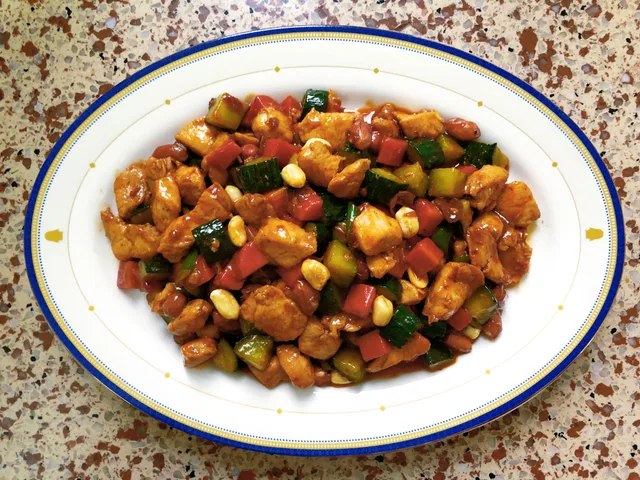
Kung pao chicken
Diced chicken with scorched chilies and peanuts, sour before sweet.
Read about kung pao chicken →Twice-cooked pork
Boiled pork belly fried with chili bean paste and garlic leaves.
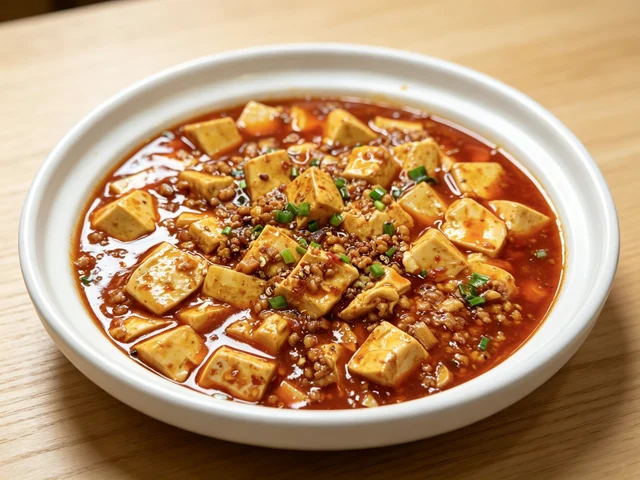
Read about twice-cooked pork →Mapo tofu
Soft tofu in a numbing, spicy sauce with minced beef.
Read about mapo tofu →Sichuan classics
- Mapo Tofu
Tofu dish · Lunch or dinner, with rice
- Kung Pao Chicken
Chicken stir-fry · Lunch or dinner, with rice
- Sichuan Hot Pot
Hot pot · Shared meal
- Dan Dan Noodles
Small dressed noodles · Snack
- Bobo Chicken
Cold skewers · Snack
- Sweet Water Noodles
Thick dressed noodles · Breakfast or a snack
FAQ
Questions about Yuxiang Shredded Pork
Is there fish in yuxiang shredded pork?
No. 鱼香 is the seasoning Sichuan cooks used for fish: pickled red chilies, ginger, garlic and scallion with sugar, vinegar and soy sauce. The dish is pork cooked in that seasoning.
Where is yuxiang shredded pork from?
Sichuan, including Chongqing. Historians date it to the Republican period, and it is now cooked all over China.
What does yuxiang taste like?
Salty, sweet, sour and gently spicy at once, with a strong smell of garlic, ginger and scallion and an orange-red color from pickled chilies.
What is the sauce ratio?
Chefs use sugar and vinegar in roughly equal weight and very little soy sauce: one textbook uses 25 grams each of sugar and vinegar and 5 grams of soy sauce for 200 grams of pork. Spoon formulas such as “1-2-3-4” are easy to remember but use much more soy sauce.
Is it spicy?
Mildly. The heat comes from pickled chilies, which are softer than dried ones, and it is balanced by sugar and vinegar.
What vegetables go in?
Traditionally wood ear with bamboo shoot or lettuce stem. Carrot, green pepper and celery are common outside Sichuan but make the dish more watery.
Can I use chili bean paste instead of pickled chilies?
Yes, one Sichuan textbook lists it as the substitute, but some chefs say the fish-fragrant taste is only right with pickled chilies.
What is it called on American menus?
Often shredded pork with garlic sauce; also fish-fragrant or fish-flavored shredded pork.
How is it different from Beijing-sauce shredded pork?
Both are quick stir-fries of pork slivers. Beijing-sauce pork uses sweet bean sauce and raw scallion, with no vinegar or chili; yuxiang pork is sweet, sour and spicy.
Sources
Sources and further reading
- 1 Land of Plenty: A Treasury of Authentic Sichuan Cooking, pp. 18, 196–98, 258, 285–87 and 353: fish-fragrant pork slivers, fish cooking, fish-fragrant eggplants and the fish-fragrant flavorFuchsia Dunlop, W. W. Norton (2003)
- 2 Yuan Tingdong Chuancai Yanjiu (袁庭栋川菜研究), chapters “Sichuan cooking then and now” and “On classic and authentic” (in Chinese)Yuan Tingdong; Sichuan Literature and Art Publishing House (2021)
- 3 Lan Yong, Yanhuo Bashu (烟火巴蜀), chapters “Smoke and fire of the rivers and lakes” and “Five laughs at the Sichuan cuisine splitters” (in Chinese)Sichuan Literature and Art Publishing House (2021)
- 4 Chen Xiaoqing, Chi Zhe Chi Zhe Jiu Lao Le (吃着吃着就老了), essay “Memories of a deprived palate” (干瘪味蕾记忆) (in Chinese)Wenhui Publishing House (2024 edition)
- 5 Shi Guanghua, Chuancai de Weidao Meixue: Lajiao Zhenwei (川菜的味道美学:辣椒真味), chapters on pickled chilies, scorched chilies, fragrant chilies and chili bean paste (in Chinese)Guangdong People’s Publishing House (2023)
- 6 Liu Guangfu, Chuanwei Jiachangcai Pengren Jichu Lilun yu Shiji Caozuo (川味家常菜烹饪基础理论与实际操作), sections on garnishes, seasoning, knife work and dish recipes (in Chinese)Liu Guangfu (2025)
- 7 Shredded pork with garlic sauce (鱼香肉丝)Maggie Zhu, Omnivore’s Cookbook ↗
- 8 Master chefs’ dishes: yuxiang shredded pork, the pickled chilies and sugar to vinegar one to one (video, in Chinese)Da Shi De Cai (大师的菜), Bilibili ↗
- 9 Zheng Shaowu of Beijing’s Sichuan Restaurant makes yuxiang shredded pork with bamboo shoot and wood ear (video, in Chinese)Lao Fan Gu (老饭骨), Bilibili ↗
- 10 An older-style yuxiang shredded pork with weights, sugar to vinegar five to four (video, in Chinese)Wang Gang (美食作家王刚R), Bilibili ↗
- 11 Is there fish in yuxiang pork? A Sichuan master chef on pickled chilies and crucian carp (video, in Chinese)An Qiujin (安秋金), Bilibili ↗
- 12 A Chongqing back-street restaurant, 2026: yuxiang shredded pork for 14 yuan (video, in Chinese)Da Ge Zai Shanghai (达哥在上海), Bilibili ↗
Last updated October 2026