
01
A block of tofu, cut into a mountain of thread
In the 1960 recipe the piled shreds are scalded four times, then once more with the ginger on top.
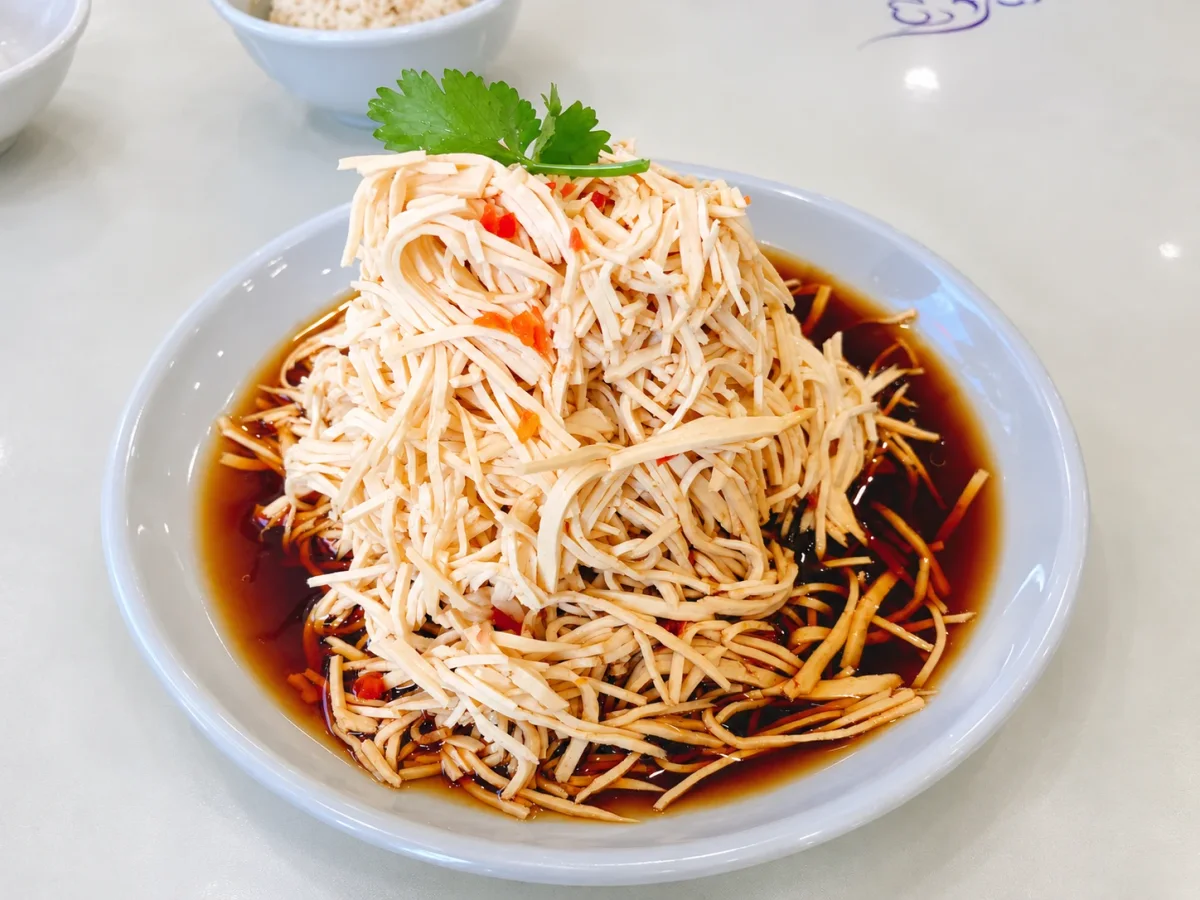
It comes to the table as a neat cone of pale shreds on a small plate, a tuft of ginger threads on top, standing in a shallow pool of dark sauce. The shreds are the whole dish. They are cut from a special firm, white pressed tofu, first sliced horizontally into very thin sheets and then cut across into strands as fine as thread, and they are scalded with boiling water over and over until they are soft and the raw bean taste has gone. Only then are they piled up, crowned with ginger and dressed with soy sauce sweetened with a little sugar and a generous pour of sesame oil.
To eat it you lift the shreds from the bottom with chopsticks and turn them over, so the sauce from the plate coats the strands. The taste is quiet: soft tofu, the warmth of raw ginger, salt and sweetness from the soy, a strong nutty smell of sesame oil. A 1960 national cookbook describes it as fine as thread, light in colour, fresh and tender, pure in taste and not greasy, “good with tea or with wine.”
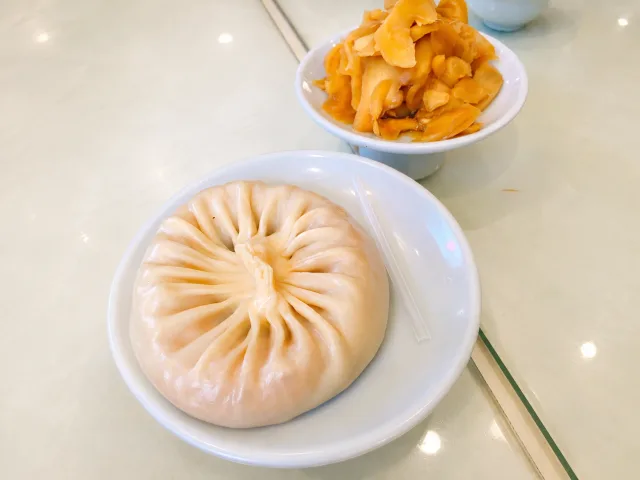
In Yangzhou it is the dish that opens a morning tea. A China Daily reporter at the Yechun Teahouse in 2018 found it was the first thing to arrive, “a mini mountain” of tofu tangles, before the steamed buns and crab-roe soup dumplings.
02
Sixteen slices or thirty: the knife work
Tang gansi and wensi tofu are the two dishes that show the fineness of Yangzhou’s cutting.
Yangzhou talks about its “three knives”: the barber’s razor, the pedicurist’s blade and the cook’s cleaver. Tang gansi is the cleaver’s test. The cook lays a block of pressed tofu flat and, holding the blade parallel to the board, slices it into sheets from top to bottom. The 1960 cookbook asks for 15 or 16 sheets from a block, a 1985 book for about 20, “as thin as paper.” The writer Wang Zengqi set the standard most often quoted: sixteen slices to a block, shreds as fine as horsehair, not one broken. A 2014 newspaper guide to Yangzhou put it at 16 to 18 sheets from a block two centimeters thick, and 28 at most; among Huaiyang chefs, 20 sheets makes a beginner and more than 30 a master.
At a one-man stall in Yangzhou in 2024, the cook, who had made nothing but tofu shreds for 34 years, split a block about three centimeters thick into 20 to 30 sheets of about one millimeter, then cut them into strands just as fine, using one knife for slicing and another for shredding. The slicing alone took more than three hours a day. Many shops now use shreds cut by machine, which eat quite differently.
The ginger gets the same treatment. The 1960 recipe wants it cut “as fine as cotton thread,” fine enough to pass through the eye of a needle.
03
The tofu: pressed hard, curdled with brine
Ordinary pressed tofu crumbles under the knife; gansi needs a block made for it.
The tofu for gansi is a large, firm, pale block known in Yangzhou as 大白干, “big white dried tofu.” The 1960 cookbook describes how it was made: soybeans soaked and skinned, ground by hand on a small mill, curdled with salt brine rather than gypsum, and the curds scooped into cloth and pressed. The result, it says, is loose yet even inside, so that it can be cut into neat shreds that hold together. Before slicing, the blocks were boiled once, spread out to cool and left until the next day.
Yangzhou has been proud of its dried tofu for a long time. Li Dou’s 1795 guide to the city, The Painted Boats of Yangzhou, notes that at Zhucaopo, the reed market by the south gate, the best dried tofu was made by the Yao family and was simply called “Yao gan.” In 2014 a Guangzhou newspaper reported that Yangzhou cooks running teahouses in Nanjing still had their tofu brought from Yangzhou every day.
Scalding matters as much as cutting. Freshly cut shreds carry a yellowish, slightly bitter liquid from the pressing; cooks soak them in boiling water, pour it off and repeat, three or four times, then scald each portion again as it is ordered.
04
How a teahouse made it: the 1960 recipe
The oldest detailed recipe comes from a Nanjing teahouse and describes two stages: a batch scalded the night before, and each bowl scalded again to order.
For one portion: about 105 g of shredded dried tofu, 6 g of young ginger, 45 g of soy sauce mixed with 9 g of sugar, and 30 g of sesame oil.
- 1. The night before
Put the day’s shreds in a large crock, cover generously with boiling water and leave overnight. Next day pour the water off and scald them with fresh boiling water three more times, to take away the taste of the pressing liquid.
- 2. Pile and pour
For each order, heap a portion of shreds in a bowl in a tall dome. Hold the bowl from below with four fingers, pour boiling water over the shreds to the rim, then press the shreds down with your thumb and tip the water out. Do this four times.
- 3. Ginger
Pile the ginger threads on top and scald once more, draining well.
- 4. Dress
Pour over the sweetened soy and then the sesame oil. The diner turns the shreds over from the bottom with chopsticks and mixes them before eating.
The quantities are generous with sesame oil, about two tablespoons for a small plate.
Sources [8]
05
Morning tea: “skin wrapped in water”
Wang Zengqi’s rule: gansi is not for eating with rice, it is for tea.
Yangzhou people describe a good day with a pun: 早上皮包水,下午水包皮, “in the morning, skin wraps water; in the afternoon, water wraps skin,” meaning tea in the teahouse in the morning and a soak in the bathhouse later in the day. The teahouses are old. In 1795 Li Dou wrote that “the teahouses of my home town are the best in the world,” with gardens, fine cups and a speciality for every house. Today the best known are Fuchun, Yechun and Gonghechun, and a Yangzhou morning tea still usually starts with a plate of tang gansi and a pot of green tea, followed by steamed buns.
Zhu Ziqing, who grew up in Yangzhou, described the dish in his 1934 essay “On Yangzhou” and added that “tang gansi is best plain: it does not get in the way of eating other things.” Nanjing’s teahouse gansi was famous too, he allowed, but people who praised it had evidently never been to Zhenjiang or Yangzhou, where it was much finer and never so sweet. Wang Zengqi, from nearby Gaoyou, added that drinking tea and eating gansi passes the time and wakes up the appetite.
The dish is cheap. At that Yangzhou stall in 2024 a plate cost 7 yuan, topped with ginger and coriander, with sesame oil as the key seasoning; larger plates cost 10, 15 or 20 yuan. In 2025 the city listed it among its landmark foods, alongside wensi tofu soup, Yangzhou fried rice and lion’s head meatballs.
06
Da zhu gansi: the shreds simmered in chicken stock
Tang gansi has a grander sibling for the dinner table.
大煮干丝, da zhu gansi or “big-boiled tofu shreds,” uses the same shreds but cooks them. The 1960 recipe boils them hard for 15 minutes in chicken stock with shredded chicken, chicken skin, gizzard and liver, bamboo shoot, dried shrimp roe and lard, until the broth turns milky and rich; it is finished with pork kidney and soy, and the bowl is topped with stir-fried shrimp, pea shoots and a crown of ham shreds, red, yellow and white.
Yangzhou tells a story about its origin: that local officials served the Qianlong Emperor a “nine-shred soup” of ham, bamboo shoot, whitebait, wood ear, mushroom, laver, egg pancake, chicken and dried tofu in chicken stock, and that ordinary kitchens later trimmed it down to da zhu gansi. It is a story rather than a record. Da zhu gansi is also called jialiao gansi, “gansi with extra ingredients,” and is cooked in plenty of stock over fierce heat.
Restaurants keep inventing richer versions. A 2019 Huaiyang recipe for crab-roe gansi simmers crab shells and roe with chicken for the stock and cooks the shreds in it for two or three minutes.
07
Gansi around the Yangtze
Teahouse gansi is shared by the cities of the lower Yangtze and the Grand Canal.
Zhenjiang’s version was just as famous in the 1930s. A 1935 Shanghai cookbook author, waiting for a train in Zhenjiang, ordered gansi at a teahouse by the station and ate three bowls in a row; in Shanghai, he wrote, the Zhenjiang-style teahouses such as Laobanzhai served it too. Upstream in Anhui, Chaohu makes a cold plate of spiced and stinky tofu shreds piled under braised pork, cucumber and chilli.
| Dish | Where | How it differs |
|---|---|---|
| Scalded tofu shreds 烫干丝 | Yangzhou, Zhenjiang, Nanjing | Shreds scalded raw, piled in a cone with ginger, soy, sugar and sesame oil |
| Simmered tofu shreds 大煮干丝 | Yangzhou | Shreds boiled in chicken stock with chicken, ham, shrimp and pea shoots |
| Crab-roe tofu shreds 蟹黄干丝 | Yangzhou restaurants | Simmered in a stock of crab shells, roe and chicken |
| Daming Temple gansi | Yangzhou | Vegetarian: bamboo shoot, mushroom and soybean-sprout stock |
| Chaoxian gansi 巢县干丝 | Chaohu, Anhui | Spiced and stinky tofu shreds with braised pork, cucumber, chilli and vinegar |
08
Tofu shreds at home
This follows the 1979 Jiangsu cookbook, for one small plate.
100 g firm white pressed tofu (sold as “dried tofu” or “pressed tofu” in Chinese shops; the plain white kind, not the brown spiced kind), 6 g young ginger, 5 g light soy sauce, 10 g sugar, 30 g toasted sesame oil, a few coriander leaves. Optional: a few soaked dried shrimp.
- 1. Firm up
Simmer the tofu block in water for a few minutes, lift it out, cool completely and, ideally, chill it overnight; cold tofu slices more cleanly.
- 2. Slice and shred
With a sharp, thin knife held flat, slice the block into as many thin sheets as you can, 10 is a good start and 16 is the classic aim. Stack a few sheets and cut them into very fine shreds. Cut the ginger into the finest threads you can.
- 3. Scald
Put the shreds in a bowl and pour boiling water over them; drain and repeat three times, until soft and free of the beany taste. Heap them into a cone on a plate. Put the ginger on top and pour a last kettle of boiling water over, then drain well.
- 4. Dress
Stir the soy sauce and sugar together, pour over the ginger, then the sesame oil. Turn the shreds from the bottom just before eating.
Supermarket pressed tofu is softer than Yangzhou’s and will not give you thirty sheets; thicker shreds still taste good. Eat it straight away, with tea.
09
How to order it
Order it first, with tea.
At morning tea
At Fuchun, Yechun or any Yangzhou teahouse, tang gansi is the opening plate before the steamed buns; order a pot of green tea with it.
Tang or zhu
烫干丝 is the plain, scalded one; 大煮干丝 or 煮干丝 is the hot one in chicken stock, more of a dinner dish.
Turn it before eating
Lift the shreds from the bottom so the sauce coats them, then eat.
Sizes
Small stalls sell it by price: a 7-yuan plate is enough for one with tea.
With crystal pork
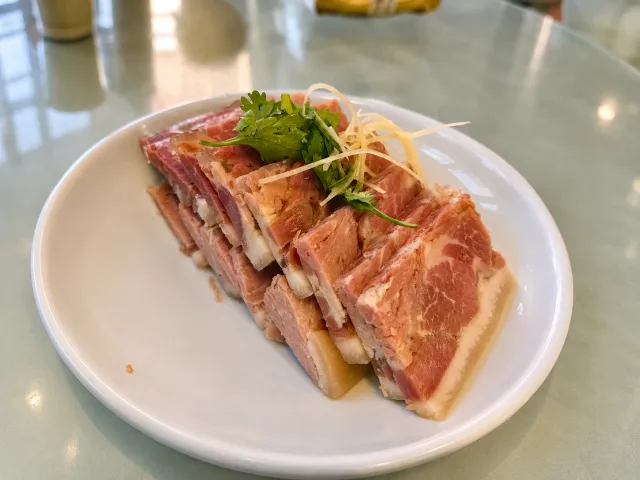
In Zhenjiang and Yangzhou it shares the morning tea table with crystal pork; order both.
10
More from the Huaiyang table
Other pages on the atlas.
Crab roe soup dumplings
The other must-order dish at a Yangzhou morning tea.
Read about crab roe soup dumplings →Zhenjiang crystal pork
Pressed pork in jelly, eaten with tea in the morning.
Read about crystal pork →Lion’s head meatballs
Yangzhou’s great meatballs, also cut by hand.
Read about lion’s head →Chinese tofu
Pressed, dried, fermented and silken tofu, and how they are used.
Read the tofu guide →Jiangsu classics
- Crab Roe Soup Dumplings
Jiangsu soup dumpling · Morning tea, autumn crab season
- Zhenjiang Crystal Pork
Pressed pork hock in clear jelly · Breakfast with tea or noodles
- Squirrel Mandarin Fish
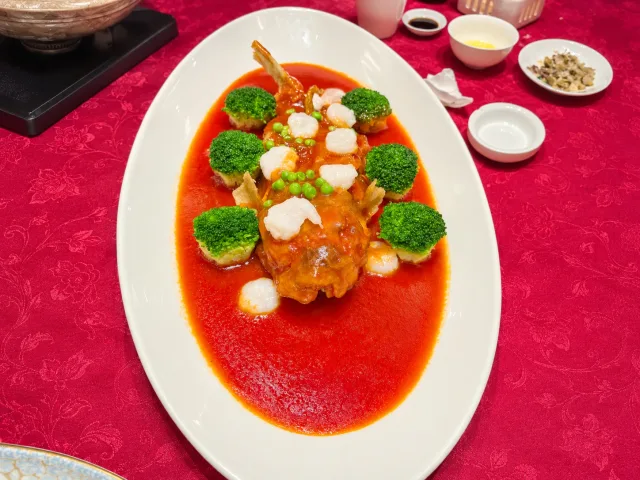
Deep-fried whole fish in sweet-and-sour sauce · Banquets, shared restaurant meals
- Lion’s Head Meatballs
Pork meatballs in clear broth · Lunch, dinner or a banquet
FAQ
Questions about Yangzhou Scalded Tofu Shreds
What is tang gansi?
A Yangzhou teahouse dish of firm pressed tofu sliced into very thin sheets, cut into thread-fine shreds, scalded with boiling water several times, piled in a cone and dressed with ginger, soy sauce, sugar and sesame oil.
Is it the same as shredded tofu skin?
No. Gansi is cut by hand from a thick block of pressed tofu; shredded tofu skin is made from thin sheets and has a different, chewier texture.
How many slices does a block make?
Old cookbooks ask for 15 or 16 sheets from a block; Yangzhou cooks talk of 20 to 30, and the finest about one millimeter thick.
Why scald it so many times?
To soften the shreds and wash out the yellowish, slightly bitter liquid left from pressing the tofu, so only a clean bean taste remains.
What is the difference between tang gansi and da zhu gansi?
Tang gansi is scalded and dressed; da zhu gansi boils the same shreds in rich chicken stock with chicken, ham and shrimp.
Is tang gansi served hot or cold?
Warm: the shreds are scalded just before serving and eaten at once, but the dish is not cooked further.
Where is the best place to eat it?
At a Yangzhou morning tea, in old teahouses such as Fuchun and Yechun or at small stalls that still cut by hand.
Sources
Sources and further reading
- 1 Li Dou, The Painted Boats of Yangzhou (扬州画舫录), chapter 7: the Yao family’s dried tofu (in Chinese)Chinese Wikisource (text of 1795) ↗
- 2 Li Dou, The Painted Boats of Yangzhou, chapter 1: Yangzhou’s teahouses and their specialities (in Chinese)Chinese Wikisource (text of 1795) ↗
- 3 “On gansi” (话说干丝): Zhu Ziqing, Zhou Zuoren and Cao Juren on teahouse tofu shreds (2024) (in Chinese)China Energy News, People’s Daily (in Chinese) ↗
- 4 From home cooking to state banquets: Fuchun Teahouse’s gansi and Yangzhou knife work (2024) (in Chinese)China News Service, via ifeng (in Chinese) ↗
- 5 Eating Yangzhou, starting with snacks: how many slices to a block of dried tofu (2014) (in Chinese)Southern Metropolis Daily, via ifeng (in Chinese) ↗
- 6 Owen Fishwick, Breakfast in Yangzhou is something to wake up for (2018)China Daily ↗
- 7 Yangzhou landmark foods showcased: wensi tofu soup, scalded tofu shreds, Yangzhou fried rice (2025) (in Chinese)Yangzhou government account, The Paper (in Chinese) ↗
- 8 Famous Chinese Dishes, vol. 8: Jiangsu and Zhejiang (中国名菜谱·第八辑), p. 24: scalded tofu shreds (in Chinese)Light Industry Press (1960), indexed by laocp.tech ↗
- 9 Chinese Cookbook: Jiangsu (中国菜谱·江苏), p. 271: scalded tofu shreds (in Chinese)China Financial and Economic Publishing House (1979), indexed by laocp.tech ↗
- 10 Chinese Snacks: Jiangsu (中国小吃·江苏风味), p. 174: scalded tofu shreds (in Chinese)China Financial and Economic Publishing House (1985), indexed by laocp.tech ↗
- 11 Famous Chinese Dishes, vol. 8: Jiangsu and Zhejiang, p. 27: tofu shreds simmered in chicken stock (大煮干丝) (in Chinese)Light Industry Press (1960), indexed by laocp.tech ↗
- 12 New Home Recipes (家庭新食谱), p. 151: soaked tofu shreds, with a note on Zhenjiang gansi (in Chinese)Central Bookstore, Shanghai (1935), indexed by laocp.tech ↗
- 13 Famous Chinese Dishes, new edition: Vegetarian (中国名菜谱·素菜), p. 16: Yangzhou tofu shreds from Daming Temple (in Chinese)China Financial and Economic Publishing House (1992), indexed by laocp.tech ↗
- 14 Chinese Snacks: Anhui (中国小吃·安徽风味), p. 54: Chaoxian tofu shreds (in Chinese)China Financial and Economic Publishing House (1985), indexed by laocp.tech ↗
- 15 A Yangzhou stall that has made only tofu shreds for 34 years: 1 mm slices, 7 yuan a bowl (video, in Chinese)Nanjing Zhou Xiaojiu (南京舟小九), Bilibili (June 2024) ↗
- 16 A Huaiyang chef’s crab-roe tofu shreds: “20 slices is a beginner, over 30 is a master” (video, in Chinese)Dashi de Cai (大师的菜), Bilibili (December 2019) ↗
Last updated November 2026