
01
Pork hock, pressed in its own jelly
The 1960 Zhenjiang recipe calls the meat better still when dipped in Zhenjiang vinegar.
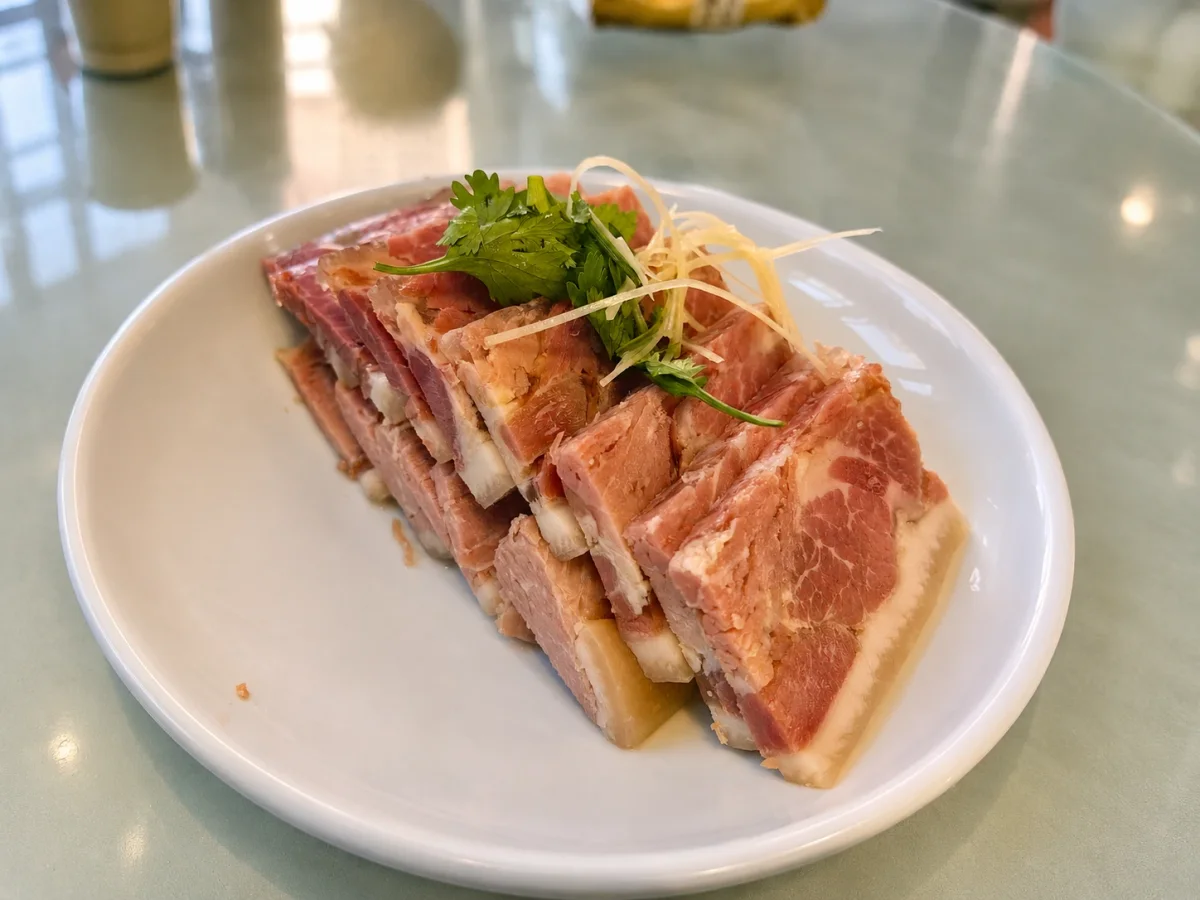
The cut is the pork hock, the lower leg above the trotter, with its mix of lean muscle, tendon, fat and thick skin. It is boned and opened flat, rubbed with salt and a little saltpetre and left to cure, then simmered for hours under a weight with scallion, ginger, Sichuan pepper and star anise. While still hot the meat is laid skin side down in shallow pans and the pans are stacked so the weight presses it into a dense slab and squeezes out much of the fat. The cooking broth is skimmed, cleared and poured back over, and as it cools it sets into a clear jelly that fills every gap.
A 1979 Jiangsu cookbook describes what comes out: red meat, white skin “smooth and gleaming,” and a jelly so transparent that the dish is called 水晶, “crystal.” The saltpetre is what keeps the lean meat rose-pink instead of grey after hours of cooking, and why the fat holds its shape instead of melting. The older Zhenjiang recipe, recorded in 1960, adds that the meat is fragrant and tender, “does not stick in the teeth,” and, with so much fat pressed out, is not greasy. Cut cold, each slice is a little cross-section of the leg: lean meat marbled with tendon, a strip of fat, and amber jelly against the skin.
The name is a pun that stuck. 肴 means a cooked dish, as in 佳肴, but people in Zhenjiang still say xiāo ròu, after 硝, saltpetre, which is how the meat was first known.
02
“Not eaten as a dish”: Zhenjiang’s three oddities
镇江有三怪: vinegar that never goes off, crystal pork that is “not a dish,” and a pot lid boiled with the noodles.
Zhenjiang’s rhyme of three oddities runs: 香醋摆不坏,肴肉不当菜,面锅里面煮锅盖. The vinegar keeps for years; the noodles are cooked with a small wooden lid floating in the big pot; and crystal pork, the second oddity, is “not eaten as a dish.” That means it is not saved for the dinner table. Zhenjiang eats it in the morning, as a snack with tea or beside a bowl of noodles.
The habit is old. A 1935 Shanghai household cookbook describes Zhenjiang’s teahouses: almost every one served noodles and small dishes, the waiter brought a cup of tea first, then crystal pork, tofu shreds and tofu skin, then little steamed dumplings, and of all of them the city’s own crystal pork was the customers’ favourite. Today the pairing is noodles. In 2024 the city’s Communist Party secretary, Ma Minglong, wrote that a bowl of pot-lid noodles “with crystal pork, dipped in vinegar” was the taste of Zhenjiang and the first thing visitors should try, in a city with more than 3,800 pot-lid noodle shops.
Noodles, vinegar and crystal pork go together. Vinegar goes on the noodles and on the pork, and crystal pork goes beside the noodles or on top of them. In 2026 the Yangtse Evening Post proposed a Zhenjiang morning tea built on them: a bowl of pot-lid noodles, a plate of crystal pork, blanched tofu shreds and a basket of crab roe soup dumplings.
03
Three hundred years, a donkey-riding immortal and a mistake with saltpetre
Nobody recorded who first made it, so Zhenjiang tells stories instead.
Cookbooks put its age at about three hundred years: “famous nationwide, already three hundred years old,” says the Zhenjiang recipe of 1960, and a 1990 Jiangsu cookbook repeats the figure. The same 1990 book gives the city’s favourite legend. Zhang Guolao, one of the Eight Immortals, was riding his donkey backwards to the Queen Mother’s Peach Banquet when he passed over Zhenjiang, smelled crystal pork, came down disguised as an old man to eat it and forgot the banquet altogether. The book quotes a verse to match, ending 嫣红嫩冻水晶肴, “crystal pork, rose-red in tender jelly.”
The other story is about a mistake. A cook, the telling goes, salted pork hocks with saltpetre by mistake, and found the meat came out pink, firm and fragrant. Zhenjiang likes the moral: in a 2025 essay the city’s Party secretary listed crystal pork among the city’s happy accidents, the “wrongly made” hock, the “spoiled” wine that became vinegar and the “misplaced” pot lid, as proof of a place that tolerates trial and error. The same essay recalls that crystal pork was well received at the banquet for the founding of the People’s Republic in 1949, and that Jin Yong has his hero Wei Xiaobao praise Zhenjiang crystal pork in The Deer and the Cauldron.
In 1990 the cookbook named three restaurants that made it best: Yanchun, Jingkou Hotel and Tongqinglou. Yanchun, founded in 1890 and named after a couplet by the scholar Wu Jiheng, was still serving it on its ground floor with snacks and noodles in 2020.
04
How Zhenjiang made it: the 1960 recipe
The Zhenjiang recipe recorded in a 1960 national cookbook is written for a batch of a hundred legs.
The batch: fifty front and fifty hind pork legs of about 1.5 kilograms each, boned to roughly 85 to 90 kilograms of meat. The cure: salt, and saltpetre water made by dissolving 6 qian (about 30 grams) of saltpetre in 10 jin (5 litres) of water and leaving it for two weeks. The cooking: 90 litres of water with 4 kilograms of salt and a little alum, scallion, ginger, Sichuan pepper and fennel tied in cloth, Shaoxing wine and a little sugar.
- 1. Bone and pierce
Each leg is split and boned without cutting into the small round muscles that become the prized cuts. The lean is pricked all over with an iron skewer so the cure can reach the middle.
- 2. Cure by the season
About 30 grams of saltpetre water and roughly 100 grams of salt are rubbed into each leg: more salt and only six to eight hours in the vat in summer, three days in spring and autumn, a week in winter. Too much saltpetre turns the meat dark.
- 3. Soak and scrape
The cured legs are soaked in cold water, scraped clean of bristles and rinsed in warm water until no blood remains.
- 4. Simmer under weight
The legs go into the boiling brine in layers, are skimmed, then seasoned and held down with a bamboo basket topped by a jar of water. The pot is kept barely moving, “like sesame bubbles,” for an hour, the legs are turned, and they cook two and a half to four hours more, seven-tenths done in summer and nine-tenths in winter.
- 5. Press
Hot from the pot, two or three legs go skin down into each shallow pan, and the pans are stacked five or six high for twenty minutes to press the meat and squeeze out fat; a hundred legs give up about 2.5 kilograms of it.
- 6. Set the jelly
The broth is skimmed, boiled with a little more alum to clear it, and poured around the pressed meat. Cooled, or chilled in summer, it sets into clear jelly. The rest of the broth is kept as old broth for the next day’s batch.
The Beijing Hotel’s 1979 recipe for a smaller batch adds pork skin and hens’ feet to the pot to give the jelly more body, and also keeps the broth from batch to batch, saying meat cooked in old broth tastes better.
05
The four cuts
Zhenjiang cooks name the pieces of the leg, and regulars order by name.
The names are old kitchen slang and vary a little between books: the 1960 recipe writes 玉带满肴 and 三角当肴, the Beijing Hotel calls the lean-heavy slice 眼睛膛. Restaurants without a regular clientele simply cut the slab into even slices; the Beijing Hotel cut them five centimeters long and two thick.
| Name | Where on the leg | What it is like |
|---|---|---|
| 眼镜肴 “spectacles” | Two pieces of tendon above the front trotter | Cut into slices shaped like a pair of glasses; soft, springy sinew |
| 玉带钩肴 “jade belt hook” | Beside the front trotter | Curved like a belt hook; very tender, more fat than lean |
| 三角棱肴 “three-cornered” | Above the front trotter | Fat and lean together, fragrant and soft |
| 添灯棒肴 “lamp stick” | Upper hind leg, with a thin bone | All lean, for people who like lean meat |
06
Ginger, vinegar, noodles and a morning drink
Put a few shreds of ginger on a slice, pour on a little Zhenjiang vinegar, and eat it cold.
The partners never change. Fine shreds of ginger go on top, black Zhenjiang vinegar goes over or in a saucer beside, and the sharpness of both cuts the richness of the jelly and fat. A 1935 cookbook had the ginger chopped as small as rice grains and stirred into the vinegar; the Beijing Hotel, in 1988, poured the ginger-vinegar over slices cut five centimeters long. The ginger and vinegar are meant to warm the stomach, since the pork is eaten cold early in the morning.
The same slices go on noodles. The 1935 book gives 肴肉面, noodles in a salty stock with pickled mustard greens, the pork laid on top, “as much as you like”; Shanghai snack shops in 1983 served crystal pork on noodles in a white broth of fish and pork bones. In Zhenjiang it sits on or beside a bowl of pot-lid noodles. In 2020 Yanchun charged 18 yuan for a plate of crystal pork, 3 yuan more for a dish of hand-cut ginger, and 18 yuan for crystal pork noodles; a noodle shop in the old Xijindu quarter charged 28 yuan for noodles with a piece on top. In 2024 a single slice added to a bowl in an ordinary noodle shop cost about 7 yuan.
Neighbouring towns have their own versions. In Danyang, a county-level city within Zhenjiang, crystal pork is made from the pork shank alone, a cut known locally as 老鼠肉, “mouse meat,” and it is firmer and drier, and is part of a morning drink: a plate of it, a bowl of noodles, barley porridge and two liang of liquor, taking an hour. Dantu, between the two, makes a version halfway between them.
07
From the noodle shop to vacuum packs
Crystal pork is now as much a souvenir as a breakfast.
Yuanchun, the city’s largest maker, can turn out nearly 3,000 tonnes of meat products a year, led by crystal pork hock, and sells them through more than a hundred supermarkets and restaurants in Jiangsu, Zhejiang, Anhui and Shanghai. In 2024 it began selling small vacuum packs as a travel snack at tourist sites, and they went on China Eastern flights.
Packaged crystal pork keeps chilled and travels well. In Zhenjiang itself it is still eaten with tea or noodles in the morning.
08
Crystal pork at home
This follows the Beijing Hotel’s 1988 method, scaled to one hock.
For one boneless pork hock with skin, about 1 kg: 60 g salt; curing salt (pink salt containing sodium nitrite), used exactly as its label directs for 1 kg of meat, or none; 1 g each Sichuan pepper, star anise and fennel seed; 6 g rock sugar; 40 g scallion and 30 g ginger; 1 tablespoon Shaoxing wine; a strip of pork skin or 4 chicken feet for extra jelly. To serve: young ginger cut into fine shreds and Zhenjiang (Chinkiang) black vinegar.
- 1. Cure
Trim the hock, prick the lean all over with a skewer, rub in the salt and curing salt and refrigerate, covered, for two days, turning it once. Without curing salt the meat will taste the same but turn grey-brown instead of pink.
- 2. Soak and blanch
Soak in cold water for two hours, scrape the skin clean, then blanch the hock and the pork skin or chicken feet in boiling water and rinse.
- 3. Simmer
Cover with fresh water, add the spices in a cloth bag, the scallion, ginger, rock sugar and wine, weigh the meat down with a plate and simmer very gently for about two hours, until a chopstick goes in easily.
- 4. Press
Lay the hock skin side down in a small deep tray. Skim the broth well, strain it and pour enough over to cover the meat. Put a board or a second tray on top with a weight and chill overnight.
- 5. Slice
Turn out the set slab and cut slices about 5 cm long and 1 to 2 cm thick with a hot, wet knife.
Serve cold with a pinch of ginger shreds on each slice and vinegar poured over or on the side. Keep it chilled and eat it within a few days.
09
How to order it
Ask for it by its local name.
Say it the local way
Written 肴肉, it is pronounced xiāo ròu in Zhenjiang; 水晶肴蹄 on a menu is the same dish.
With noodles
In a pot-lid noodle shop, add a slice of crystal pork to your bowl, about 7 yuan in 2024, and use the vinegar on the table.
At a teahouse or old restaurant
Order a plate, and ask for ginger shreds if they are not included; Yanchun charged 18 yuan for the pork and 3 yuan for the ginger in 2020.
In Yangzhou and Danyang
Yangzhou teahouses serve it too; in Danyang look for the drier shank version with a morning drink.
To take home
Vacuum-packed crystal pork is sold in Zhenjiang shops and supermarkets across the Yangtze delta; keep it cold.
10
More from Jiangsu and the Yangtze
Other pages on the atlas.
Lion’s head meatballs
Yangzhou’s great pork dish, clear-stewed or red-braised.
Read about lion’s head →Crab roe soup dumplings
The Yangtze’s biggest soup dumpling, drunk through a straw.
Read about crab roe soup dumplings →Squirrel mandarin fish
Suzhou’s fried, sweet-and-sour mandarin fish.
Read about squirrel mandarin fish →Dongpo pork
Hangzhou’s slow-braised pork belly.
Read about Dongpo pork →Jiangsu classics
- Crab Roe Soup Dumplings
Jiangsu soup dumpling · Morning tea, autumn crab season
- Yangzhou Scalded Tofu Shreds
Shredded pressed tofu, scalded and dressed · Morning tea
- Squirrel Mandarin Fish
Deep-fried whole fish in sweet-and-sour sauce · Banquets, shared restaurant meals
- Lion’s Head Meatballs
Pork meatballs in clear broth · Lunch, dinner or a banquet
Noodles from other regions
FAQ
Questions about Zhenjiang Crystal Pork
What is Zhenjiang crystal pork?
Pork hock cured with salt and saltpetre, simmered with spices, pressed in shallow pans and set in its own clear jelly, then sliced cold and eaten with shredded ginger and Zhenjiang vinegar.
Why is it called crystal pork?
Because the jelly that sets around the pressed meat is clear and the skin white and glossy; cookbooks call it 水晶, “crystal.”
How do you pronounce 肴肉?
In Zhenjiang it is xiāo ròu, after 硝, the saltpetre used to cure it, although the character 肴 is normally read yáo.
What does “肴肉不当菜” mean?
It is one of Zhenjiang’s “three oddities”: crystal pork is not kept for dinner as a main dish but eaten in the morning with tea or noodles.
Why is the meat pink?
The cure includes saltpetre, which keeps the lean meat pink after long cooking, as in ham. Without it the meat turns grey-brown.
What do you eat with crystal pork?
Fine shreds of ginger and Zhenjiang black vinegar, and often a bowl of pot-lid noodles.
How much does crystal pork cost?
A slice added to noodles cost about 7 yuan in a Zhenjiang noodle shop in 2024; a plate was 18 yuan at Yanchun in 2020, with ginger 3 yuan extra.
Sources
Sources and further reading
- 1 Zhenjiang launches a magazine on pot-lid noodles: the “three oddities” and noodles with crystal pork and vinegar (2024) (in Chinese)The Paper (in Chinese) ↗
- 2 Zheng Sheng, Zhenjiang’s Party secretary on pot-lid noodles, vinegar and crystal pork (2025) (in Chinese)The Paper (in Chinese) ↗
- 3 Four noodle shops in Zhenjiang, with prices at Yanchun and Yujia Chufang (2020) (in Chinese)The Paper, Paike channel (in Chinese) ↗
- 4 Famous Chinese Dishes, vol. 8: Jiangsu and Zhejiang (中国名菜谱·第八辑), p. 50: crystal pork, from Zhenjiang’s own practice (in Chinese)Light Industry Press (1960), indexed by laocp.tech ↗
- 5 Chinese Cookbook: Jiangsu (中国菜谱·江苏), p. 19: crystal pork hock (in Chinese)China Financial and Economic Publishing House (1979), indexed by laocp.tech ↗
- 6 Famous Chinese Dishes: Jiangsu (中国名菜谱·江苏风味), p. 50: crystal pork hock, its legend and the four cuts (in Chinese)China Financial and Economic Publishing House (1990), indexed by laocp.tech ↗
- 7 Famous Recipes of the Beijing Hotel (北京饭店名菜谱), p. 66: crystal pork (in Chinese)Beijing Hotel; Beijing Publishing House (1979), indexed by laocp.tech ↗
- 8 Huaiyang Cooking of the Beijing Hotel (北京饭店的淮扬菜), p. 119: Zhenjiang crystal pork (in Chinese)Economic Daily Press (1988), indexed by laocp.tech ↗
- 9 New Household Recipes (家庭新食谱), p. 149: crystal pork in Zhenjiang teahouses, and crystal pork noodles (in Chinese)Central Bookstore, Shanghai (1935), indexed by laocp.tech ↗
- 10 Chinese Snacks: Shanghai (中国小吃·上海风味), p. 70: noodles with pickled greens and crystal pork (in Chinese)China Financial and Economic Publishing House (1983), indexed by laocp.tech ↗
- 11 Wan Lingyun, American students visit Yuanchun, Zhenjiang’s largest crystal pork maker (2025) (in Chinese)Yangtse Evening Post (in Chinese) ↗
- 12 Zhenjiang’s “three oddities” and the case for a Zhenjiang morning tea (2026) (in Chinese)Zi Niu News, Yangtse Evening Post (in Chinese) ↗
- 13 Crystal pork “cured like gunpowder”: how Zhenjiang, Danyang and Dantu make it, and 7 yuan a slice in a noodle shop (video, in Chinese)Ye Shu De Sifang Shishi (耶叔的四方食事), Bilibili (May 2024) ↗
Last updated November 2026