
01
A pot of clear broth, beef and offal
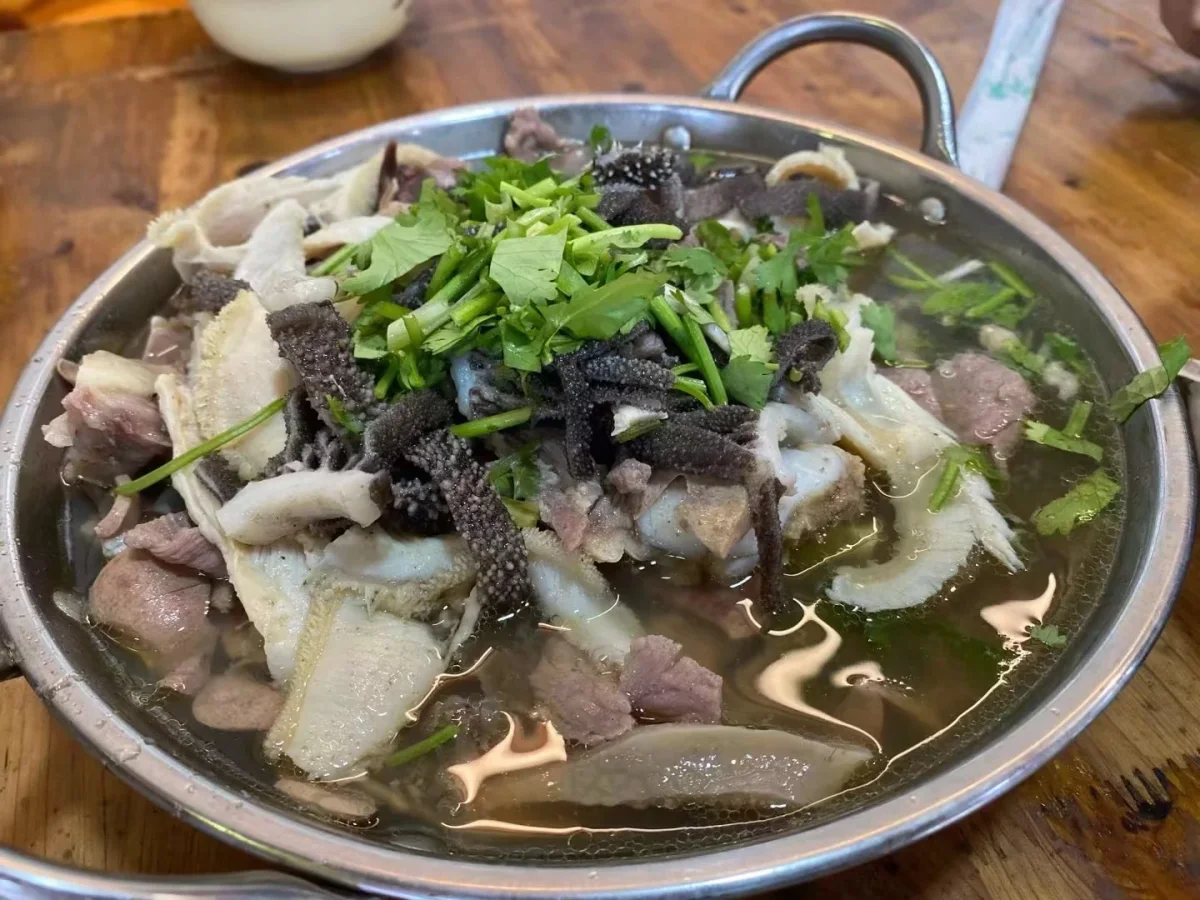
The dish is mostly offal, in a clear, mild soup, with chilli on the side for dipping.
It arrives as a wide steel pot or a deep bowl of pale, slightly cloudy soup, heaped with thin slices of beef and a jumble of offal: grey-white strips of tripe, black frilled tripe, honeycomb tripe, tongue, liver and short lengths of intestine, everything topped with a handful of chopped coriander. Each person gets a small dish of coarse red chilli powder. You fish out a piece, dip it, eat it and then drink some of the broth.
Despite the Sichuan address, the soup is not spicy. It tastes of beef bone and ginger with a faint herbal note, and its job is to cook the meat and wash the chilli down. The heat and fragrance come from the dip, and many tables also order a bowl of rice and a stir-fried dish.
The cooking is simple, which is why there are so many shops. As Sichuan Daily described it in 2021, there are three steps: make the broth, put in the meat, poach. A big pot and a table make a restaurant.
02
Why “feet up”
The name describes how people ate it.
跷脚 means “with a foot raised.” The usual explanation is that the first places selling it were too poor for stools. Customers stood at a square table, bowl in hand, and rested one foot on the wooden crossbar beneath it, In another version, it was first sold at the roadside as fast food, with nowhere to sit. Shops write the name both as 跷脚 and 翘脚.
In the late Qing dynasty, the story goes, a local herbal doctor named Zhou Tianshun collected the beef offal that wealthy households threw into the river, washed it and simmered it in a pot with medicinal herbs, and gave it to poor families. The broth was fragrant and thought to keep illness away, and the dish spread.
This is the story told in Suji. China Daily, retelling it in English in 2025, adds that the dish caught on with the dockworkers of the river town because it was cheap and full of flavour.
03
The broth: bones, ginger and twenty-odd herbs
Everything depends on the soup.
Shops start with beef bones, a lot of them. In 2025 one Leshan shop used about 100 jin of bones, some 50 kilograms, for 300 jin of water, and went through about three tonnes of bones a month. Ginger goes in generously, along with a cloth bag of spices and Chinese herbs: Sichuan Daily reported in 2021 that one well-known shop uses 21 of them. Cloves are used sparingly, because too many spoil the broth. The herbs are meant to sit in the background; in a good pot you smell beef and ginger, and barely taste the spice bag.
The broth needs at least four hours before it can be used, and the most careful shops give it eight. In front of a busy shop there are usually three big pots: one of old stock, one of fresh broth, and the working pot where the meat is poached. Every portion poached thins the working pot a little, so it is topped up from the other two through the day.
04
Water buffalo offal and yellow-cattle beef
The meat that matters most comes from water buffalo.
Suji’s shops traditionally slaughtered water buffalo, the working animal of the rice fields around Leshan. When one Suji brand opened in Chengdu and tried using local yellow cattle to save money, the beef came out less juicy, and it went back to having fresh meat trucked up from Leshan. Some cooks split the difference: that Leshan shop in 2025 used yellow-cattle meat, which it thought tastier, but water-buffalo offal, especially the liver, which stays crisp rather than melting.
A typical pot holds sliced beef and a mix of offal. Menus list each part separately so you can choose: 毛肚 black frilled tripe, 千层肚 white leaf tripe, 金钱肚 honeycomb tripe, 牛舌 tongue, 黄喉 aorta, 牛肝 liver, 肠 intestine, 胸膘 brisket fat that turns crunchy, 脑壳肉 head meat full of gelatin. Each needs a different time in the broth, so cooks put the meat in first and the tripe at the last moment. Some shops coat the beef slices in a little starch to keep them tender. The tripe comes in fresh every morning.
05
The four classic dishes
A qiaojiao beef shop lives on four dishes.
Sichuan Daily called these the “four pieces” that can keep a shop going. At that Leshan shop in 2025 the liver was fried for about ten seconds in plenty of rapeseed oil and served so pink it still looked raw, crisp rather than soft. The dry chilli dip is the fifth piece. Made the old way, the powder is coarser than machine-ground, so the chilli keeps its fragrance.
| Dish | What it is |
|---|---|
| 涮牛肉 / 牛杂, poached beef and offal | The pot itself: slices of beef and offal in the bone and herb broth |
| 冒血旺, poached blood curd | Cubes of blood curd in a red, numbing, salty broth, soft as tofu pudding |
| 蒸牛肉, steamed beef | Beef coated in seasoned rice meal and chilli, steamed in small bamboo steamers |
| 油爆牛肝, flash-fried liver | Thin slices of crisp buffalo liver fried for seconds with chilli, Sichuan pepper and scallion |
| 海椒面, dry chilli dip | Coarsely ground dried chilli, sometimes with Sichuan pepper and salt, for dipping |
06
Suji: a town named for a dish
Suji sits on the road between the Leshan Giant Buddha and Mount Emei, and its food has made it a destination of its own.
Suji is an old market town on the Emei River, about 12 kilometers from the Giant Buddha and 21 from Mount Emei, and was once the starting point for pilgrims walking to the mountain. In 2021 it had about 40,000 people and around a hundred qiaojiao beef shops, most of them run by married couples and named after a family or a place. Some go back generations: Gushixiang was founded by its present owner’s grandmother about seventy years before.
Recognition followed. The dish entered Leshan’s list of intangible heritage, and in 2023 the craft of making it was added to Sichuan’s provincial list. The local government has since spent heavily on turning Suji into what China Daily called the first town in Sichuan named after a dish, with more than 80 qiaojiao beef restaurants and a heritage museum in a restored Qing courtyard house, where old stoves, copper pots and broth tools are on show. In the first seven months of 2025 the town received more than 6.3 million visitors, and the flagship of one large chain served 6,000 to 7,000 customers a day at the peak.
07
Qiaojiao beef at home
A scaled-down version for a family pot.
About 2 kg beef bones (marrow and knuckle) and 6 litres of water; a large piece of ginger, smashed; a small spice bag of star anise, a little cassia, a few cloves, Sichuan pepper and dried tangerine peel; 300 g beef shin or brisket, 300 g mixed tripe (black and white leaf tripe, honeycomb tripe) and 150 g liver, all sliced thin; salt; coriander; coarse dried chilli powder and a little ground Sichuan pepper for the dip.
- 1. Blanch and simmer
Blanch the bones, rinse them, then cover with fresh water, add the ginger and spice bag and simmer gently for at least four hours, skimming. Season lightly with salt.
- 2. Prepare the dip
Toast dried chillies in a dry pan until fragrant, then crush or pound them coarsely; mix with a little ground Sichuan pepper and salt.
- 3. Poach in order
Bring a pot of the broth to the table on a burner. Poach the beef slices first, then liver and intestine, and the tripe last, for just 10 to 20 seconds.
- 4. Serve
Ladle meat and broth into bowls, scatter coriander, and dip each piece in the chilli.
Spices should stay in the background; if the broth tastes of cloves, use fewer next time. Ask a butcher for fresh tripe already cleaned.
08
How to order it
Choose your parts, then add the side dishes.
Pick a pot or pick parts
Some shops sell a mixed pot by size, a small one was 68 yuan in Leshan in 2025; others price each part separately, about 15 to 18 yuan a plate in 2022.
Add the classics
Order steamed beef, blood curd and the flash-fried liver alongside, with rice.
Go early
Fresh offal arrives in the morning; locals eat it for breakfast and lunch.
Mind the dip
The soup is mild; ask for less chilli in the dip if you do not want the heat.
Drink the soup
The broth is meant to be drunk; finish the pot with a bowl of it.
09
More from Leshan and Sichuan
Other pages on the atlas.
Bobo chicken
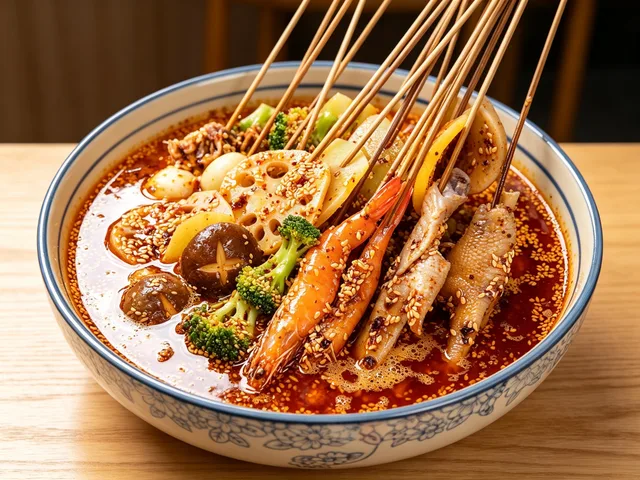
Leshan’s skewers in a cold bowl of chilli oil.
Read about bobo chicken →Sichuan hot pot
The spicy, tallow-based hot pot of Chengdu and Chongqing.
Read about Sichuan hot pot →Chaoshan beef hot pot
Another beef pot, built on freshly cut beef and a clear broth.
Read about Chaoshan beef hot pot →Sichuan food
Leshan, Chengdu, Zigong and Yibin on one map.
Explore Sichuan →Sichuan classics
- Guangyuan Steamed Rice Noodles
Steamed rice-sheet noodles · Breakfast
- Sichuan Hot Pot
Hot pot · Shared meal
- Mapo Tofu
Tofu dish · Lunch or dinner, with rice
- Dan Dan Noodles
Small dressed noodles · Snack
- Bobo Chicken
Cold skewers · Snack
- Jiangyou Intestines
Pork intestines, braised and cold-dressed · Breakfast and lunch with rice
FAQ
Questions about Leshan Qiaojiao Beef
What is qiaojiao beef?
A Leshan dish of beef and offal poached in a long-simmered broth of beef bones, ginger and herbs, served in the soup with coriander and eaten with a dip of dry chilli powder.
Why is it called “feet-up” beef?
The first places selling it had no stools; customers stood at the table and rested a foot on the crossbar underneath.
Is qiaojiao beef spicy?
The soup is not. The heat comes from the dry chilli dip, which you can use as much or as little as you like.
What parts of the cow are in it?
Sliced beef plus offal: several kinds of tripe, tongue, aorta, liver, intestine, brisket fat and head meat. Many shops let you choose each part.
Where is the best place to eat it?
Suji old town in Leshan’s Shizhong district, between the Leshan Giant Buddha and Mount Emei, where it began and where there are more than 80 shops.
How much does it cost?
In Suji about 30 to 50 yuan a head in 2021; parts were about 15 to 18 yuan a plate in 2022, and a small mixed pot was 68 yuan in 2025.
How is it different from Sichuan hot pot?
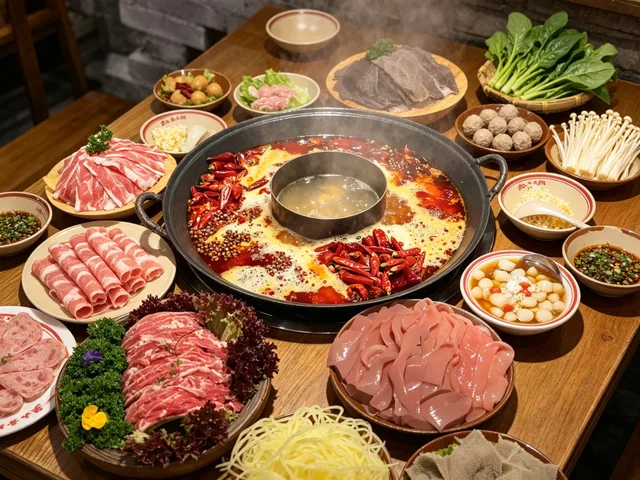
Sichuan hot pot cooks in a spicy beef-tallow broth at the table; qiaojiao beef uses a clear, mild bone and herb broth, usually with the meat poached in the kitchen, and the chilli comes as a dip.
Sources
Sources and further reading
- 1 Wang Fei and Zeng Xiaoqing, Suji qiaojiao beef: an intangible heritage dish and its new life (2021) (in Chinese)Sichuan Daily, Chuanguan News (in Chinese) ↗
- 2 Lu Xingyu, Suji old town: heritage food draws visitors (2025) (in Chinese)Sichuan Daily, Chuanguan News (in Chinese) ↗
- 3 Leng Runyu, Suji renewed: the qiaojiao beef heritage museum and the old town at night (2026) (in Chinese)Sichuan Daily, Chuanguan News (in Chinese) ↗
- 4 Peng Chao and Zhao Junfeng, Local cuisine boosts Sichuan tourism (2025)China Daily ↗
- 5 How qiaojiao beef got its name: bone broth, tripe and liver in Leshan (video, in Chinese)CCTV Documentary (央视纪录), Bilibili (August 2022) ↗
- 6 Suji qiaojiao beef from a heritage practitioner: eight hours of broth (video, in Chinese)Dashi de Cai (大师的菜), Bilibili (September 2021) ↗
- 7 A chef eats at Feng Si Niang qiaojiao beef in Leshan: 169 yuan for three (video, in Chinese)Zhentan Tang Renjie (真探唐仁杰), Bilibili (May 2022) ↗
- 8 Yellow-cattle bones and buffalo offal: 100 jin of bones for 300 jin of broth in Leshan (video, in Chinese)Nanjing Zhou Xiaojiu (南京舟小九), Bilibili (January 2025) ↗
Last updated November 2026