
01
Rice sheets, steamed and cut
Guangyuan steamed rice noodles are sheets of steamed rice batter cut into ribbons and dressed warm with chilli oil, garlic water and soybean sprouts.
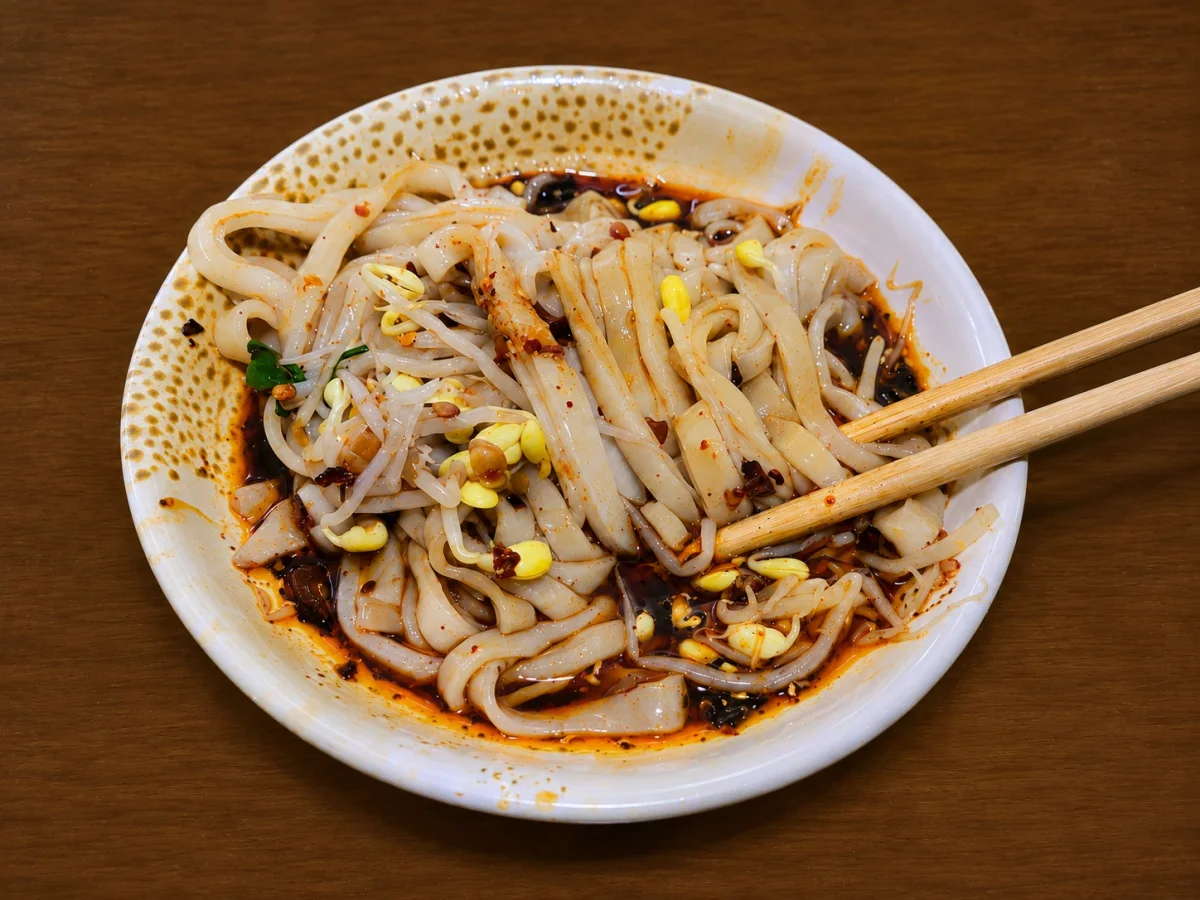
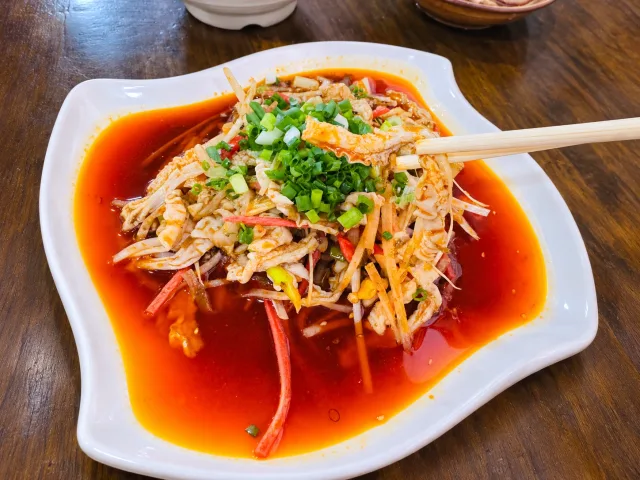
A bowl comes to the table as broad, flat, slightly translucent ribbons folded over one another, glossy with oil, a tangle of soybean sprouts with their yellow heads on top, a little coriander, and a pool of red chilli oil and dark sauce at the bottom of the bowl, waiting to be stirred through.
The ribbons are made of rice, not wheat. Local rice is soaked and ground with water into a thin slurry, which is poured onto a cloth stretched over a steamer and steamed for a minute or two into a sheet. The sheet is turned out onto a board, the cloth peeled away, the surface brushed with oil, and the sheets are stacked and cut, thin or wide, to order. The texture is soft and slightly sticky, with a gentle spring, smoother than wheat noodles.
They are served warm or at room temperature, and the name is a standing joke: Guangyuan’s “cold noodles” are neither cold nor noodles. Locals often call them hot liangmian, 热凉面, to make the point.
02
Chilli oil, garlic water and soybean sprouts
The seasonings are few, and each shop is judged by them.
The dressing is simple: chilli oil, soy sauce, salt, a little MSG, and garlic water, crushed garlic steeped in water, which gives garlic flavour without raw bite. Many shops add a ladle of their own cooked seasoning liquid, and some a pinch of sugar and scallion, pickled green chillies or fried peanuts.
The chilli oil is where shops compete. Each has its own recipe; some aim for fragrance, others add chopped fresh chilli, but none is very hot, because the chillies are mostly mild, fragrant erjingtiao. In the best bowls, stirring turns the chilli oil into a thick red paste that clings to every ribbon instead of sliding off.
Then the soybean sprouts, 黄豆芽, blanched and dropped in by the handful. They add crunch and a nutty, beany flavour against the soft rice, and Guangyuan people call them the soul of the dish.
On one Guangyuan street in 2019 three liangmian shops stood side by side, each calling itself the original Lao Sun liangmian, and each bowl was different: one finished with a little sugar and scallion, at another the noodles needed longer in the dressing to take up the flavour, and a third shop, run by the Zheng family, added pickled green chilli and ground pepper.
| Ingredient | What it is | Role |
|---|---|---|
| 米凉面 rice ribbons | Steamed rice-batter sheets, cut | Soft, slightly springy base |
| 红油 chilli oil | Mostly mild erjingtiao chillies | Fragrance more than heat |
| 蒜水 garlic water | Crushed garlic steeped in water | Garlic without raw bite |
| 料水 seasoning liquid | Each shop’s cooked sauce | Salt and depth |
| 黄豆芽 soybean sprouts | Blanched sprouts | Crunch and bean fragrance |
03
Breakfast, and the last bowl of the night
In Guangyuan the day starts and ends with liangmian.
Breakfast in Guangyuan means a bowl of steamed rice noodles. By local custom, a Guangyuan person’s day begins with a bowl of liangmian and ends with a bowl of night liangmian; people take one with them when they leave home and eat one as their first meal when they come back. There are more than 3,000 liangmian shops in the city, which together employ nearly ten thousand people.
The shops are small, often with the steamer working in the open at the front, one every few dozen metres, and the best are sold out before noon. A bowl usually comes with something to drink: a thick soy-milk rice porridge, 豆浆稀饭, corn porridge or red-bean porridge. Many people add steamed buns, filled with preserved vegetable or pork, and a dish of pickles. The combination is the point: the salty pickles and sour radish are too sharp to eat alone and the soy-milk porridge too heavy, but together, with the chilli-slicked noodles, they balance. Most shops will make your noodles hot or cold.
By 2024 there were black-rice liangmian, extra-wide liangmian and scalding-hot versions alongside the classic white bowl.
04
The empress’s noodles
Guangyuan ties its noodles to its most famous daughter.
Guangyuan is the home town of Wu Zetian, the only woman to rule China as emperor in her own name, and the noodles are sold as 女皇蒸凉面, the empress’s steamed liangmian. A popular legend says that the young Wu, her childhood sweetheart and the owner of a noodle shop worked out how to make smooth, non-sticky rice noodles together one summer, and that the shop owner, seeing the two delighted children hug, named them husband-and-wife rice noodles. It is a story, not history, and even those who tell it admit it is unproven.
The official version is grander. When Sichuan approved a skills standard for the dish in 2026, the province described it as an iconic snack of northern Sichuan carrying more than 1,300 years of food culture, and noted that its making is on the provincial list of intangible cultural heritage.
Guangyuan sits on Sichuan’s northern border with Shaanxi, and just across the hills Hanzhong has its hot mianpi and Ankang its steamed noodles, made with the same steamers and cloths, and almost the same. Guangyuan’s liangmian, Hanzhong’s hot mianpi and Ankang’s steamed noodles are close relatives.
05
What it costs
Breakfast here costs less than 10 yuan.
A small bowl cost 4 yuan in 2021 and 2022 and a large one 5; in 2026 the smallest bowl was still 4 yuan, with 5- and 6-yuan bowls for bigger appetites. Bowls are sized small and large, not weighed by the liang as noodles are in Chengdu and Chongqing. With porridge and a couple of buns, breakfast costs well under 10 yuan.
06
Steamed rice noodles at home
A shallow tin and a wok of boiling water will do.
For 3 to 4: 500 g long-grain rice, not sticky; 500 ml water and 250 ml boiling water; oil for brushing; 150 g soybean sprouts; 3 cloves garlic, crushed and steeped in 3 tablespoons water; light soy sauce, salt, a pinch of sugar, Sichuan pepper powder, vinegar, sesame oil; 4 tablespoons chilli oil with its sediment; chopped scallion. An 8-inch metal tin or pizza pan and a wok or steamer.
- 1. Soak and grind
Wash the rice several times, then soak it at least 6 hours. Blend with 500 ml water until very fine, two or three times, and strain. Stir in the boiling water and leave 10 to 20 minutes.
- 2. Steam
Oil the tin, pour in a thin layer of slurry and swirl it level. Set the tin over fiercely boiling water, cover and steam 1 to 1½ minutes, until the sheet puffs up.
- 3. Peel and cut
Cool the base of the tin in cold water, peel the sheet off, brush it with oil and stack. Repeat, then cut the stack into ribbons 1 cm wide.
- 4. Dress
Blanch the sprouts and put them in the bowls. Add the warm ribbons, then soy, salt, sugar, Sichuan pepper, a little vinegar, garlic water, sesame oil, chilli oil and scallion. Stir well.
Old, less sticky rice gives the best texture; glutinous rice makes the sheets gummy.
07
How to order it
Go early and ask for it hot.
Hot or cold
Say 热的 for warm noodles straight from the steamer.
Size
Small, 小碗, or large, 大碗; 4 to 6 yuan.
With it
A bowl of soy-milk porridge and a steamed bun.
Heat
The chilli oil is mild; ask for 多放辣椒 if you want more.
When
Breakfast, before the best shops sell out, or late at night for a bowl of night liangmian.
08
More from Sichuan
Other pages on the atlas.
Jiangyou intestines
Another northern Sichuan town and its signature dish.
Read about Jiangyou intestines →Liangpi
Shaanxi’s cold steamed noodles, the cousin across the hills.
Read about liangpi →Sichuan cold rabbit
Rabbit dressed in chilli oil and black beans.
Read about Sichuan cold rabbit →Sichuan food
From Chengdu snacks to the northern hills.
Explore Sichuan →Sichuan classics
- Leshan Qiaojiao Beef
Beef and offal in herbal bone broth · Breakfast or lunch, shared pot
- Sichuan Hot Pot
Hot pot · Shared meal
- Mapo Tofu
Tofu dish · Lunch or dinner, with rice
- Dan Dan Noodles
Small dressed noodles · Snack
- Bobo Chicken
Cold skewers · Snack
- Jiangyou Intestines
Pork intestines, braised and cold-dressed · Breakfast and lunch with rice
FAQ
Questions about Guangyuan Steamed Rice Noodles
What are Guangyuan steamed rice noodles?
Sheets of steamed rice batter cut into ribbons and dressed warm with chilli oil, garlic water, seasoning and soybean sprouts.
Why are they called cold noodles if they are hot?
The name liangmian is traditional; they are usually served warm or at room temperature, so locals also call them hot liangmian.
Are they made of wheat?
No, of rice, soaked, ground and steamed, so they are naturally wheat-free; check the sauces if you need to avoid gluten.
Are they spicy?
Mildly. Guangyuan chilli oil is mostly fragrant erjingtiao chilli.
How much do they cost?
About 4 yuan for a small bowl and 5 to 6 yuan for a large one in 2021 to 2026.
Did Wu Zetian really invent them?
That is a legend. Guangyuan was her home town, and the dish is sold as the empress’s steamed liangmian.
How are they different from liangpi?
They are close cousins; Guangyuan’s are made of rice, usually eaten warm, and dressed with soybean sprouts and garlic water.
Sources
Sources and further reading
- 1 “Noodles” made of rice: the bowl Guangyuan people love (in Chinese)Zhang Min, Sichuan Online / Sichuan Daily (11 July 2024) ↗
- 2 Shu brocade, sugar art, steamed liangmian: official standards for Sichuan crafts (in Chinese)National Business Daily, from the Sichuan Department of Human Resources and Social Security (17 April 2026) ↗
- 3 Hot liangmian: undisputed number one among Guangyuan snacks (video, in Chinese)Yutian Riji (雨田日记), Bilibili (May 2026) ↗
- 4 Guangyuan liangmian, “invented by Wu Zetian” (video, in Chinese)Mizijun (密子君), Bilibili (December 2019) ↗
- 5 Guangyuan liangmian is neither cold nor noodles (video, in Chinese)Ge Shixian (午餐肉艺术家葛世贤), Bilibili (April 2022) ↗
- 6 Guangyuan hot liangmian: like liangpi but quite different, 5 yuan a bowl (video, in Chinese)Xunyou Guiji (巡游轨迹), Bilibili (May 2021) ↗
- 7 Steamed rice noodles at home: called zhengmian in Jiangyou and liangmian in Guangyuan (video, in Chinese)Zhou Zhou Ai Zuofan (周周爱做饭a-), Bilibili (February 2023) ↗
Last updated November 2026