
01
A town that eats intestines for breakfast
Fresh intestines reach Jiangyou’s shops at six in the morning, and the first bowls go out at breakfast.
Jiangyou sits in the hills of northern Sichuan, in Mianyang prefecture. Most visitors come for Li Bai, the Tang poet who grew up in Qinglian, just outside town. Sichuan people come for the intestines. Jiangyou is a 150-kilometre drive from Chengdu, and in 2022 there were three intestine shops within fifty metres of one another; the town’s reputation was sealed by the food writer and documentary maker Chen Xiaoqing, who called Jiangyou the world’s hometown of intestines and told how he once kept eating his bowl alone in an empty restaurant while an aftershock shook the town.
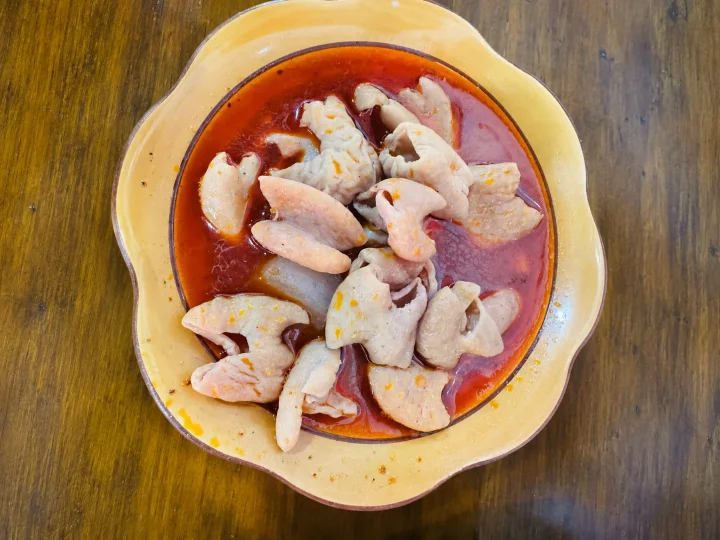
The dish is ordinary people’s food, made rich. Pork intestines, cleaned and cut into short lengths, are fried hard in oil with dried chilli, Sichuan pepper and warm spices, then simmered in stock until soft, glossy and red. The result is heavy and fragrant, with a soft, slightly springy bite and very little smell. Like Chongqing hot pot, it began as a home dish of ordinary people.
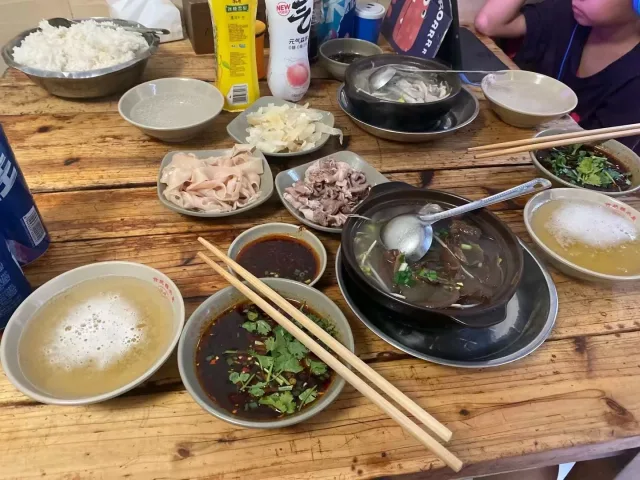
Jiangyou people eat it from the moment shops open. The standard order is three bowls: intestines, plain rice and a sour soup of vinegar, ginger and scallion that rinses the fat from the mouth.
02
Cleaning: the job before dawn
Everything depends on how the intestines are washed, and how much fat is left on.
In Jiangyou, washing intestines is a trade of its own. One shop in 2022 took delivery at six in the morning; the intestines were rubbed again and again with salt, vinegar and baijiu, the thick head end cut off and cleaned separately, and everything blanched in boiling water before a row of women with cleavers spent an hour and a half cutting 150 kilograms into short pieces.
Sichuan cookbooks describe the same work. A 1960 national cookbook rubs the intestines hard with salt, washes off the slime, turns them inside out to pick off any dirt clinging to the fat, and repeats until they are white, slightly rough to the touch and free of smell; a 2001 Sichuan home cookbook adds a scrub with powdered alum. Both insist on one thing: the fat inside stays. Clean off all the fat and what is left eats like rubber bands.
03
Red-braised intestines over radish
The signature is 红烧肥肠, red-braised intestines.
Red-braised intestines are made in big pots and kept warm all day. The spices used in Jiangyou are Sichuan pepper and dried chilli, star anise, garlic and ginger, cassia, black cardamom, sand ginger and bay leaf, fried hard in plenty of oil with the intestines before stock goes in and the pot simmers until the pieces are soft and the sauce is red and glossy. A 2001 Sichuan cookbook gives an older home method: sugar is caramelised in lard to colour the intestines, then they simmer with ginger, scallion and Sichuan pepper, with a heap of garlic cloves added near the end.
In Jiangyou the intestines are served over chunks of white radish that have soaked up the sauce. In 2021 a large bowl cost 60 yuan, and some locals like the radish better than the meat. The pot stays warm beside the stove, and the longer it sits, the deeper the flavour.
04
Cold-dressed, dry-fried, steamed: forty ways with one ingredient
One Jiangyou shop in 2022 made more than forty intestine dishes.
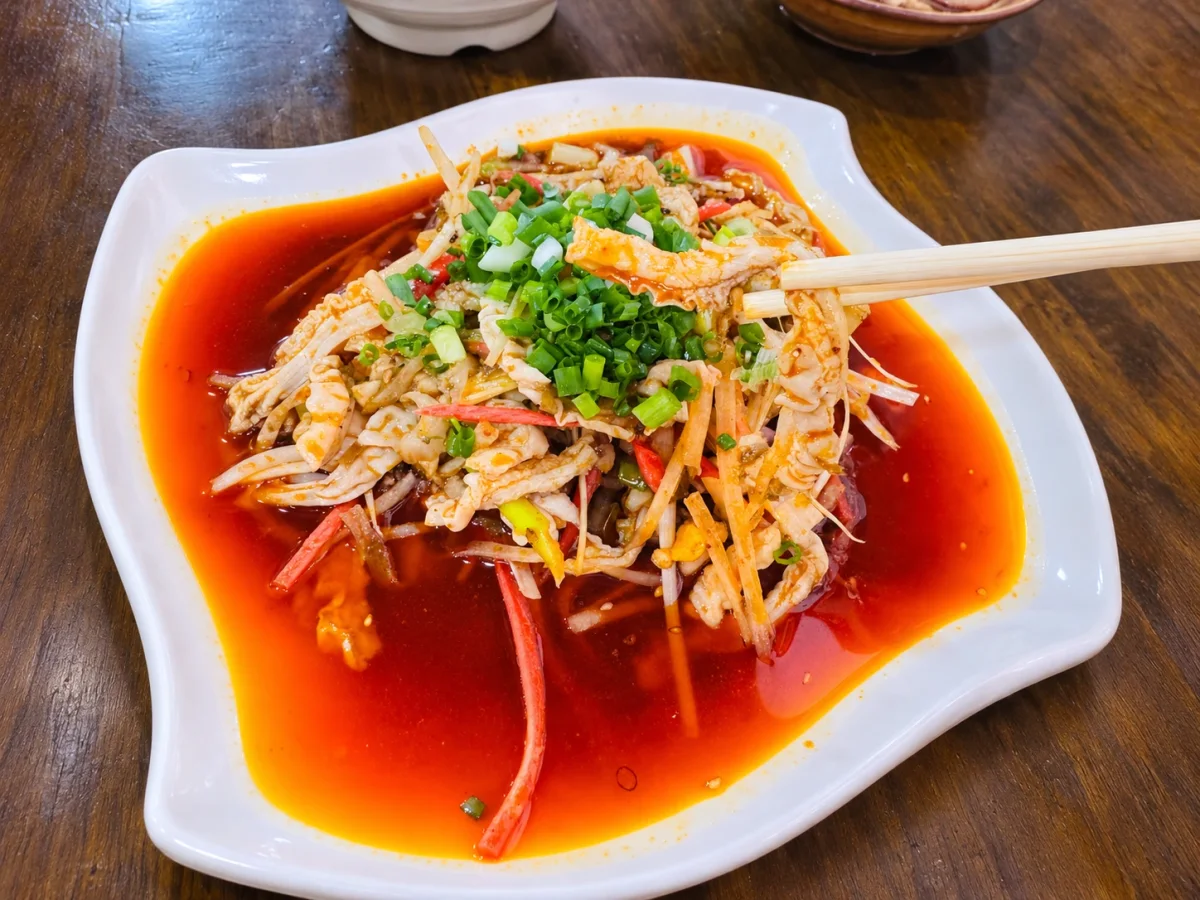
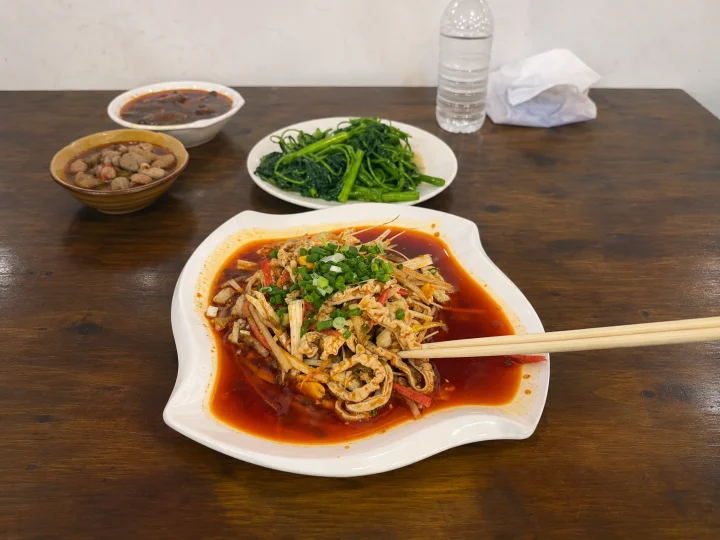
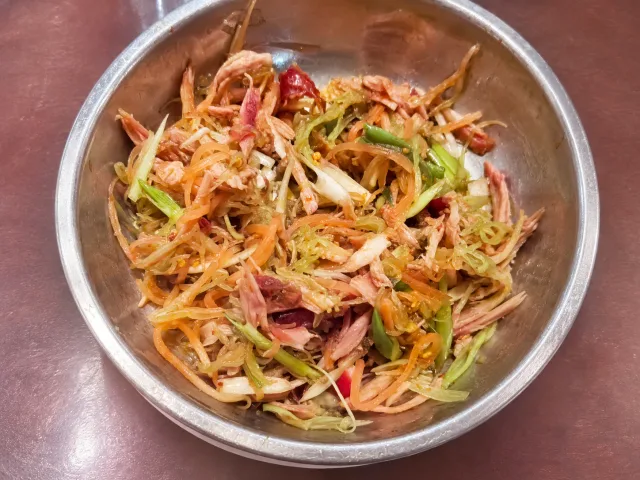
For the cold-dressed version, boiled intestines are cut into strips and piled over thin white celery stems, then covered in chilli oil, vinegar, garlic and sesame, to be tossed together at the table; the result is springy, sour and hot rather than greasy. In 2021 it was hard to find anywhere outside Jiangyou. Dry-fried intestines go the other way, fried until the rings are crisp and dry like a snack.
Sichuan’s old intestine soup survives too. A 1960 national cookbook records a banquet version developed from the street snack “intestine soup”: intestines steamed for three hours, then simmered in a soup of mashed dried peas fried in lard and chicken stock.
| Dish | How it is made | What it is like |
|---|---|---|
| 红烧肥肠 red-braised | Fried with chilli and spices, simmered in stock | Soft, glossy, red; over radish |
| 凉拌肥肠 cold-dressed | Boiled, sliced, tossed with chilli oil, vinegar, garlic and sesame over celery | Springy and sour-hot; rare outside Jiangyou |
| 干煸肥肠 dry-fried | Fried until the rings are crisp and dry | Crunchy, the hottest dish on the table |
| 粉蒸肥肠 steamed in rice meal | Coated in spiced rice meal and steamed | Soft; eaten with red oil and raw garlic |
| 清炖肥肠 / 肥肠汤 clear-simmered | Simmered in clear broth, sometimes with mashed peas | Mild; Sichuan’s old “intestine soup” |
More from the same table
Our own photographs of Jiangyou intestines: in chilli oil, and dressed cold beside the side dishes.
05
Rice, vinegar soup and the side dishes
An intestine shop is also a small canteen.
The vinegar soup is the essential partner: hot water sharpened with vinegar, ginger and scallion, drunk between mouthfuls to cut through the fat. Shops also keep steamed dishes and soups: 烧白, slices of pork belly steamed over preserved mustard greens, steamed ribs in rice meal, cold boiled pork, meatball soup and kelp soup. At one Jiangyou shop in 2021, rice, chicken soup and pickles came to 3 yuan a person, refills included.
Why intestines for breakfast? The explanation given in Jiangyou is practical: farmers in the hills north of town needed a cheap, filling meal before a day of heavy work.
06
Lengzhanzhan: toothpicks and dipping sauces
Jiangyou’s other gift to Mianyang is a table of cooked bites on toothpicks.
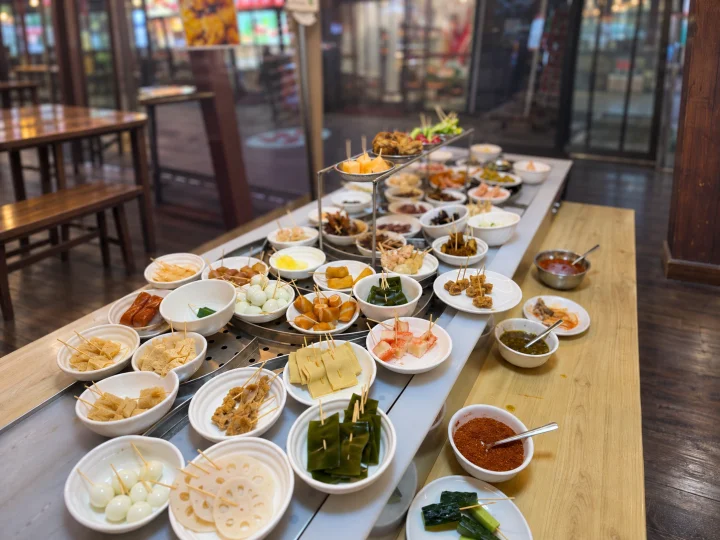
Lengzhanzhan, 冷沾沾, “cold dip-dip,” began in Jiangyou and is now eaten all over Mianyang, where it holds the place that bobo chicken holds in Leshan. A counter is laid with dozens of bowls of cooked food, each piece on a toothpick: quail eggs, kelp knots, lotus root, tofu skin, sausage, fish tofu, gizzards, crab sticks, broccoli, potato. You sit at a shared table, often with strangers, take what you like and dip it into communal bowls of sauce: a “three-fresh” savoury dip, mala or peanut sauce.
At the end you pay by counting toothpicks, 5 mao each at one Jiangyou street stall in 2023, where four people ate for 8.5 yuan. Small spring rolls of shredded potato and kelp are rolled to order.
A lengzhanzhan counter
Our own photograph of a lengzhanzhan counter: dozens of bowls of cooked bites on toothpicks, with dipping sauces alongside.
07
Red-braised intestines at home
This combines the 2001 Sichuan home method with the Jiangyou spices.
1 kg cleaned pork large intestine (from a Chinese butcher), salt, a little white vinegar or baijiu; 3 tablespoons lard or oil; 30 g sugar; 10 dried chillies, 1 teaspoon Sichuan pepper, 2 star anise, a piece of cassia, 1 black cardamom, 2 bay leaves; 1 tablespoon Pixian chilli bean paste (optional); 50 g ginger and scallion; 1 litre stock or water; 300 g white radish in chunks; a head of garlic, peeled; coriander.
- 1. Clean
Rub the intestines with salt and vinegar, rinse, turn inside out and pick off any dirt without stripping the fat; repeat until they smell clean. Blanch 10 minutes, then cut into 3 cm pieces.
- 2. Colour
Melt the sugar in the fat until amber, add the intestines and stir until coated and browned. Add chillies, Sichuan pepper, spices, ginger, scallion and bean paste and fry hard for 2 to 3 minutes.
- 3. Simmer
Add the stock, bring to the boil, skim and simmer covered about an hour, until tender. Add the radish and garlic for the last 25 minutes.
- 4. Serve
Season with salt, reduce until glossy, and serve over the radish with coriander, rice and a bowl of hot water with vinegar, ginger and scallion.
Intestines vary a lot; test with chopsticks and cook longer if they are still tough.
08
How to order it
Go early, order the set, add one other style.
The set
Order red-braised intestines with rice and vinegar soup; add a cold-dressed or dry-fried plate if there are two or more of you.
Go in the morning
Jiangyou shops start serving at breakfast; the pots are freshest early.
Prices
About 30 yuan a head with side dishes in 2021; a big bowl of braised intestines 60 yuan.
Outside Jiangyou
Mianyang city has many Jiangyou-style intestine shops if you cannot make the trip.
For a snack
Lengzhanzhan stalls charge by the toothpick; sit down, dip and count your sticks.
09
More from Sichuan
Other pages on the atlas.
Bobo chicken
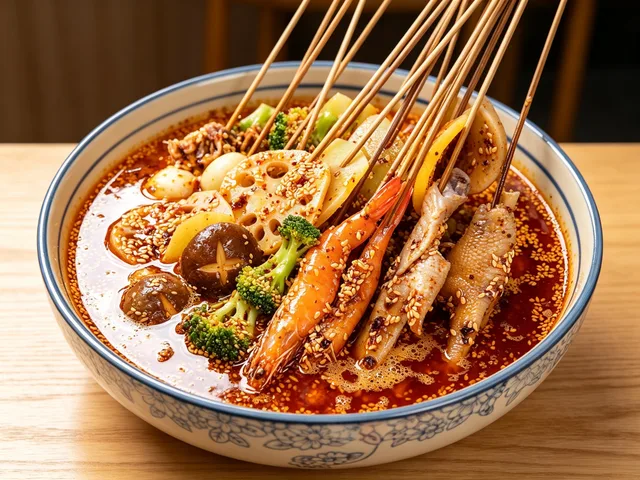
Leshan’s skewers in chilli oil, cousin of lengzhanzhan.
Read about bobo chicken →Leshan qiaojiao beef
Another Sichuan offal pot, in herbal broth.
Read about qiaojiao beef →Fuqi feipian
Chengdu’s cold-dressed beef and offal.
Read about fuqi feipian →Sichuan food
Chengdu, Leshan, Zigong and beyond.
Explore Sichuan →Sichuan classics
- Zigong Dipping-Sauce Dishes
Boiled meats with chili dip · Lunch or dinner with rice
- Sichuan Cold Rabbit
Cold dressed rabbit · Cold dish with rice or beer
- Sichuan Hot Pot
Hot pot · Shared meal
- Mapo Tofu
Tofu dish · Lunch or dinner, with rice
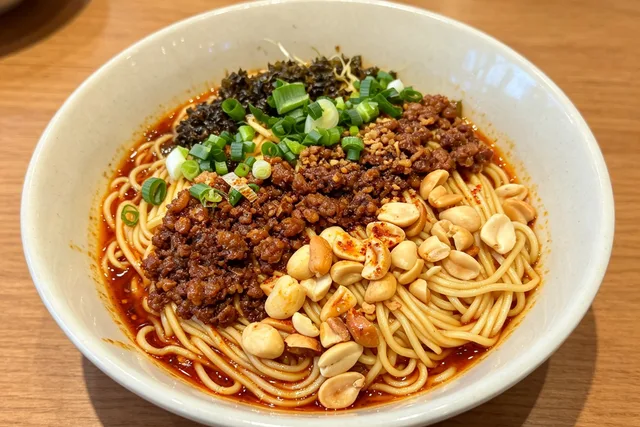
- Dan Dan Noodles
Small dressed noodles · Snack
- Bobo Chicken
Cold skewers · Snack
Rice dishes from other regions
FAQ
Questions about Jiangyou Intestines
What are Jiangyou intestines?
Pork large intestines cooked in many ways in Jiangyou, Sichuan, most famously red-braised with chilli and spices over radish, eaten with rice and vinegar soup.
Do they smell?
Well-cleaned intestines have very little smell; Jiangyou shops wash them with salt, vinegar and baijiu and blanch them before cooking.
Why do people eat them for breakfast?
It is local habit; the usual explanation is that farmers needed a filling meal before heavy work, and shops open early to serve it.
What is the vinegar soup?
Hot water seasoned with vinegar, ginger and scallion, drunk with the intestines to cut the fat.
Are they very spicy?
Red-braised intestines are rich and moderately hot; dry-fried ones are the hottest; the cold-dressed version is sour and hot.
What is lengzhanzhan?
A Jiangyou snack of cooked bites on toothpicks, dipped in shared sauces and paid for by counting the sticks.
Where is Jiangyou?
In Mianyang, northern Sichuan, about 150 km from Chengdu; Li Bai grew up at Qinglian nearby.
Sources
Sources and further reading
- 1 Mianyang food in spring: Mianyang rice noodles, Jiangyou intestines and lengzhanzhan (2022) (in Chinese)Feekr Travel, via Sina Fashion (in Chinese) ↗
- 2 Famous Chinese Dishes, vol. 7: Sichuan (中国名菜谱·第七辑), p. 53: intestine and mashed pea soup, with the cleaning method (in Chinese)Light Industry Press (1960), indexed by laocp.tech ↗
- 3 Everyday Sichuan Cooking (大众川菜), p. 142: intestines braised with garlic (in Chinese)Sichuan Science and Technology Press (2001), indexed by laocp.tech ↗
- 4 Jiangyou intestines: a Jiangyou morning starts with a bowl (narrated short film) (in Chinese)Li Lihong (配音解说李立宏), Bilibili (August 2023) ↗
- 5 Jiangyou, where China eats the most intestines: washing, cutting and the breakfast set at Qinglian (video, in Chinese)Xueyu Tandian (雪鱼探店), Bilibili (January 2022) ↗
- 6 Li Bai’s hometown, the world capital of intestines: cold-dressed and dry-fried intestines (video, in Chinese)Chiguangba Jinzi (吃光吧金子), Bilibili (March 2021) ↗
- 7 Jiangyou intestines for about 30 yuan a head: braised intestines over radish, steamed pork and three-yuan rice and soup (video, in Chinese)Xiaobei E le (小贝饿了), Bilibili (November 2021) ↗
- 8 Jiangyou intestines, then lengzhanzhan at a shared table: toothpick skewers and dipping sauces (video, in Chinese)Yanbian Xiao Yang Yijia (延边小杨一家), Bilibili (November 2023) ↗
Last updated November 2026