
01
Poached, cooled, torn and dressed
The old Chengdu classic is diced rabbit with peanuts, 花仁兔丁, dressed with fermented black beans and chilli oil.
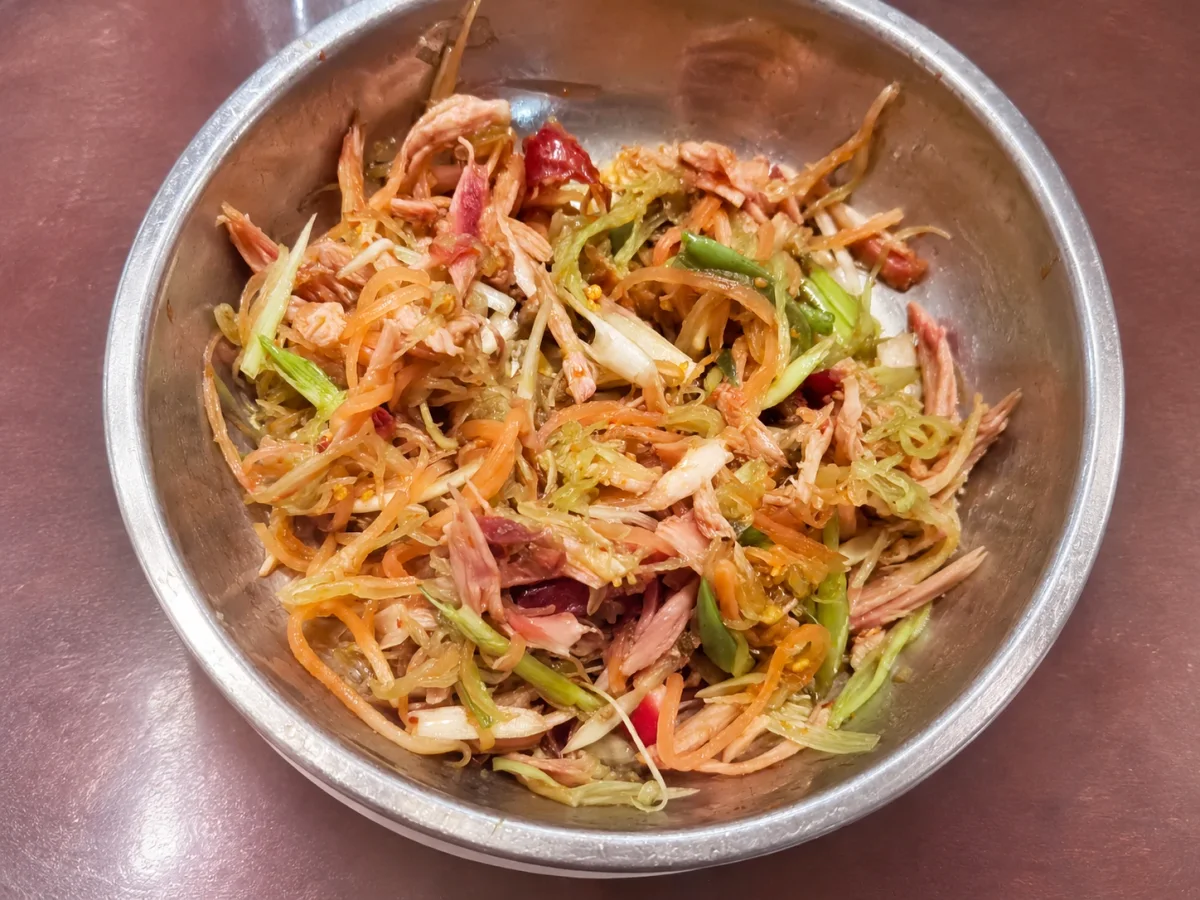
The bowl at the top of this page is the home version: a steel mixing bowl of rabbit pulled into shreds, 兔丝, and tossed with slivers of carrot and pale green vegetable, lengths of scallion, strips of green chilli and whole Sichuan peppercorns, all glossy with oil. It is the kind of dish a Sichuan family makes from half a rabbit and the contents of the vegetable basket.
Restaurants and stalls make it three main ways. Hand-torn rabbit, 手撕兔 or 凉拌兔, is pulled apart along the grain into ragged pieces that soak up the dressing. Diced rabbit, 兔丁, is chopped through the bone into small cubes, the form of the old Chengdu classic with peanuts. Shredded rabbit, 兔丝, as in our photograph, is pulled into fine threads.
The cooking is the simplest part. The rabbit is poached until just tender, with ginger, scallion and a few spices or with salt alone, and then cooled, so that the meat is firm enough to cut and stays moist.
02
“No rabbit gets out of Sichuan alive”
No other part of China eats rabbit like Sichuan.
Chinese internet users joke that no rabbit leaves Sichuan alive. The figures bear them out. According to the Sichuan Academy of Animal Science, quoted by the provincial paper Sichuan Daily in March 2026, the province raises a steady 180 million meat rabbits a year and eats about 200 million rabbits and more than 300 million rabbit heads, more than any other province on both counts. Sichuan eats more rabbits than it raises and buys in the rest.
Rabbit farming is now a serious industry, with breeds developed for meat. In 2026 a farm in Huaying, in eastern Sichuan, was raising Shuxing No. 1, 蜀兴1号, a meat rabbit bred with the provincial academy and the first in southwest China developed with its own intellectual property.
Besides the heads, more than 300 million a year, rabbit meat is sold cooked by the jin at street stalls, and cold dressed rabbit is the everyday way to eat it.
Sources [1]
03
Chilli oil, black beans and something crunchy
The dressing changes from stall to stall, but it is built from the same parts.
The base of most dressings is red chilli oil, 红油, made by pouring hot oil over ground chillies. For cold rabbit it is meant to be fragrant rather than fierce; at Chongqing stalls in 2024 it was not hot at all. Heat comes from fresh bird’s-eye chillies, 小米辣, added for those who ask, and numbing from Sichuan pepper, ground or as an oil.
Fermented black beans, 豆豉, are the second flavour of the classic Chengdu style. In Pixian, the town famous for chilli bean paste, a family shop that has dressed rabbit the same way for decades mixes douchi into its red oil. The old Chengdu recipe for rabbit with peanuts, 花仁兔丁, fries chopped Taihe douchi with a little chilli bean paste into a dark, savoury paste that coats each cube.
Then come the seasonings that balance it: garlic, a little vinegar, light soy sauce, a pinch of sugar, sesame oil, and plenty of chopped scallion and coriander. Finally something crunchy goes in: fried peanuts or fried peas, added at the last moment so they stay crisp. Stalls toss each order in a bowl in front of you and ask how strong you want it.
Home cooks are freer. The family-style bowl in our photograph has no peanuts at all but plenty of shredded vegetables and fresh green chilli, which make the dish go further and add crunch of their own.
| Style | Cut | Dressing |
|---|---|---|
| 手撕兔 hand-torn | Pulled into ragged pieces | Chilli oil, peas or peanuts, scallion, coriander |
| 红油兔丁 diced in red oil | Cubes on the bone | Chilli oil, garlic, soy, sugar, Sichuan pepper |
| 花仁兔丁 diced with peanuts | Cubes on the bone | Douchi and bean paste, chilli oil, peanuts |
| 豆豉红油兔 black bean and red oil | Torn or diced | Chilli oil with fermented black beans |
| 家常兔丝 home-style shreds | Fine shreds | Oil, fresh chilli, Sichuan pepper, shredded vegetables |
04
Bought by weight, dressed to order
Stalls sell cooked rabbit whole or by the half, by weight.
Across Sichuan and Chongqing, cold rabbit is sold from small counters at markets and on street corners. The cooked rabbits are laid out whole. You choose one, or ask for half, the stallholder weighs it, tears or chops it on the board, and tosses it with the dressing in a big bowl before packing it into a box or a bag.
You are asked two questions: how hot, and what to leave out. Mild, 微辣, or medium, 中辣, is the usual choice; extra bird’s-eye chilli, peanuts, peas, scallion and coriander are added or left out as you like. The belly meat is a favourite.
In 2025 a Pixian shop bought its rabbits fresh at the market every morning and sold a portion for a little over 30 yuan. The Chengdu stall that charged 88 yuan a jin in 2025 also sold diced rabbit in red oil.
05
What it costs
Prices vary with the city and with what is weighed.
At street stalls and country markets in Chongqing in 2024, dressed rabbit was 40 to 41 yuan a jin, half a kilogram; a whole rabbit came to between 80 and about 100 yuan. In Chengdu prices are higher: a street stall in 2025 charged 88 yuan a jin, and would sell half a rabbit. Plates in small restaurants cost a little over 30 yuan; a plate of diced rabbit with peanuts was about 38 yuan. Cooked rabbit was already selling for about 80 yuan a jin many years ago.
The bones are part of the eating: diced rabbit in particular is nibbled off small pieces of bone.
06
Diced rabbit with peanuts at home
This is the old Chengdu way with diced rabbit and peanuts, huaren tuding.
For 4: half a rabbit about six months old, about 800 g; ginger, 2 scallions, 1 tablespoon baijiu or Shaoxing wine, ½ teaspoon Sichuan peppercorns, 1 star anise; 60 g raw peanuts and oil to fry them; 20 g fermented black beans, chopped, and 10 g chilli bean paste; 2 cloves garlic, crushed; 2 scallions and a handful of coriander, chopped; 1 teaspoon vinegar, 1 tablespoon light soy sauce, 1 teaspoon sugar, 1 teaspoon sesame oil, ½ teaspoon Sichuan pepper oil and 3 tablespoons chilli oil with its sediment.
- 1. Poach
Blanch the rabbit with ginger, scallion and wine, rinse, then simmer in fresh water with ginger, scallion, Sichuan pepper and star anise for about 25 minutes until just cooked. Lift out and leave to cool completely.
- 2. Peanuts
Put the peanuts in cold oil and fry over the lowest heat for 3 to 4 minutes, until they crackle. Drain; they crisp as they cool.
- 3. Paste
Fry the black beans and chilli bean paste in a little oil over low heat until fragrant and dark red. Let it cool.
- 4. Chop and dress
Chop the cold rabbit through the bone into even 2 cm cubes. Toss with the paste, garlic, scallion, coriander, vinegar, soy, sugar, sesame oil, Sichuan pepper oil and chilli oil. Add the peanuts last.
Chop the rabbit only when it is cold, or it falls apart, and add the peanuts at the very end so they stay crunchy.
Sources [5]
07
How to order it
Point, say how much, and say how hot.
Whole or half
Stalls sell by the whole or half rabbit, weighed by the jin; restaurants sell plates.
Heat
Ask for 微辣, mild, if you are not used to Sichuan chilli; 中辣 is medium.
Cut
手撕 for hand-torn pieces, 兔丁 for small cubes on the bone.
Toppings
Say yes to peanuts, fried peas, scallion and coriander; add 小米辣 for real heat.
Eat it soon
The dressing softens the peanuts and the meat dries as it sits; eat within a few hours.
08
More from Sichuan
Other pages on the atlas.
Zigong dipping-sauce dishes
Plain-boiled meats and rabbit with a fierce chilli dip.
Read about Zigong dipping-sauce dishes →Fuqi feipian
Sliced beef and offal in chilli oil.
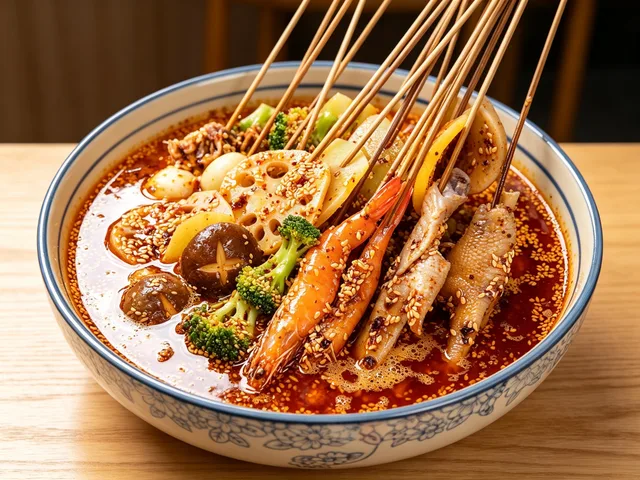
Read about fuqi feipian →Bobo chicken
Cold skewers in a bowl of chilli oil.
Read about bobo chicken →Sichuan food
From Chengdu snacks to Zigong salt-town cooking.
Explore Sichuan →Sichuan classics
- Jiangyou Intestines
Pork intestines, braised and cold-dressed · Breakfast and lunch with rice
- Zigong Dipping-Sauce Dishes
Boiled meats with chili dip · Lunch or dinner with rice
- Sichuan Hot Pot
Hot pot · Shared meal
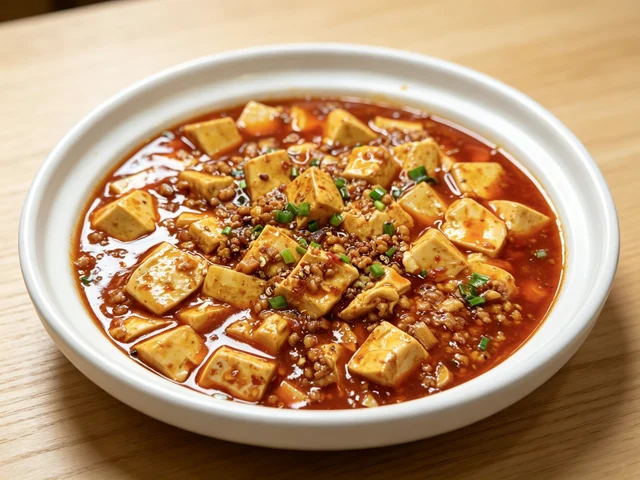
- Mapo Tofu
Tofu dish · Lunch or dinner, with rice
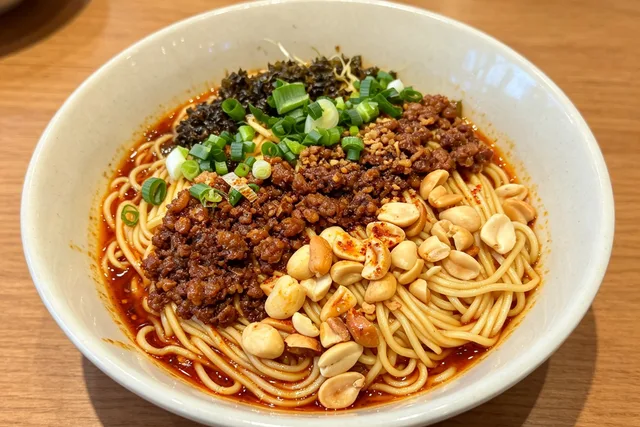
- Dan Dan Noodles
Small dressed noodles · Snack
- Bobo Chicken
Cold skewers · Snack
Rice dishes from other regions
FAQ
Questions about Sichuan Cold Rabbit
What is Sichuan cold rabbit?
Rabbit poached plain, cooled, then torn, diced or shredded and tossed with chilli oil, fermented black beans or fresh chilli, Sichuan pepper, scallion and peanuts.
Do people in Sichuan really eat that much rabbit?
Yes. Sichuan raises about 180 million meat rabbits a year and eats about 200 million, plus more than 300 million rabbit heads, the most in China.
What does rabbit taste like?
The meat is firm; in a cold dish the flavour comes from the chilli oil and black beans.
Is it very spicy?
It can be mild. The chilli oil is chosen for fragrance; ask for 微辣, and leave out the fresh bird’s-eye chilli.
How much does it cost?
About 40 yuan a jin at Chongqing street stalls in 2024 and 88 yuan a jin at a Chengdu stall in 2025; restaurant plates cost 30 to 40 yuan.
Are there bones?
Yes, in diced rabbit; the cubes are chopped through the bone. Torn and shredded rabbit has fewer.
Where can I buy it?
At stalls in markets and on street corners in Chengdu, Chongqing and towns across Sichuan, and in small restaurants.
Sources
Sources and further reading
- 1 Why three live rabbits stole the show at a press conference (in Chinese)Pei Yusong, Sichuan Daily / Chuanguan News (10 March 2026) ↗
- 2 Hand-torn cold rabbit at 40 yuan a jin on a Chongqing street, with plenty of toppings (video, in Chinese)Fupo Wenzai (富婆雯仔100道路边摊), Bilibili (April 2024) ↗
- 3 Hand-torn cold rabbit at a Chongqing country market (video, in Chinese)Lao Niu Bu Chi Lubiantan (老牛不吃路边摊), Bilibili (July 2024) ↗
- 4 Pixian’s cold rabbit in fermented black bean and chilli oil, made the same way for decades (video, in Chinese)Meishi Bao Qingtian (美食包青天), Bilibili (March 2025) ↗
- 5 Old Chengdu’s classic cold rabbit with peanuts: how it is made (video, in Chinese)Zuimei Jiachangcai (最美家常菜), Bilibili (July 2022) ↗
- 6 Cold rabbit at 88 yuan a jin on a Chengdu street (video, in Chinese)Mei Ai You E Le (没爱又饿了), Bilibili (October 2025) ↗
Last updated November 2026