
01
Poached chicken, rice cooked in its fat and stock, and a chili dip
In Hainanese chicken rice the rice is half the dish: it is cooked in the chicken’s own fat and stock, and people judge a stall by it.
A plate of Singapore chicken rice is simple to look at: bite-sized pieces of poached chicken, pale and glossy, laid over a mound of rice, with a little dish of red chili sauce, a few slices of cucumber and a bowl of clear chicken soup. The chicken is soft and moist, with smooth skin and often a thin layer of jelly beneath it. The rice is the surprise for first-timers. It is not plain: it has been fried in chicken fat and then cooked in the stock with ginger and garlic, and in Singapore with pandan leaves, so it comes out fragrant and slightly oily, each grain separate.
The sauces carry the rest of the flavor: a chili sauce each stall makes to its own recipe, and a thick dark soy sauce, which Chua Lam insisted should ideally be brewed by Singapore’s own Hainanese, or failing that by Indonesian Chinese. The MICHELIN Guide’s note on Singapore’s most famous stall sums up what people look for: velvety chicken with springy skin, aromatic oil rice and a briny-sweet sauce.
Chicken rice is ordered by the plate, or by the half or whole chicken with rice on the side for a table. Besides poached “white” chicken there are roast chicken and Cantonese soy-sauce chicken, and many stalls sell all three.
Take it apart
What’s on a plate of Hainanese chicken rice
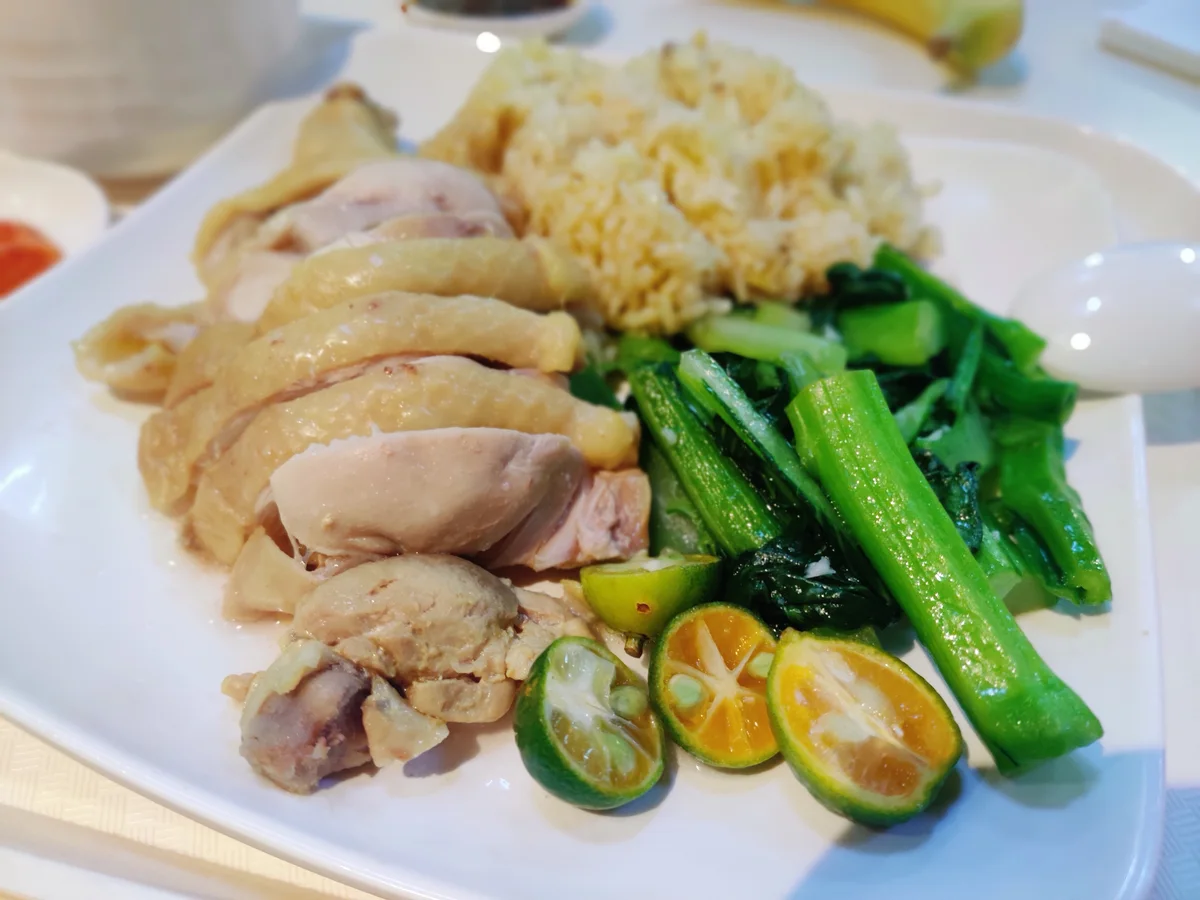
- Poached chicken
Poached, then chilled in cold water for smooth skin
- Chicken-fat rice
Fried in chicken fat, then cooked in the poaching stock
- Blanched choy sum
On the side
- Calamansi
Halved; also used in Hainan’s own dips
02
From Wenchang to the Straits
The dish is named after an island where nobody calls it that.
Singapore’s National Heritage Board, which added chicken rice to its inventory of intangible cultural heritage in 2019, credits the Hainanese community with bringing it: emigrants from Hainan who moved to Southeast Asia in the nineteenth and early twentieth centuries carried the recipe with them and changed it over time, and the dish is believed to have evolved from the Wenchang chicken of Hainan. Among the earliest chicken-rice businesses, set up in the 1930s and 1940s, were Yet Con (逸群), Chin Chin Eating House (津津餐室) and Swee Kee (瑞记).
In Wenchang the family behind the old Yukui chicken-rice shop tell their own version: a Singapore Chinese who had heard of the shop’s chicken rice came to learn it and grew rich from the chicken-rice shop he opened at home. The Hainan historian Yun Daxin identifies him as Wang Yiyuan, the first Hainanese to open a chicken-rice shop in Singapore. Malaysia has a claim too: Singapore and Malaysia both say they created the first Hainanese chicken rice, and the argument has never been settled.
On Hainan itself the poached bird is Wenchang chicken and the rice is ordered separately as chicken rice; the Wenchang chicken page tells that side of the story, from the breed to the island’s calamansi dip.
Wenchang chicken
The Hainan breed and the white-cut chicken, rice and calamansi dip of the island.
Read the Wenchang chicken guide →03
A younger bird and an ice bath
Singapore’s chicken rice is Hainanese with Cantonese technique.
The Hainanese way, as Singapore’s heritage board records it, is to poach the chicken in boiling water until it is fully cooked, soak it in room-temperature water for about half an hour, drain it, and lay it on a tray under a towel to keep the meat moist. Many cooks now use the Cantonese technique of plunging the cooked bird into iced water instead, which gives a smoother skin and the gelatinous layer under it. The other Cantonese change is the bird itself: young, tender chickens replaced the bony, muscular Wenchang breed of the original recipe.
At Thien Kee, opened in 1952 by the Hainan migrant Boh Khai Kim on Middle Road, where Hainanese gathered, the chickens weigh about two kilograms each. They are tied with raffia string, dipped in and out of boiling chicken stock a few times to scald the skin, then left in the stock for 40 minutes; then they go into room-temperature water to let the tendons relax, hang on hooks to drip off the fat, and rest 20 to 30 minutes before they are chopped. Apart from using less oil, the recipe has not changed since 1952.
| Chicken | How it is cooked | Tradition |
|---|---|---|
| Poached “white” chicken | Poached, then cooled in room-temperature or iced water | Hainanese, with Cantonese technique |
| Roast chicken | Seasoned with pepper and salt, hung to dry, then deep-fried | A stall variation |
| Soy-sauce chicken | Cooked in a dark sauce spiced with cinnamon and clove, sweetened with rock sugar | Cantonese |
Sources [3]
04
The hardest part is the rice
At an old chicken-rice stall the rice, not the chicken, is the hard part.
The rice is fried in chicken fat and then cooked in the broth skimmed off during poaching, with ginger, garlic and pandan leaves. Benjamin Boh, who learned the trade at his family’s Thien Kee as a schoolboy in the 1990s, calls it the most difficult part: the rice has to be between three and six months old to cook properly; it is stirred with a big ladle while it absorbs the stock, and the fire is adjusted throughout so it neither burns nor overheats. The process takes about 20 minutes, and the result should be fragrant and tender, soft and chewy, with every grain separate and not sticky.
In Melaka the rice comes as balls. Chicken rice balls are the city’s signature: rice cooked in chicken stock and rolled by hand into compact balls; at one neighborhood shop they come with poached chicken under a drizzle of soy and sesame oil, blanched bean sprouts with crisp shallots, and roast pork. The usual story is that the balls kept warm longer and were easier to carry to work; even Melaka writers admit it sounds like the story of most rice balls. Back in Wenchang, the Yukui shop sent out balls of chicken rice with pieces of chicken to late-night mahjong players a century ago, eaten by hand.
05
Chili, dark soy, ginger, and what comes with them
A chicken-rice stall is judged on its chili sauce almost as much as its chicken.
Singapore stalls serve the chicken with a chili sauce made in-house, a thick dark soy sauce, or both; home cooks often add a ginger and scallion dip. The usual sides are cucumber slices and a bowl of soup made from the stock, and many stalls add braised eggs in dark soy, beancurd, bean sprouts, kailan greens or achar, a pickle of cucumber, carrot and cabbage with crushed peanuts and sesame. In Ipoh in Malaysia the local version is bean-sprout chicken: the chicken is much like the chicken in Hainanese chicken rice, while the bean sprouts, grown in water that runs through limestone, are fat, white and unusually tasty, and Chua Lam ranked them among the best things in the town.
| Dip | What it is | Use it for |
|---|---|---|
| Chili sauce | Made by each stall to its own recipe | Dabbing on each piece of chicken |
| Dark soy | Thick dark soy, ideally brewed by Hainanese in Singapore | Rice and chicken alike |
| Ginger and scallion | Pounded with salt, with smoking oil poured over; common in home versions | Cutting the richness |
06
A national dish, and a salty one
Singapore treats chicken rice as part of its identity.
Chicken rice is sold almost everywhere in Singapore, from hawker stalls to high-end restaurants, and is lauded as one of the national dishes; there are halal versions, and families cook their own at home. In 2016 Chan Hon Meng of Liao Fan Hong Kong Soya Sauce Chicken Rice and Noodle won a Michelin star for his soy-sauce chicken rice. Tian Tian at Maxwell Food Centre is the stall visitors queue for; Singapore Airlines puts chicken rice on selected flights as a taste of Singapore, and chains such as Wee Nam Kee have opened abroad. Chefs have turned it into chicken rice risotto, chicken rice sushi and even chicken-rice-flavored potato chips.
All that fat and soy has a cost. In 2024 Lianhe Zaobao reported that the sodium in local dishes eaten out in Singapore had risen by 22 percent over fourteen years; in Hainanese chicken rice it rose by 65 percent. With Temasek Polytechnic’s school of food and nutrition, the paper made a low-sodium chicken rice using low-sodium salt and soy sauce, to test whether stalls could cut the salt without losing the flavor.
A plate is still cheap by Singapore standards. In 2026 Tian Tian charged S$5 to S$6 a plate at its Maxwell stall, while its new branch at Jewel Changi Airport asked S$11 for a set with soup.
07
Back in China, under its Southeast Asian name
In mainland China the Singapore name came home.
In mainland China the Singapore name is now used on the menus of restaurants and canteens. The plate at the top of this page, photographed in a company canteen in Shenzhen, shows the usual hybrid: poached chicken on yellowish chicken-oil rice, blanched choy sum, a dab of chili sauce and halved calamansi, the little citrus of Hainan’s own dip. In Hainan the order is different: the chicken and the rice are ordered separately, and the dip is calamansi with garlic, ginger and salt. Order “Hainanese chicken rice” in Haikou, Chua Lam wrote, and you mark yourself as a visitor from Nanyang.
In Haikou the bird is sold by the half or whole: in 2025 half a chicken cost ¥63 at Feipo Lan (肥婆兰鸡饭), a small shop that fills up with locals at mealtimes.
Coconut chicken hot pot
Chicken cooked at the table in young-coconut water, with a calamansi dip.
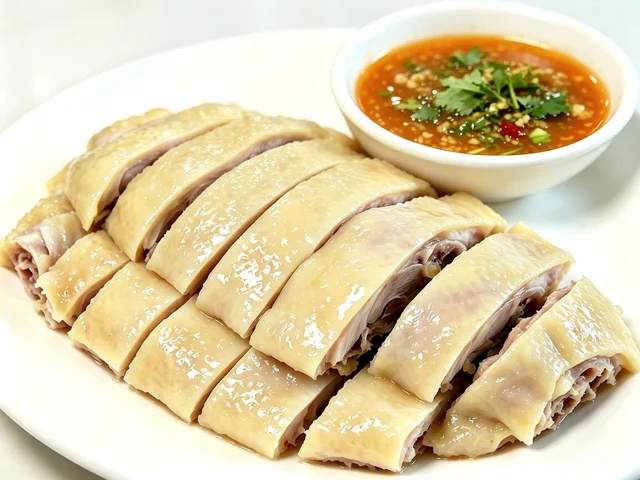
Read the coconut chicken guide →Cantonese white-cut chicken
Guangdong’s poached chicken with a ginger-scallion dip.
Read the white-cut chicken guide →08
Chicken first, then rice in its stock
For two or three, put 500 g of boneless chicken thighs (or a small whole chicken) in a pot with a few slices of ginger and some scallion, cover with cold water, add a spoon each of light soy sauce and Shaoxing wine, bring to a boil and skim, then cover and keep it at the lowest heat for 15 minutes; a whole bird needs much longer. Lift the chicken into iced water for a smoother skin, or into room-temperature water in the Hainanese way, and keep the stock.
Finely chop shallots, garlic and ginger and fry them in oil or rendered chicken fat over medium heat until lightly golden, add washed rice and stir-fry for two or three minutes, then cook it in the chicken stock in place of water, with a knotted pandan leaf if you have one. For the dip, pound ginger and scallion with salt and pour over a little smoking oil; serve with chili sauce and dark soy, sliced chicken, cucumber and a bowl of the stock.
09
Qingbuliang and Hainan rice noodles
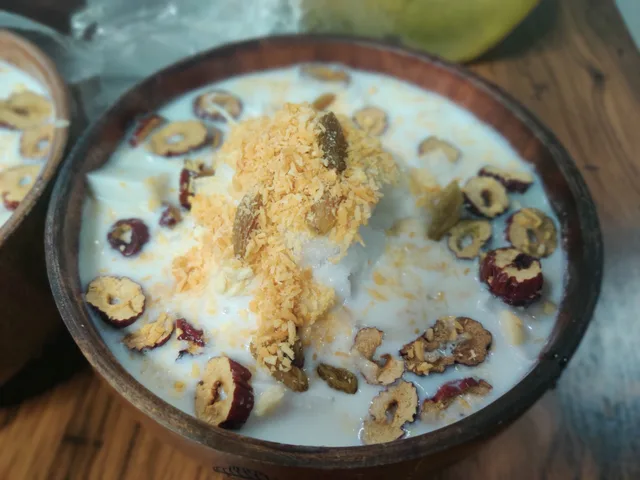
Qingbuliang
Hainan’s iced coconut-milk dessert of beans, taro and fruit.
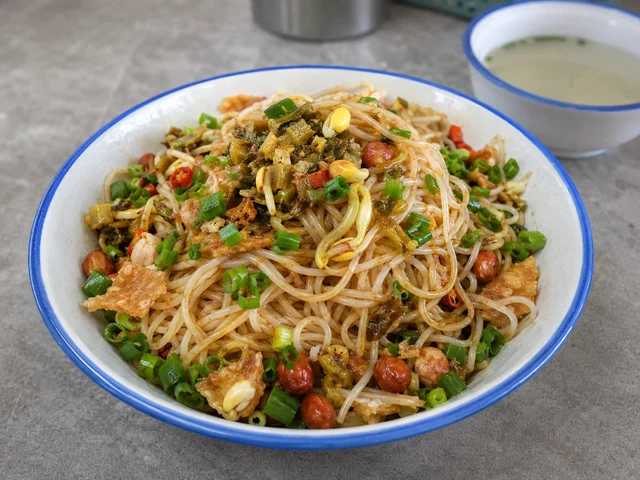
Read the qingbuliang guide →Hainan rice noodles
Thin rice noodles with a thick gravy and toppings.
Read the Hainan rice noodles guide →Hainan food
The island’s chickens, ducks, rice noodles and coconut dishes.
Read the Hainan guide →Hainan classics
- Hainan Rice Noodles
Dressed rice noodles · Breakfast
- Qingbuliang
Iced dessert · Afternoon or evening, at night markets
- Wenchang Chicken
White-cut chicken · Lunch or dinner
- Coconut Chicken Hot Pot
Hot pot · Shared meal
- Hainan Fried Rice Noodles
Fried rice noodles · Breakfast, tea houses or late night
- Baoluo Rice Noodles
Rice noodles · Breakfast
FAQ
Questions about Hainanese Chicken Rice
Is Hainanese chicken rice from Hainan?
It grew out of Hainan’s Wenchang chicken and chicken rice, but the dish called Hainanese chicken rice was made by Hainanese emigrants in Singapore and Malaysia. In Hainan the chicken and the rice are ordered separately.
Why is the rice so fragrant?
It is fried in chicken fat and cooked in the poaching stock with ginger and garlic, and in Singapore often with pandan leaf.
Why is the chicken skin smooth and jelly-like?
Many cooks plunge the poached chicken into iced water, a Cantonese technique; the traditional Hainanese method cools it in room-temperature water.
What sauces come with it?
A chili sauce made at the stall and thick dark soy sauce; home versions often add a ginger and scallion dip.
What are chicken rice balls?
Melaka’s version: rice cooked in chicken stock and rolled by hand into small balls, served with poached chicken.
Sources
Sources and further reading
- 1 Yun Daxin, Hainan Meishi Tanqi (海南美食探奇), chapter on the Yukui chicken-rice shop in Wencheng (in Chinese)Nanfang Publishing House, Haikou (2024)
- 2 Chua Lam (蔡澜), Chua Lam Lüxing Meishi Wenhua (蔡澜旅行美食文化), chapters “Malaysia” and “Australia”: Ipoh bean-sprout chicken and the soy sauce for chicken rice (in Chinese)Qingdao Publishing House (2016; WeChat Read edition)
- 3 Chicken rice (ICH-064): Hainanese and Cantonese versions, the rice, the early businesses and Thien Kee’s methodRoots.sg, National Heritage Board, Singapore (intangible cultural heritage inventory, 2019) ↗
- 4 Tian Tian Hainanese Chicken Rice, Maxwell Food CentreThe MICHELIN Guide Singapore ↗
- 5 So, if Hainan chicken didn’t come from Hainan, where is it from?Lisa Cam, South China Morning Post (2018) ↗
- 6 Far from Melaka’s tourist trail, Tian Tian’s chicken rice balls roll out a taste of nostalgiaKenny Mah, Malay Mail (2025) ↗
- 7 Tian Tian opens at Jewel Changi: a chicken rice set from S$11, against S$5–6 at Maxwell (2026)Little Big Red Dot ↗
- 8 Sodium in Singapore’s Hainanese chicken rice rose 65 percent in 14 years: a low-sodium version made with Temasek Polytechnic (video, in Chinese)Lianhe Zaobao (联合早报网), Bilibili (2024) ↗
- 9 A simple Hainanese chicken rice at home: thighs poached in a lidded pot, rice fried with shallot, garlic and ginger and cooked in the stock (video, in Chinese)Bali Han Shi (巴黎Han师), Bilibili ↗
- 10 Hainanese chicken rice at Feipo Lan in Haikou: half a chicken for ¥63 (video, in Chinese)Chan Xu (馋叙), Bilibili ↗
Last updated October 2026