
01
Plain meat, everything in the dip
Zigong dipping-sauce dishes mostly use rabbit, beef and pork, all boiled in plain water.
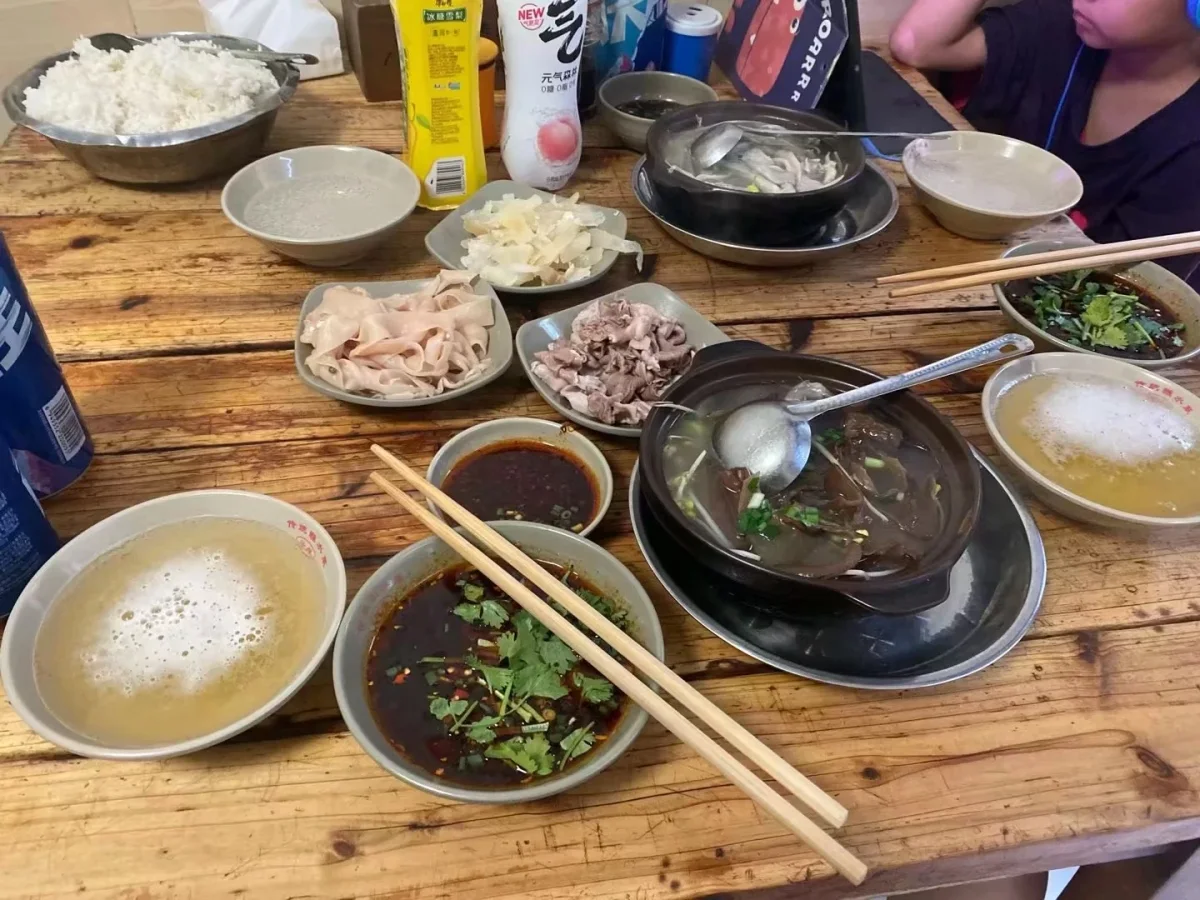
Our photograph shows a typical table: little plates of sliced boiled pork, beef and offal, a deep bowl of dark red dip scattered with coriander, a clay pot of soup, rice in a steel basin and bowls of pale soup to drink. Nothing on the plates is seasoned. The beef, pork and rabbit have been boiled in plain water and taste only of meat until each slice is dragged through the dip.
Because the meat is plain, the shops compete on dip. At the good shops the meat itself hardly differs from one to the next; what differs is how far the chilli is roasted and fried and how the seasonings are balanced, which gives each shop its own style and its own loyal customers.
Zigong, in the south of Sichuan, was built on salt. The historian Lan Yong’s survey of Sichuan and Chongqing “rivers-and-lakes” cooking notes that the city was founded on salt and named for it, and that its cooking, yanbang cai, salt-guild food, grew out of salt production and the tastes of the salt workers and merchants. That same salt is also the reason why Zigong food tastes as heavy and salty as it does.
02
The dip, by the bowl and by the jar
The dip is a dark, oily paste of roasted chilli, Sichuan pepper and salt.
A Zigong dip comes as a bowl of red oil with a thick layer of chilli and seasoning settled at the bottom. Stir it before you start: the bottom is hotter and saltier than the oil on top, so start by dipping only in the oil. It smells a little like Lao Gan Ma chilli crisp but is several times hotter, numbing as well as hot, and it gets hotter with every mouthful. Zigong heat stings the lips but does not trouble the stomach, and the dip tastes different from the Zigong food served in Chongqing.
Meat and vegetables get different dips: an oil dip for meat, which is hotter, and a sauce dip for vegetables. In 2023 two plates of meat came with two bowls of dip; a bowl is reckoned to cover about three plates; you can ask for more, and the shop will season the new bowl with extra salt and MSG. Leftover dip is good for soaking bread. Shops sell their dip by the jar, and plenty of customers carry one home to stir into noodles.
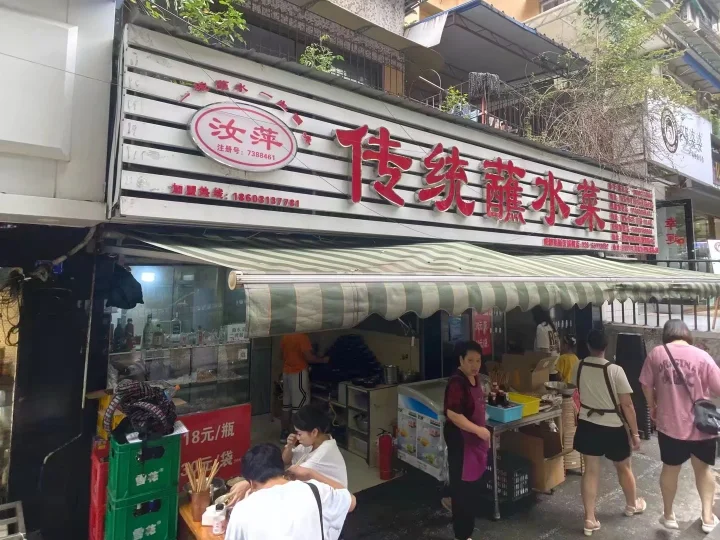
A dipping-sauce shop
Our own photograph of a traditional dipping-sauce restaurant.
03
What to order, by the liang
Point at the counter and order a liang or two of each.
Shops lay the dishes out at the counter and you order by weight, a liang or two of each, then go back for more. In 2025 thinly sliced beef shank was 20 yuan for two liang and a plate of sweet-potato leaves 10 yuan, and three meat dishes and a vegetable came to 63 yuan; in 2022 three people ate for about 150. Everything is made fresh that day, and shops sell stir-fried dishes and clay pots as well. Rabbit is everywhere, as shredded rabbit, rabbit liver, and tangpi tu, scalded-skin rabbit with skin almost transparent and small bones to watch for; it tastes like chicken breast, only more tender. Lan Yong’s book traces Zigong’s rabbit habit to the salt workers: rabbit and its seasonings were cheap, and cold-eaten rabbit, the home-style dish that best represents salt-guild cooking, became a dish almost every Zigong family knows how to make.
| Dish | What it is | Notes |
|---|---|---|
| 牛肉 beef | Shank with tendon, boiled, sliced thin | The priciest, about 100 yuan a jin in 2025 |
| 白肉 boiled pork | Pork belly or leg boiled plain | Fat and lean; tastes of pork |
| 猪耳朵 pig’s ear | Boiled and sliced | Crunchy |
| 鸭肠 duck intestine | Blanched, cut short | Crisp and springy |
| 毛肚 牛大肚 tripe | Beef tripe, blanched | Chewy |
| 兔 rabbit | Shredded rabbit, scalded-skin rabbit, rabbit liver | Zigong’s favourite meat |
| 素菜 vegetables | Eggplant, sweet-potato leaves and others | With a milder dip |
04
Clay-pot soup and rice
A clay pot of meatballs is ordered to cool the mouth.
Almost every table orders a clay-pot soup, often soft, loose meatballs in clear broth, and a pile of rice. The rhythm goes: a slice through the red dip, a spoonful of plain soup, a mouthful of rice. A meal of zhanshui cai means huffing and puffing your way through a bowl and a half of rice. It is drinking food as well: the same plates go equally well with liquor and with rice.
05
Rabbit and bittern tofu: more salt-city food
Salt shaped more than the dip.
Rabbit is Zigong’s signature meat, and Lan Yong’s team went to find out why. They interviewed Chen Maojun, a local historian of salt-merchant culture who has written books on salt-guild cooking. Chen explained that the name cold-eaten rabbit, lengchi tu, is old, but the dish as people know it grew out of older ones, tangerine-peel rabbit, chilli rabbit and rock-sugar rabbit, and has spread widely only in recent years; dried out and heavily spiced, it keeps a month at room temperature and two in the fridge. Many articles credit one Liu Yigong with creating it. No one knows when Zigong began raising rabbits, the book says, but neighbouring Rong county exported more than 40,000 rabbit skins in 1936, and the city bought 240,000 in 1952. Rabbit and its seasonings were cheap, so the salt workers ate it and carried it home.
Salt also gave Zigong its tofu. Bittern, the brine left over from making salt, is what sets the tofu of nearby Fushun, famous for its douhua, soft tofu eaten with a dip of its own: pounded chilli paste, sesame and huoxiang leaves. Most douhua in Sichuan and Chongqing is now set with bittern. As with zhanshui cai, each shop’s dip differs.
06
Zigong barbecue, under a heap of scallion
At night Zigong eats barbecue, and it is just as fierce.
Zigong also eats late-night barbecue. One popular roadside barbecue stall, in 2021, opened at half past nine at night, with tables set out under single bulbs. The skewers, beef, ribs, gizzards and sausages, came to the table, and before anything else every plate was buried under a heap of chopped scallion. The seasoning was hot and, above all, numbing; four people spent 230 yuan.
The beef was the house speciality, full of flavour, neither dry nor stringy; the ribs were charred outside and tender inside; and the heat built skewer by skewer.
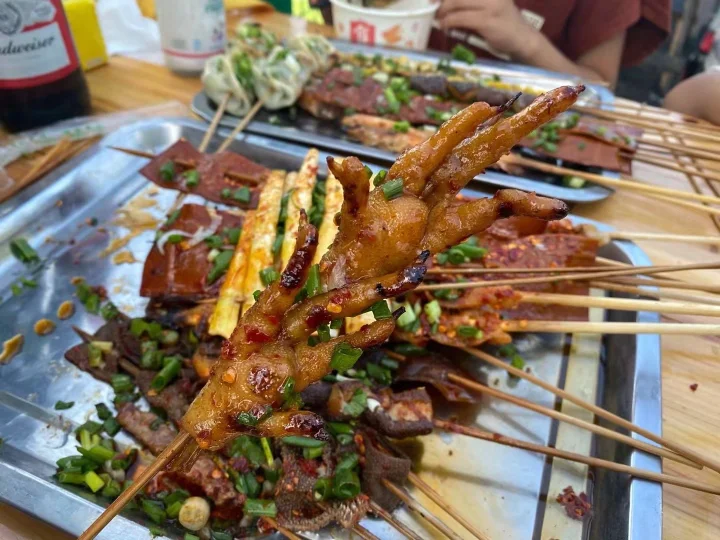
The barbecue photograph here is in the same style: a steel tray of skewers, chicken feet, beef and potato slices glossy with chilli and Sichuan pepper, scattered thickly with scallion.
Zigong-style barbecue
Our own photograph of a tray of Zigong-style skewers.
07
A Zigong-style dip at home
How far the chilli is roasted and fried matters most.
Beef shank, pork belly, and pig’s ear or tripe; an onion; for the dip, dried red chillies roasted in a dry pan and pounded into coarse flakes, ground Sichuan pepper, salt, MSG if you like, oil, and chopped coriander.
- 1. Boil
Simmer each meat separately in plain water until tender, without seasoning. Cool and slice thinly, the beef shank especially.
- 2. Mix the dip
Put the chilli, Sichuan pepper, salt and MSG in a heatproof bowl, pour over hot oil and stir. Keep the dip for the meat hotter than any dip for vegetables.
- 3. Serve
Lay the beef on sliced onion and the other meats on plates, give each person a bowl of dip with coriander on top, and serve with rice and a clear soup.
08
How to order it
Order small and often.
By weight
A liang or two of each dish; add more as you go.
Price
About 150 yuan for three people in 2022; 63 yuan for three meats and a vegetable in 2025.
Heat
Dip in the oil on top first; the seasoning at the bottom is hotter and saltier.
Soup and rice
Order a clay-pot soup and plenty of rice.
Take some home
Shops sell the dip by the jar.
09
More from Sichuan
Other pages on the atlas.
Bobo chicken
Leshan’s skewers soaked in chilli oil.
Read about bobo chicken →Leshan qiaojiao beef
Beef offal soup with a dry chilli dip.
Read about qiaojiao beef →Sichuan food
From Chengdu to the salt city.
Explore Sichuan →Sichuan classics
- Jiangyou Intestines
Pork intestines, braised and cold-dressed · Breakfast and lunch with rice
- Sichuan Cold Rabbit
Cold dressed rabbit · Cold dish with rice or beer
- Sichuan Hot Pot
Hot pot · Shared meal
- Mapo Tofu
Tofu dish · Lunch or dinner, with rice
- Dan Dan Noodles
Small dressed noodles · Snack
- Bobo Chicken
Cold skewers · Snack
Rice dishes from other regions
FAQ
Questions about Zigong Dipping-Sauce Dishes
What are Zigong dipping-sauce dishes?
Beef, pork, offal and rabbit boiled plain, sliced and eaten with a fiery dip of roasted chilli, Sichuan pepper and salt.
Why is the meat unseasoned?
All the flavour comes from the dip; shops compete on their dip recipe.
How hot is it?
Very. Dip in the oil on top first; the seasoning at the bottom is hotter and saltier.
How do you order?
By weight, a liang (50 g) or two of each dish.
What is yanbang cai?
Salt-guild cuisine, the name for Zigong’s cooking. Zigong was founded on salt and named for it, and its food grew out of salt production and the tastes of salt workers and merchants.
What goes with it?
Rice, a clay-pot soup, and often a jar of dip to take home.
What is Zigong barbecue like?
Late-night skewers of beef, ribs, gizzards and sausage, hot and numbing, served under a heap of chopped scallion.
Sources
Sources and further reading
- 1 Lan Yong, Bashu Jianghu Cai Lishi Diaocha Baogao (巴蜀江湖菜历史调查报告): “A historical survey of Zigong cold-eaten rabbit” (in Chinese)Sichuan Literature and Art Publishing House, 2019; WeRead edition ↗
- 2 Three hours’ drive for authentic Zigong dipping-sauce dishes: a whole table of them (video, in Chinese)Ganfan San Jianke (干饭三健客), Bilibili (September 2024) ↗
- 3 A foreigner’s first Zigong dipping-sauce dishes, ordered by the liang at a roadside table (video, in Chinese)Lao Fei Alex (老费Alex), Bilibili (May 2022) ↗
- 4 Zigong dipping-sauce dishes, and the bittern-set tofu of Fushun (video, in Chinese)Ye Shu de Sifang Shishi (耶叔的四方食事), Bilibili (August 2023) ↗
- 5 Zigong dipping-sauce dishes: scalded-skin rabbit, beef shank and rabbit liver in red oil (video, in Chinese)Jun zai Xi’an (君在西安), Bilibili (September 2025) ↗
- 6 A 230-yuan roadside barbecue in the dinosaur city: this tastes very Zigong (video, in Chinese)Zhang Xixi (张喜喜-), Bilibili (October 2021) ↗
Last updated November 2026