
01
Wrinkled beans, crisp pork and yacai
Dry-fried green beans are green beans cooked until their skins wrinkle, then tossed with crisp minced pork and fermented mustard stem.
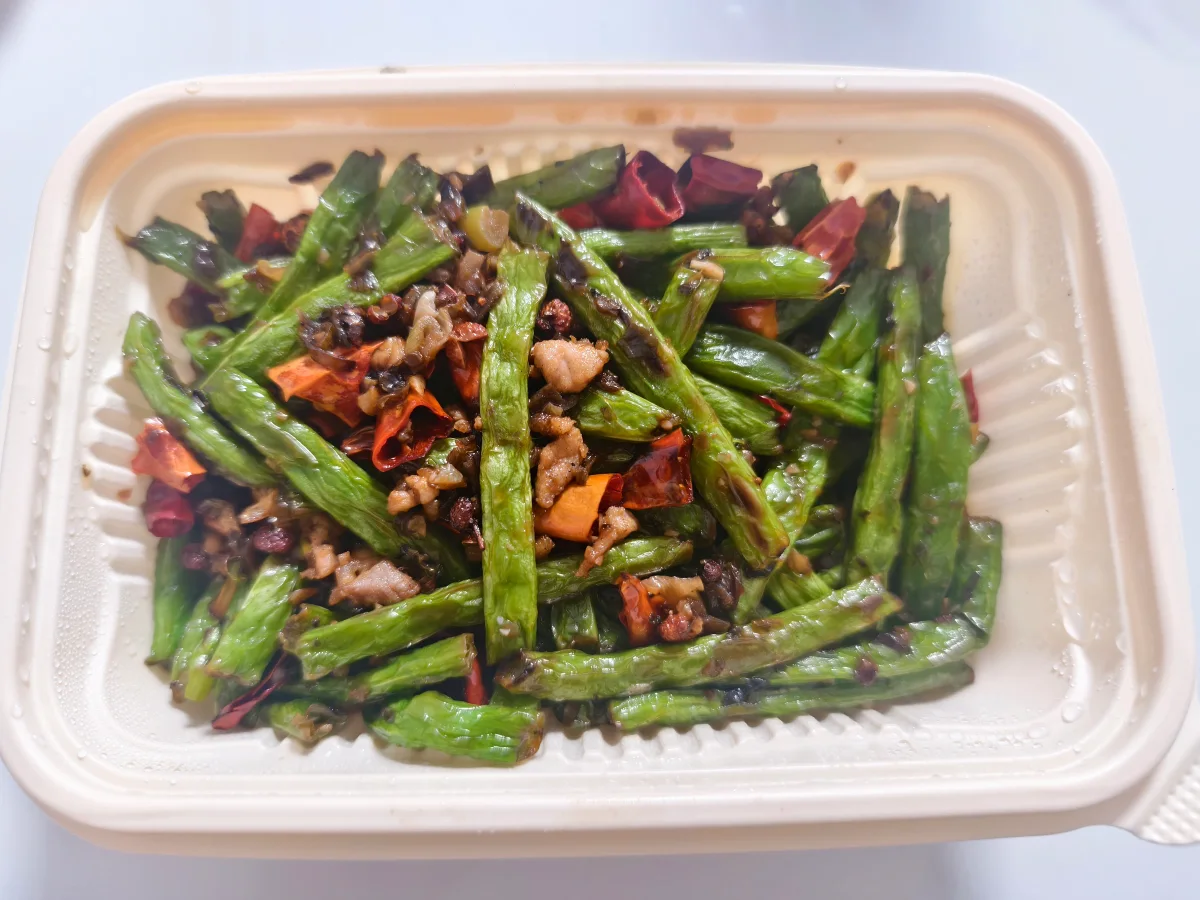
Done well, the beans are wrinkled and lightly blistered outside, tender inside, and coated with little crisp bits of pork and the dark, savory specks of yacai. The standard set by the cooking school of Sichuan Tourism University in Chengdu: emerald green, savory, dry-fragrant and tender. There is no sauce at all; the flavor clings to the beans.
Fuchsia Dunlop calls it a Sichuan classic that is now famous around the world, and it is a family dish: many older Sichuanese, she writes, can still turn out a fine plate of it, or of mapo tofu. The first real Sichuan home cooking she ever ate was at the seventh-floor flat of a friend’s eighty-year-old grandmother, and dry-fried green beans were the star of that meal.
The beans in this page’s photograph came in a takeaway box, the restaurant way: wrinkled beans with minced pork, yacai and pieces of dried chili.
02
What dry-frying means
Dry-frying, 干煸, is one of the defining techniques of Sichuan cooking.
In dry-frying the ingredient goes into the wok with little or no oil and is turned over steady heat until it gives up its water, shrinks and smells toasty; only then do the oil and seasonings go in. There is no marinade and no batter. The aim is 干香滋润, dry-fragrant yet still moist, and the method suits dense, long-fibered animal ingredients such as squid or eel, and crisp vegetables with little water, such as green beans.
China’s national heritage listing for Sichuan cooking techniques names dry-frying among the handful of methods the cuisine is best at, alongside quick stir-frying, rice-meal steaming and pickling. Dunlop’s examples: dry-fried green beans, eggplant and beef slivers.
03
Deep-fried or slow-fried
The name says dry-fried; most restaurant kitchens deep-fry.
The traditional method is slow: beans in a hot wok with as little oil as possible, turned until their skins wrinkle and they soften. Dunlop writes that every cook she watched in Sichuan deep-fried them instead, because it is much faster, and the Chengdu cooking school teaches it the same way: beans into oil at 150°C until the skins wrinkle, the beans are just cooked through and bright green, then out. Deep-fried beans come out crisper and greener than dry-fried ones, and how long they stay in decides the bite. Pulled out when half the skins have puckered, they stay firm; left until nearly all are wrinkled, they have the soft, slightly yielding texture of Chengdu restaurants.
Home cooks have other routes. The Woks of Life sears the beans in a dry wok over medium-low heat for about twenty minutes, until they show small scorch marks. Dunlop passes on a friend’s tip: roast them on a tray at 250°C for about fifteen minutes, turning once, before stir-frying. At the far end is the old-school way recorded in Mrs. Chiang’s Szechwan Cookbook, which dry-fried the beans for more than two hours, until they were shriveled and limp.
| Method | How |
|---|---|
| Cooking school (Chengdu) | Deep-fried at 150°C until the skins wrinkle and the beans turn bright green |
| Dunlop | Deep-fried at 180°C until soft and slightly wrinkled |
| Dunlop’s oven alternative | Roasted on a tray at 250°C for about 15 minutes, turned once |
| The Woks of Life | Dry wok, no oil, medium-low heat for about 20 minutes |
| Mrs. Chiang (old school) | Slow dry-frying for more than two hours, until shriveled |
04
Yacai and pork
The beans carry the dish; yacai gives it its flavor.
Yacai, 芽菜, is the stem of a Sichuan mustard plant, salted and fermented with brown sugar and spices. It tastes savory and slightly sour, and the Yibin version is, in Dunlop’s words, indispensable in two famous dishes, dan dan noodles and dry-fried green beans. In 2021 yacai was among the products protected under the China–EU agreement on geographical indications.
The pork is minced and fried until crisp and fragrant before the beans go back in; fatty pork tastes best. The amounts are small. The cooking school uses 50 grams of pork and 15 grams of yacai to 250 grams of beans, so the pork reads as a seasoning, not a main ingredient. If you cannot find yacai, Tianjin preserved vegetable, 冬菜, will do.
Pork was not always the partner. Mrs. Chiang’s Szechwan Cookbook, written in the United States in the 1970s, seasoned the beans with dried shrimp and zhacai, probably because yacai could not be bought there then. Taylor Holliday of the Mala Market says she has never seen shrimp in the dish in Sichuan and that pork is how it is made now. She also finds the dish almost as good without pork, because the real flavor comes from the yacai.
05
Savory or spicy
It comes savory or spicy.
The textbook dish is not hot at all. The cooking school’s recipe has no chili and no Sichuan pepper; its flavor is classed as 咸鲜, savory, and comes entirely from pork, yacai, soy and a little sesame oil. Some cooks fry dried chilies and Sichuan pepper in the oil first, and most recipes you will find in English add chilies; the takeaway box in the photograph has them. Even then the chilies are often left whole, for color and fragrance more than heat. Dunlop gives both, and a vegetarian one with chilies, Sichuan pepper, ginger, garlic and scallion in place of pork.
06
Always cook green beans through
Raw or underdone green beans can make you ill.
Raw green beans contain natural toxins, chiefly phytohaemagglutinin (a lectin) and saponins, which thorough cooking destroys. Hong Kong’s Centre for Food Safety notes that poisoning usually begins within one to three hours, with severe nausea and vomiting followed by diarrhoea, and warns that low-heat cooking and uneven heating need special care, which is exactly the risk with dry-frying. As Zhang Huiqiang, deputy director of the Sichuan Cuisine Museum in Chengdu, told Xinhua, it is not green beans that poison people, but undercooked ones.
For this dish that means the beans must be soft right through, with no raw green color and no beany taste. The Chengdu cooking school insists the beans be fried until cooked right through but not burnt. At home, if you dry-fry and are not sure, follow the advice of Hubei’s health officials: after stir-frying, add a little water, cover the wok and simmer for ten minutes or more, turning the beans so they heat evenly, then finish them. The same officials suggest buying young beans rather than old ones, trimming off the tips and strings, where the toxins are most concentrated, and never filling the wok more than halfway.
07
Ordering it
Look for two names on the menu.
In China the dish appears as 干煸四季豆 or 干煸豆角. On menus 干煸豆角 usually means the same dish, though 豆角 can also refer to yard-long beans, a different bean, so ask if it matters to you. Abroad it is usually listed as dry-fried green beans, often with Sichuan or Szechuan in front. It is a dish for the table, eaten with rice.
Mild or spicy
Ask whether they add dried chilies; 不要辣 gets you the savory version.
Vegetarian
Ask for it 不放肉, without pork; yacai gives plenty of flavor. Some kitchens fry in lard, so say you are vegetarian.
Check the beans
They should be soft and wrinkled right through, with no raw green inside and no beany taste.
08
Dry-fried green beans at home
Fry the beans, then the pork, then bring them together.
This is Dunlop’s recipe. Choose young, tender beans without much string. If you would rather not deep-fry, roast the beans at 250°C for about fifteen minutes, turning halfway, then start from the pork.
400 g green beans; oil for deep-frying; 3 tablespoons lard (optional); 75 g minced pork, preferably fatty; ½ tablespoon Shaoxing wine; 4½ tablespoons Yibin yacai or Tianjin preserved vegetable, finely chopped; 2 teaspoons light soy sauce; 1 teaspoon sesame oil.
- 1. Trim
Top and tail the beans, string them if needed, and cut them into bite-sized lengths.
- 2. Fry the beans
Heat the oil to 180°C; a bean dropped in should sizzle vigorously. Fry the beans until soft right through and slightly wrinkled, then lift out and drain well.
- 3. Fry the pork
Pour off all but 3 tablespoons of oil (or replace it with the lard) and heat over a high flame. Fry the pork until cooked and fragrant; when it turns pale, add the wine.
- 4. Bring together
Add the beans and stir-fry until piping hot, then add the yacai and the soy sauce. Taste and add a little more salt or soy if needed.
- 5. Finish
Stir in the sesame oil and serve. For a spicy version, fry a handful of dried chilies and a little Sichuan pepper in the oil before the pork.
09
More Sichuan home cooking
Other dishes on the atlas.
Mapo tofu
Another dish many older Sichuan home cooks can still make well.
Read about mapo tofu →Dan dan noodles
The street noodle that shares its yacai with these beans.
Read about dan dan noodles →Stir-fried shredded potatoes
Another everyday vegetable dish, cooked so it stays crisp.
Read about shredded potatoes →Sichuan classics
- Mapo Tofu
Tofu dish · Lunch or dinner, with rice
- Kung Pao Chicken
Chicken stir-fry · Lunch or dinner, with rice
- Sichuan Hot Pot
Hot pot · Shared meal
- Dan Dan Noodles
Small dressed noodles · Snack
- Bobo Chicken
Cold skewers · Snack
- Sweet Water Noodles
Thick dressed noodles · Breakfast or a snack
FAQ
Questions about Dry-Fried Green Beans
What does dry-fried mean?
Cooked in a wok with little or no oil until the ingredient loses water, wrinkles and smells toasty, before seasonings go in. Most restaurants now deep-fry the beans instead, which is quicker.
What is yacai?
Fermented mustard stem from Sichuan, best known from Yibin. It gives the beans their dark, savory flavor. Tianjin preserved vegetable is the usual substitute.
Is it spicy?
The classic version is savory, not hot. Some cooks add dried chilies and Sichuan pepper; ask if you want it mild.
Are green beans dangerous?
Only undercooked. Raw green beans contain natural toxins destroyed by thorough cooking, so the beans must be soft right through.
Can I make it without pork?
Yes. Leave out the pork and use a little more yacai, with ginger, garlic, scallion, dried chilies and Sichuan pepper.
What is the difference between 干煸四季豆 and 干煸豆角?
Usually none. 豆角 can also refer to yard-long beans, a different bean, so ask if it matters to you.
Sources
Sources and further reading
- 1 Fuchsia Dunlop, The Food of Sichuan, Chinese edition Chuancai (川菜): “The Sichuan kitchen,” “Vegetables” (dry-fried green beans, vegetarian version) and “56 cooking methods” (in Chinese)CITIC Press (2020)
- 2 “Dry-fried green beans” (干煸四季豆), teaching video in the classic Sichuan dishes database (in Chinese)Sichuan Cuisine Development Research Center, Sichuan Tourism University (2026) ↗
- 3 “Cooking technique: dry-frying” (烹制工艺——干煸), teaching video (in Chinese)Sichuan Cuisine Development Research Center, Sichuan Tourism University (2026) ↗
- 4 Sichuan cuisine cooking techniques (川菜烹饪技艺), national intangible cultural heritage list, item Ⅷ-272 (2021) (in Chinese)China Intangible Cultural Heritage Network ↗
- 5 “Beware of green bean poisoning” (警惕四季豆中毒) (in Chinese)Hubei Center for Disease Control and Prevention, Hubei Health Commission (May 25, 2021) ↗
- 6 John Lum, “Phytohaemagglutinin Poisoning,” Food Safety Focus 208Centre for Food Safety, Hong Kong (November 2023) ↗
- 7 Tang Wenhao and Dong Xiaohong, “Are green beans a food safety risk? Experts on how to eat them safely” (四季豆有食品安全风险?) (in Chinese)Xinhua (February 24, 2025) ↗
- 8 “Geographical branding bolsters trade ties”Xinhua, via China Daily (April 2, 2021) ↗
- 9 Judy Leung, “Sichuan Dry Fried Green Beans”The Woks of Life (updated October 21, 2020) ↗
- 10 Taylor Holliday, “Sichuan Dry-Fried Green Beans (Ganbian Sijidou)”The Mala Market (updated August 16, 2026) ↗
Last updated November 2026