
01
Little fish, fried dry
Dry-fried loach is small freshwater loach fried slowly until crisp and dry, then tossed with Sichuan pepper, dried and fresh chilli, ginger and garlic.
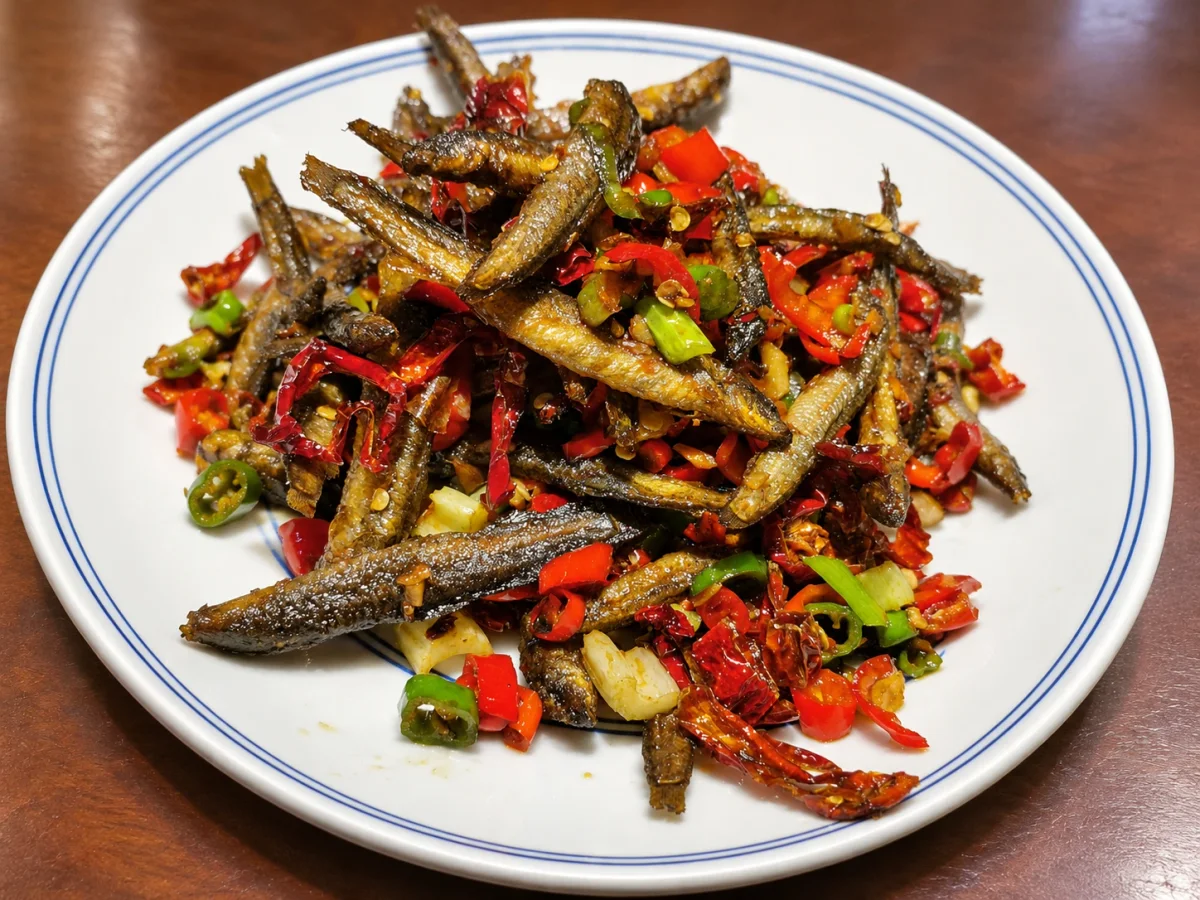
Piled high on a white plate with a blue rim, the loach in our photograph are whole, slim and dark, their skins fried to a bronzed, slightly blistered crisp, among diced fresh red and green chilli, rings of green chilli, curls of dried chilli, slices of garlic and scattered Sichuan peppercorns, everything glossy with oil.
Loach, 泥鳅, are small freshwater fish, and for this dish cooks choose ones about as thick as a little finger. Fried long enough, the bones become brittle and the whole fish can be eaten; small ones are often cooked whole without gutting.
It is a jianghu dish, the name for Chongqing’s tavern cooking of big handfuls of chilli, sheets of red oil and big plates, and it is eaten as a drinking dish: numbing, spicy and crisp.
02
Ganbian, the Sichuan dry-fry
The name describes the technique.
Ganbian, 干煸, means “dry-frying”: cooking an ingredient in a small amount of oil, stirring and turning it, until its own water has been driven off and it is shrunken, chewy or crisp and deeply savoury. It is one of the signature methods of Sichuan cooking. The official description of Sichuan cuisine cooking techniques, listed as national intangible cultural heritage in 2021, counts more than fifty methods and singles out quick stir-frying, ganbian, rice-meal steaming and pickling as the ones Sichuan does best. It names Sichuan and Chongqing as the core area of the cuisine and stresses quick stir-frying over a fierce fire.
With loach the dry-frying takes patience. The wok is heated, greased and filled with a shallow layer of cold oil with a pinch of salt scattered over it, which keeps the delicate skins from sticking. The fish go in in a single layer over high heat until the undersides set, are turned, and then cook more gently for around ten minutes, until, in the cooks’ phrase, they are dry-fried dry, fragrant, cooked and through.
Deep-frying is the faster shortcut; cooks who stick to the slow pan-fry, sometimes with a spoonful of lard, consider it the proper way.
03
Cleaning the loach
Most of the work is done before the wok is hot.
The best size is about as thick as a little finger: smaller fish have no meat on them, bigger ones are hard to fry through. Wild loach cost about 15 yuan a jin at a market in 2023. Live loach are usually left in lightly salted water first, so that they spit out mud; some cooks crack an egg into the water to help them purge, then pour in beer to stun them. In Chongqing the fishmonger will kill and clean them for you, which fishmongers in Guangdong generally will not.
Loach are covered in a thick slime, which has to go. Some cooks rub them with a handful of salt and a splash of strong baijiu, others scrub them with flour, and then rinse until the water runs clear. The salt and alcohol also take away the earthy, muddy smell. Small loach can be cooked whole; larger ones are gutted with scissors, the heads (and sometimes tails) cut off, and each fish laid on its belly and pressed flat with the side of a knife so that it fries evenly and absorbs the seasoning.
Some cooks marinate them for half an hour in rice wine, pepper and scallion, or ginger, garlic, salt and Shaoxing wine, before frying, which removes any lingering muddiness.
04
Sichuan pepper, chilli and garlic
The second stir-fry is quick and fierce.
With the fish fried and lifted out, a little oil is left in the wok and the aromatics go in: dried Sichuan peppercorns, slices of ginger and garlic, and plenty of dried chilli, which Chongqing cooks call the soul of the dish. The chillies are cut small and fried over low heat so that they colour and perfume the oil without burning. Then the heat goes up, the loach go back in with fresh green or red chilli, and everything is tossed for a minute.
The seasoning is salt, a little sugar, MSG or chicken essence, white pepper and a dash of soy sauce run round the hot edge of the wok so that it sizzles. Cooks finish with a few drops of numbing rattan-pepper oil, chopped scallion and a spoonful of red chilli oil for colour. That builds the numbing-hot mala flavour, one of the compound flavours the heritage description counts among Sichuan cooking’s twenty-seven.
Every cook varies it. Some add garlic shoots or strips of pickled vegetable; some finish with a splash of vinegar round the wok and a scatter of sesame seeds; some use green Sichuan pepper for a sharper, more floral numbness.
| Ingredient | When | Why |
|---|---|---|
| 泥鳅 loach | Fried first, slowly | Crisp, sweet, edible bones |
| 花椒 Sichuan pepper | Second fry, low heat | Numbing fragrance |
| 干辣椒 dried chilli | Second fry, low heat | Colour, aroma, heat |
| 姜蒜 ginger and garlic | Second fry | Pungency |
| 青红椒 fresh chilli | With the fish | Freshness and colour |
| 藤椒油 rattan-pepper oil | At the end | A last numbing note |
05
Chongqing’s other loach dishes
Dry-frying is one of several ways with loach.
Chongqing’s jianghu restaurants also braise loach. For soft-braised loach, 软烧泥鳅, also called pa niqiu, 耙泥鳅, “tender loach”, the fish are simmered for twelve to fifteen minutes in a red, spicy sauce of pickled chilli, Sichuan pepper and jianghu hot-pot base, with chunks of loofah added at the end and hot oil poured over the top; the flesh comes out so soft that it slips off the bone. The braising liquid is seasoned with salt, MSG, chicken essence, pepper and a little aged vinegar, and the pot is finished with scallion, chilli oil and rattan-pepper oil.
Loach is also cooked with pickled mustard greens or simply with green chilli. Dry-fried loach sold for 128 yuan a plate in restaurants in 2023, and families also make it at home for festivals.
06
Dry-fried loach at home
Buy live loach and give yourself half an hour.
For 3 to 4: 500 g live loach about as thick as a little finger; 2 tablespoons salt and 2 tablespoons baijiu for cleaning; 4 tablespoons rapeseed or other oil; 1 tablespoon Sichuan peppercorns; a handful of dried chillies, cut into short pieces; 4 slices ginger; 4 cloves garlic, sliced; 2 fresh green chillies and 1 red chilli, cut into rings; ½ teaspoon salt, ½ teaspoon sugar, white pepper, 1 teaspoon light soy sauce; a few drops of rattan-pepper oil, 1 tablespoon chilli oil, chopped scallion.
- 1. Clean
Rub the loach with the salt and baijiu to loosen the slime, rinse until the water runs clear, cut off the heads, slit and clean the bellies and press each fish flat with the side of a knife. Pat dry.
- 2. Dry-fry
Heat the wok, add the oil and scatter a pinch of salt. Lay in the fish, fry over high heat until set underneath, turn, then lower the heat and fry about 10 minutes, turning often, until dry, golden and crisp. Lift out.
- 3. Aromatics
In the oil left in the wok, fry the Sichuan pepper, ginger, garlic and dried chilli over low heat until fragrant and the chilli is dark red.
- 4. Toss
Turn up the heat, add the loach and fresh chilli, season with salt, sugar and pepper, run the soy round the edge of the wok, toss, then add rattan-pepper oil, chilli oil and scallion.
Do not rush the first fry: the fish must be dry right through, or they will go soft in the second.
07
How to order it
Order it with beer, and with friends.
Which loach dish
干煸泥鳅 for crisp, dry fish; 软烧泥鳅 for soft fish in sauce.
Heat
Ask for 微辣 if you are new to Sichuan pepper; the numbing is part of the dish.
Bones
Well-fried small loach can be eaten whole; with bigger fish, eat round the backbone.
Price
Restaurants charge by the plate: 128 yuan in 2023; ask the price first.
With it
Rice or beer, and a vegetable dish to cool things down.
08
More from Sichuan
Other pages on the atlas.
Sichuan cold rabbit
Rabbit dressed in chilli oil and black beans.
Read about Sichuan cold rabbit →Zigong dipping-sauce dishes
Plain-boiled meats with a fierce chilli dip.
Read about Zigong dipping-sauce dishes →Kung pao chicken
Sichuan’s famous stir-fry with peanuts and chilli.
Read about kung pao chicken →Sichuan food
Chengdu, Chongqing and the river towns.
Explore Sichuan →Sichuan classics
- Mapo Tofu
Tofu dish · Lunch or dinner, with rice
- Kung Pao Chicken
Chicken stir-fry · Lunch or dinner, with rice
- Sichuan Hot Pot
Hot pot · Shared meal
- Dan Dan Noodles
Small dressed noodles · Snack
- Bobo Chicken
Cold skewers · Snack
- Leshan Qiaojiao Beef
Beef and offal in herbal bone broth · Breakfast or lunch, shared pot
FAQ
Questions about Sichuan Dry-Fried Loach
What is dry-fried loach?
Small freshwater loach fried slowly in a little oil until dry and crisp, then tossed with Sichuan pepper, dried and fresh chilli, ginger and garlic.
What is a loach?
A small, slim freshwater fish; live loach are kept in salted water to spit out mud before cooking.
What does ganbian mean?
“Dry-frying”: cooking in a little oil until the ingredient’s own water is driven off, a signature Sichuan method.
Can you eat the bones?
With small, well-fried loach, yes; they become brittle and crisp.
Is it very spicy?
It is numbing and hot; ask for a milder version if needed.
How much does it cost?
Restaurants charged about 128 yuan a plate in 2023; wild loach cost about 15 yuan a jin at the market.
How else is loach cooked in Chongqing?
Soft-braised in a red, pickled-chilli sauce with loofah, or with pickled greens or green chilli.
Sources
Sources and further reading
- 1 Sichuan cuisine cooking techniques (川菜烹饪技艺), national intangible cultural heritage item VIII-272 (in Chinese)China Intangible Cultural Heritage Network, Chinese National Academy of Arts (listed 2021) ↗
- 2 Dry-fried loach the Chongqing jianghu way (video, in Chinese)Chuzi Shuo Cai (厨子说菜), Bilibili (June 2021) ↗
- 3 Chongqing jianghu dishes: soft-braised loach (video, in Chinese)Chuzi Shuo Cai (厨子说菜), Bilibili (October 2022) ↗
- 4 Crisp, spicy dry-fried loach, the restaurant way, at home (video, in Chinese)Tiantian Zuo Meiwei (天天做美味), Bilibili (November 2023) ↗
- 5 Numbing, spicy, dry-fragrant loach to go with a drink (video, in Chinese)Suishou Zuo Meishi (随手做美食), Bilibili (March 2022) ↗
- 6 River food is fresh food too: loach should be dry-fried (video, in Chinese)Xun Zhenwei Lao Mei (寻真味佬美), Bilibili (August 2022) ↗
Last updated November 2026