
01
The tray is yours, the wok is the cook’s
Choose the ingredients before you choose the heat. The cook turns the tray into a single dish.
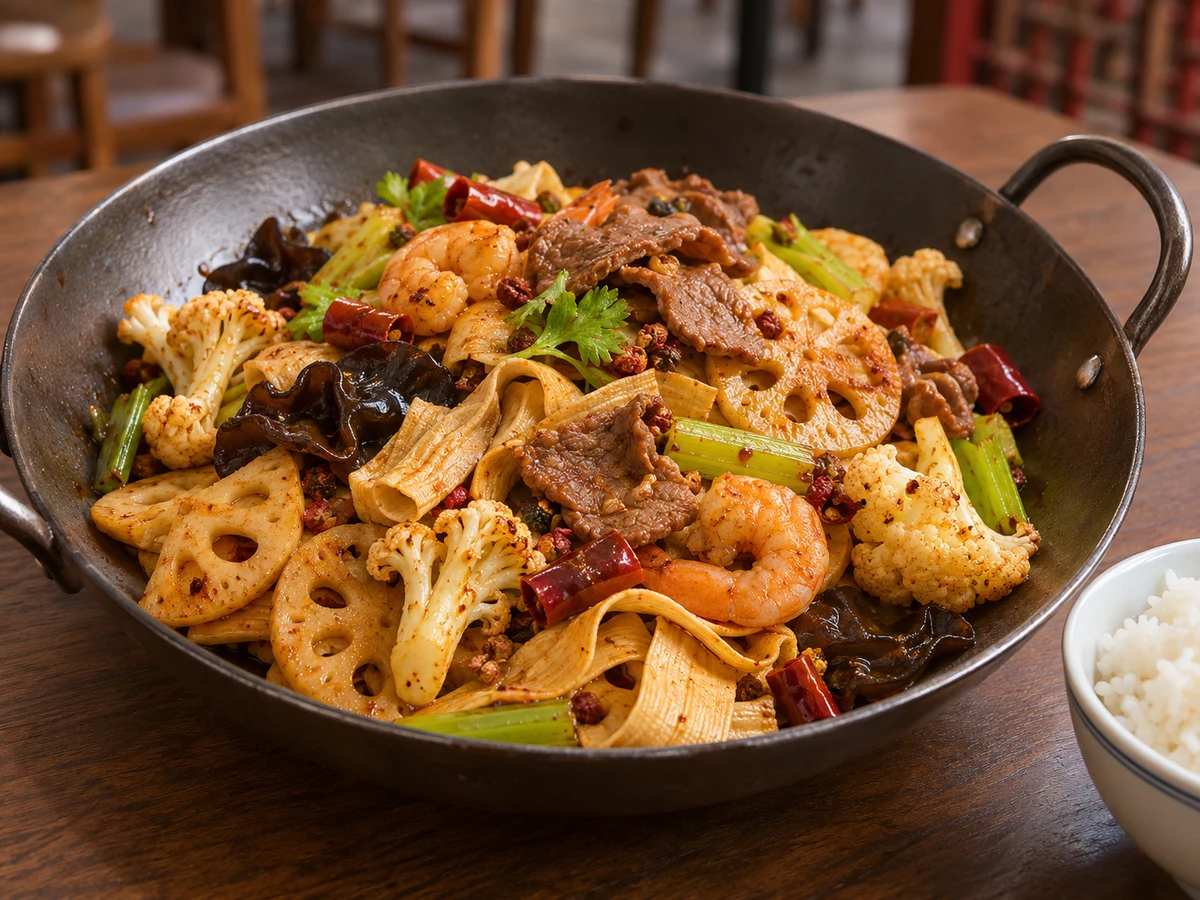
A tray can hold a few slices of lotus root, a coil of tofu skin, a handful of greens and some thinly sliced pork. You get back a shallow bowl with the same ingredients under a coat of reddish oil, smelling of garlic and dried chilies. Pick out a lotus-root coin and it still snaps. The tofu skin folds and holds the seasoning in its creases.
The wok is the last stop. Firm vegetables may be blanched first, shrimp can be fried, and some meats are seared separately. These steps let everything meet the spice base briefly at the end. In one chef’s version, lotus root, potato and mushrooms pass through water, while shrimp are blanched and then crisped in oil. Ginger, garlic, chilies, green Sichuan pepper and a chunk of hot-pot base go into the wok before the ingredients return. The whole pot is finished in the kitchen.
In his 2014 cookbook Gouweir, Luo Shengtang builds a pot around shrimp, chicken wings, lotus root and snow peas. He treats the spice oil as a separate job: soak and drain the dried spices, soften the chilies before chopping, then gently fry the chilies and Pixian fermented bean paste in a blend of rendered fats. Luo explains that the soaking keeps the spices from scorching. He blanches the vegetables, fries the shrimp and cooks the wings separately. Once the oil is ready, they come together with fresh scallion, ginger and garlic for a brief toss over high heat. Low heat draws fragrance into the oil. The final burst of heat coats the food and leaves the snow peas crisp.
The chilies provide the burn and Sichuan pepper provides the tingle. The two sensations are what má and là name. Xiāng is the fragrance of the warmed spices and aromatics, and guō is the pot. A base can be as simple as a little ready-made hot-pot seasoning fried with garlic and ginger, or a kitchen’s own paste with fermented beans and whole spices. Either way, the sauce should reach into the holes in the lotus root and cling to the mushrooms. After the last piece of food, there should be just a little seasoned oil left in the bowl.
02
Dry pot, malatang and hot pot at the counter
Malatang, gan guo and hot pot share the seasoning. What differs is what you choose, who cooks it and whether it comes in broth.
| On the menu | What you choose | What comes out |
|---|---|---|
| Mala xiang guo 麻辣香锅 | Individual ingredients and a heat level | A wok-tossed bowl with seasoning clinging to the food |
| Malatang 麻辣烫 | Individual ingredients, often with a broth choice | The kitchen boils the selection, usually served in broth |
| Gan guo 干锅 | Often a named main ingredient, such as wings, and a size | A cooked dish with a set combination, sometimes kept warm over a burner |
| Hot pot 火锅 | A broth and plates of ingredients | A simmering pot for diners to cook at the table |
The same display case can supply both malatang and mala xiang guo. A Yangguofu branch in Beijing, for example, posted one per-jin rate for fragrant pot and a lower one for malatang in 2025. The tray you fill can look the same either way. What you say at the counter decides whether it goes into the wok or the broth, so decide before the staff take your tray, especially when the stall advertises both.
Gan guo literally means dry pot, and an English menu may use “dry pot” for either dish. On a Chinese menu, a heading like 干锅鸡翅 usually points to a pot built around chicken wings, while 麻辣香锅 with a long ingredients list usually signals a mix you assemble. Where a shop uses both names, ask 自选还是配好的?, “Do I choose the ingredients, or is it a set combination?” Some malatang counters also sell a drained, dressed bowl under names such as 麻辣拌. Ask whether the kitchen tosses it in sauce after boiling or finishes it in a wok.
Malatang
Pick a similar tray, then choose how you want it boiled and dressed.
Compare malatang →Sichuan hot pot
Choose the broth and cook the dishes yourself, a few pieces at a time.
See Sichuan hot pot →03
From southwestern seasonings to a Beijing craze
The seasonings suggest Sichuan and Chongqing. Some of the clearest early records of the dish by name come from Beijing.
By September 2008 a Beijing dining survey treated fragrant pot as an established trend. It described ingredients chosen by the diner, stir-fried in an iron wok and brought to the table ready to eat. Its examples ran from Longshunyuan near Zhongguancun to a Chuanchengyuan inside a Xizhimen mall. A later local government business profile dates the founding of the Na Du brand to 2006 and places its first shop in Beijing’s Shin Kong Place.
Chongqing cooks were among the people spreading it there. A 2021 Chongqing Daily feature follows restaurateurs from Kaizhou, Chongqing, to the capital. One of them, Wang Yong, built Lashangyin around grilled fish and fragrant pot. Grilled fish and fragrant pot use the same chilies, bean paste and peppercorns, so one kitchen can turn out both.
A story credits a Beijing chef surnamed Shi with blending southwestern flavors for local customers. A different account traces it to Tujia home cooking. The Chengdu writer who repeated both also said their provenance could not be checked. In 2012 Sichuan food writer Da Cai described explaining the Beijing craze to friends in Chengdu as a pot you choose like hot pot and have stir-fried like gan guo. The publisher’s contents for Da Cai’s 2014 Sichuan cookbook list fragrant pot and dry-pot chicken wings as separate recipes. Six years after the Beijing craze, the dish was a home recipe in a Sichuan cookbook.
04
Build a tray with more than one texture
A crisp root, a folded piece of tofu skin and a mushroom give three different bites before you even add meat.
| At the counter | Examples | What it adds |
|---|---|---|
| Crisp and firm | Lotus root 莲藕, celtuce 莴笋, cauliflower 花菜 | A clean bite against the oily seasoning |
| Folds and crevices | Tofu skin 豆皮, bean-curd sticks 腐竹, wood ear 木耳 | Surfaces that hold the sauce |
| Meat or seafood | Pork belly 五花肉, shrimp 虾, beef slices 牛肉片 | Fat, sweetness or a savory bite |
| Soft and filling | Potato 土豆, wide starch noodles 宽粉, fish balls 鱼丸 | A denser bite and a heavier tray |
| Fresh greens | Baby bok choy 上海青, cabbage 娃娃菜, leafy greens | A softer bite and a break from the dense pieces |
For a first bowl, try lotus root, tofu skin, wood ear, greens and either shrimp or pork. If you want a starch in the wok, a small handful of potato or wide noodles is enough to see how it takes up the sauce. A bowl of rice catches the seasoning left at the bottom; order it separately if it is listed as an extra.
At the counter, 微辣 means mildly hot by that kitchen’s standards, 中辣 is medium and 特辣 is extra hot. 少辣, “less chili,” and 少麻, “less numbing,” ask for different adjustments. A premixed base ties the two together, so ask when you hand over the tray. A pot of vegetables can still be made with beef tallow or seasoned stock. If you avoid meat, ask 用的是素底料吗?, “Is the base vegetarian?”, before choosing the ingredients.
05
Read the unit before you fill the bowl
A price beside the scale often refers to 50 grams. One jin is 500 grams, ten times that unit.
| Where and when | Posted rate | How to read it |
|---|---|---|
| A Yangguofu branch in Beijing, November 2025 | ¥39.80 per jin | Most meat and vegetables shared a rate, with some items priced separately. Malatang was ¥32.80 per jin at that shop |
| A different Beijing mall counter, November 2025 | ¥2.98 per 50 g for mushrooms and greens, ¥5.98 for meat and seafood | The two categories have different rates |
At ¥39.80 per jin, 350 g costs about ¥28 before any extras. At the separately priced counter, 200 g of greens and 150 g of meat would also be about ¥30 before extras. Check whether meat and vegetables are weighed together, and ask whether rice, packaging or the seasoning is priced separately.
A few dense things add up quickly: a handful of fish balls, a tangle of soaked starch noodles and thick potato slices can outweigh a whole tray of greens. Some restaurant menus give each ingredient a price by the portion. There, add up the portions. When several people share a pot, each can pick two or three items and the kitchen cooks them together.
06
At a Singapore hawker stall or on a New York menu
The dish could travel wherever a stall had space for a display case, a wok and a pot of spice paste.
Food Republic told RICE Media it sent a chef to Beijing in 2008 to learn the dish, then opened its Piao Xiang stall at 313 Somerset in 2009. Ri Ri Hong’s owner recalled opening at People’s Park Food Centre in 2011. The queues there made that stall a point of reference for later diners. The owner saw familiar elements in the format: at a yong tau foo stall or a mixed-rice counter, Singaporeans already knew the pleasure of choosing a meal ingredient by ingredient. Yang Jian, a chef from Chongqing, took another route: he started with a stall in 2015 and grew a business around the same wok-fried dish. At one of his kitchens, a RICE reporter watched the cook finish with a little peppercorn oil in place of whole Sichuan pepper. It brought a floral smell while keeping the tingle relatively light.
At New York’s MáLà Project, a menu and preparation sheet filed with Manhattan Community Board 3 in 2019 use the English label “mala dry pot.” The filing shows how a base can be prepared ahead, using dried chilies, Sichuan pepper, fermented bean paste, aromatics and spices. The menu prices each ingredient by portion: lotus root and tofu skin were US$4 apiece, with white or purple rice listed separately. The order is the same as in Beijing: build a bowl, give a spice level, eat it with rice.
07
At home, finish a small batch in the wok
Cooking each group to the right texture leaves the wok free for the final toss.
Lotus root, cauliflower, tofu skin, baby bok choy and peeled shrimp make a good mix. Have ready ginger, garlic, dried chilies, Sichuan pepper, neutral oil, dry-pot or mala hot-pot paste, and cooked rice.
- 1. Cut and blanch
Slice the lotus root thinly and cut the cauliflower into small florets. Blanch the firm vegetables until just tender, followed by the greens. Drain well. If using dried tofu skin, soften it according to the packet and squeeze out excess water.
- 2. Cook the shrimp
Pat the shrimp dry and stir-fry in a little oil until cooked through, then lift them out. To use thin beef slices instead, cook them separately before the final toss.
- 3. Wake up the base
Heat a little oil over medium heat. Stir the ginger and garlic until fragrant, then add the chilies and pepper. Start with a little paste. Its salt and heat vary by brand, so taste before you add more.
- 4. Bring it together
Toss the well-drained vegetables, tofu skin and cooked shrimp with the paste until coated and hot. A skillet crowded to the rim cools down quickly. If you double the quantities, cook two batches. Finish with cilantro or sesame and bring the rice to the table.
Taste a piece of tofu skin before adding more paste. It picks up the seasoning readily, which gives a better idea of the balance than tasting the leftover oil.
Across China classics
- Stir-Fried Shredded Potatoes
Stir-fried vegetable side dish · Everyday meals with rice
- Tomato and Egg
Home stir-fry · Everyday meals, canteens
- Jiaozi
Boiled, steamed or pan-fried dumplings · Everyday meals; New Year’s Eve in the north
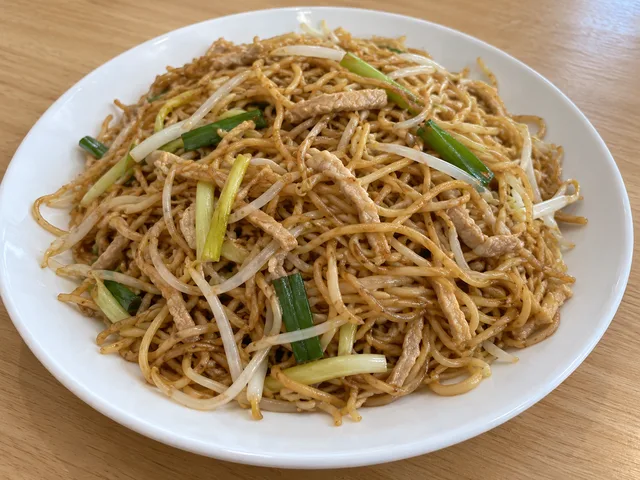
- Chow Mein
Fried wheat noodles · Lunch, late-night meals, takeaway
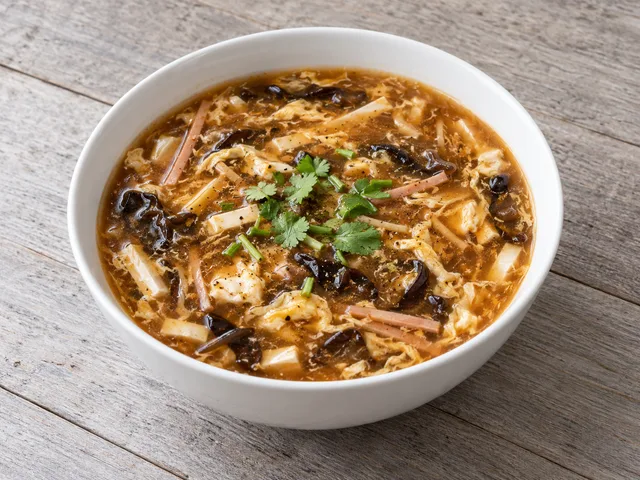
- Hot and Sour Soup
Thickened soup · With dumplings, at banquets
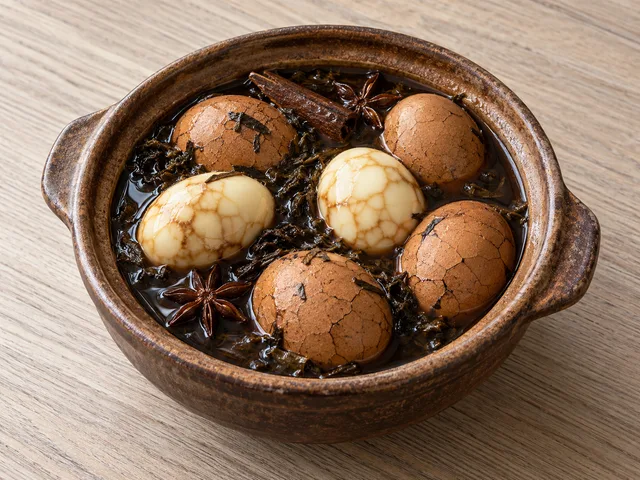
- Tea Eggs
Tea-marbled boiled eggs · Breakfast and snacks
FAQ
Questions about Mala Xiang Guo
What is mala xiang guo?
A pick-your-own Chinese stir-fry with a numbing chili and Sichuan pepper seasoning. The kitchen cooks your meat, vegetables and tofu and tosses them in a wok. It usually comes with rice on the side.
What does mala xiang guo mean?
Málà is numbing and spicy, xiāng is fragrant, and guō is pot. Menus also say mala dry pot or spicy dry pot.
Is mala xiang guo from Sichuan or Beijing?
It uses Sichuan and Chongqing flavors and dry-pot techniques. By 2008 Beijing had multiple specialist shops serving the pick-your-own stir-fry. The precise place and person of invention are unsettled.
What is the difference between mala xiang guo and malatang?
You may start at the same display case. Malatang is boiled and usually served in broth. Mala xiang guo is finished in a wok, with the sauce coating each piece.
Are gan guo and mala xiang guo the same?
Both can be called dry pot in English. On Chinese menus, gan guo often names a main ingredient and comes as a set dish, while mala xiang guo commonly lets you choose a mixed tray. If a menu says only “dry pot,” ask 自选还是配好的? to find out which you are getting.
What should I put in mala xiang guo?
Start with lotus root, a leafy green, tofu skin, a mushroom and one meat or seafood. Add a few potatoes or wide glass noodles if you want a softer, more filling bite.
How do you order it less spicy?
Try 微辣, mildly hot, or say 少辣, less chili. To ask for less numbing pepper, say 少麻. Shops that fry from one premixed base may not be able to lower one without the other.
Can mala xiang guo be vegetarian?
Yes, with a vegetarian base and vegetables, mushrooms and tofu. Ask about beef tallow, stock and any seafood seasoning even if your selections are all vegetables.
How much does mala xiang guo cost?
About ¥30 for one person before rice and extras. One Beijing branch charged ¥39.80 per 500 g in November 2025, so a 350 g bowl came to about ¥28; at another Beijing counter greens were ¥2.98 and meat ¥5.98 per 50 g. Check whether the posted price is per 50 g or per 500 g.
Sources
Sources and further reading
- 1 Fourth-quarter business profiles: Na Du’s founding date and early Beijing mall shop (in Chinese)Qingshan District People’s Government, Baotou (2025) ↗
- 2 MáLà Project’s menu and spice-base process submitted to Manhattan Community Board 3 (in Chinese)New York City public records (2019) ↗
- 3 Seven things fashionable to eat in Beijing: the new fragrant pots (in Chinese)Sina Travel (September 2008) ↗
- 4 A Chengdu writer on the Beijing fragrant pot, Chengdu dry pots and competing origin stories (in Chinese)Chengdu Food Rankings (成都美食排行榜), via Phoenix News (2017) ↗
- 5 Da Cai’s home mala xiang guo: the Beijing restaurant context, ingredients and a packaged-base method (in Chinese)Da Cai’s Sina Blog (2012) ↗
- 6 Kaizhou cooks beyond Chongqing: the Beijing business behind Lashangyin (in Chinese)Chongqing Daily, p. 9 (June 18, 2021) ↗
- 7 Da Cai, Zui Shangyin de Juewei Chuancai: Haochi Daojia, contents: mala xiang guo and dry-pot chicken wings (in Chinese)China Light Industry Press (2014), publisher’s catalogue ↗
- 8 Wang Gang’s written fragrant-pot recipe: preparing the ingredients and frying the base (in Chinese)Chef Wang Gang, Xiachufang (2018) ↗
- 9 Weighed food and price transparency: a Beijing branch’s malatang and fragrant-pot rates (in Chinese)National Business Daily, reprinted in Securities Times (November 2025) ↗
- 10 Separate prices for vegetables and meat at a Beijing fragrant-pot counter (in Chinese)New Message, p. 7, reprinted from Beijing Evening News (November 26, 2025) ↗
- 11 The Secret Life of the Mala Xiang Guo: interviews with Food Republic and Ri Ri Hong (in Chinese)RICE Media (2019) ↗
- 12 How Chongqing-born Yang Jian started a Singapore fragrant-pot business (in Chinese)Desmond Ng, CNA (2019) ↗
- 13 Ma La Xiang Guo: a tested home recipe with separate blanching and searing (in Chinese)Maggie Zhu, Omnivore’s Cookbook (updated 2025) ↗
- 14 Luo Shengtang, Gouweir: 80 Classic Home Dishes, “Mala xiang guo” (in Chinese)Beijing Science and Technology Press (2014) ↗
- 15 Mala xiang guo with shrimp, tripe, lotus root and potato (video, in Chinese)Chef Wang Gang, Bilibili (2018) ↗
- 16 Fragrant pot, beginning with the stir-fried spice base (video, in Chinese)Masters of the Dish, Bilibili (2022) ↗
Last updated November 2026