
01
A breed, not a recipe
In 2025 Qingyuan raised more than 161 million of these chickens, and the whole industry was valued at 13.7 billion yuan.
When a Cantonese menu says 清远鸡, it is telling you which chicken is in the dish, the way a menu elsewhere might name a breed of beef. Guangdong has several famous local chickens, the bearded chicken of Huizhou, the Shiqi chicken of Zhongshan, the Huaixiang chicken of Maoming, and Qingyuan chicken is the best known of them. Qingyuan’s own government calls it “the first chicken of Lingnan.”
What people pay for is texture and taste. Qingyuan’s publicity department lists the qualities: smooth skin, soft bones, tender meat and a strong chicken flavour. A 2022 Time Weekly report adds that it has little fat under the skin and firm meat, that chefs call it a “civil and military chicken” because it is good whether steamed, stir-fried, stewed or roasted, and that soup made from it is noticeably sweeter than soup from an ordinary farm bird.
The name is also a legal one. Qingyuan chicken is a national geographical indication product, the first live poultry in Guangdong to be protected that way, and only birds raised in the protected area along the North River, in Qingcheng, Qingxin, Fogang and Yingde, may carry it.
02
Hills, bamboo and 150 days
The flavour comes from slow growth and exercise.
Qingyuan lies on the North River where the flat Pearl River Delta gives way to the hills of northern Guangdong. Most farms are on hillsides, and the birds range through bamboo and woodland during the day, some flying up to roost in the trees. A Qingyuan chicken is a small breed: it does not get much bigger as it ages, so the longer it lives, the denser its meat. Farmers keep them for 150 to 200 days; an ordinary broiler goes to market at 40 to 50.
In 2026 the city went further and published a standard with an online retailer for what it calls “running chicken.” Birds must be at least 150 days old, premium ones over 160; they must spend at least six hours a day outdoors; and each wears a leg ring that counts its steps, which must pass one million before it can be sold.
Freshness matters as much as age. A Guangzhou restaurant group interviewed in 2022 described its routine: birds collected from the farms at one or two in the morning, slaughtered at five, and in its city restaurants by seven.
03
White-cut: the test of a chicken
A good Qingyuan chicken is first judged as white-cut chicken.
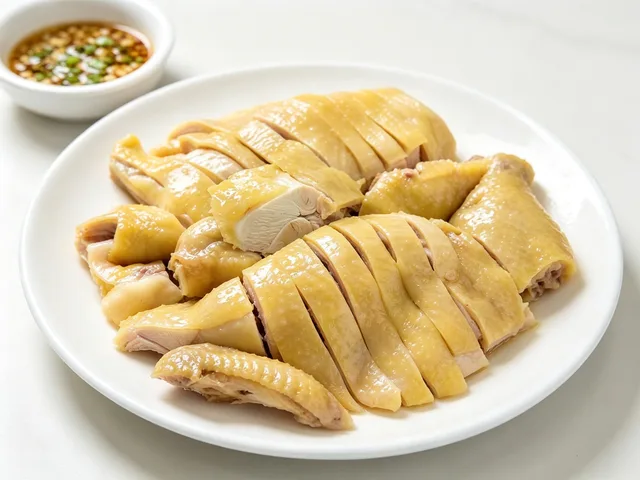
White-cut chicken, 白切鸡, hides nothing. A 1975 Cantonese cookbook gives the classic method: the whole bird is lowered into water held just below the boil and left for about fifteen minutes, lifted out twice so the hot water in the cavity drains and the inside cooks at the same pace as the outside, then plunged into cold water so the skin tightens. It is brushed with oil, chopped, and served cold with a saucer of ginger paste and scallion, salt and hot peanut oil poured over them.
The 1991 edition notes that the Qing writer Yuan Mei placed white-sliced chicken first among his chicken dishes, and that of the 210 or so chicken dishes in Cantonese cooking it is the one people never tire of. The local ideal is meat cooked through, but with a faint pink at the bone.
04
Sauna chicken: sliced raw, steamed in minutes
Sauna chicken is steamed at the table in three to five minutes.
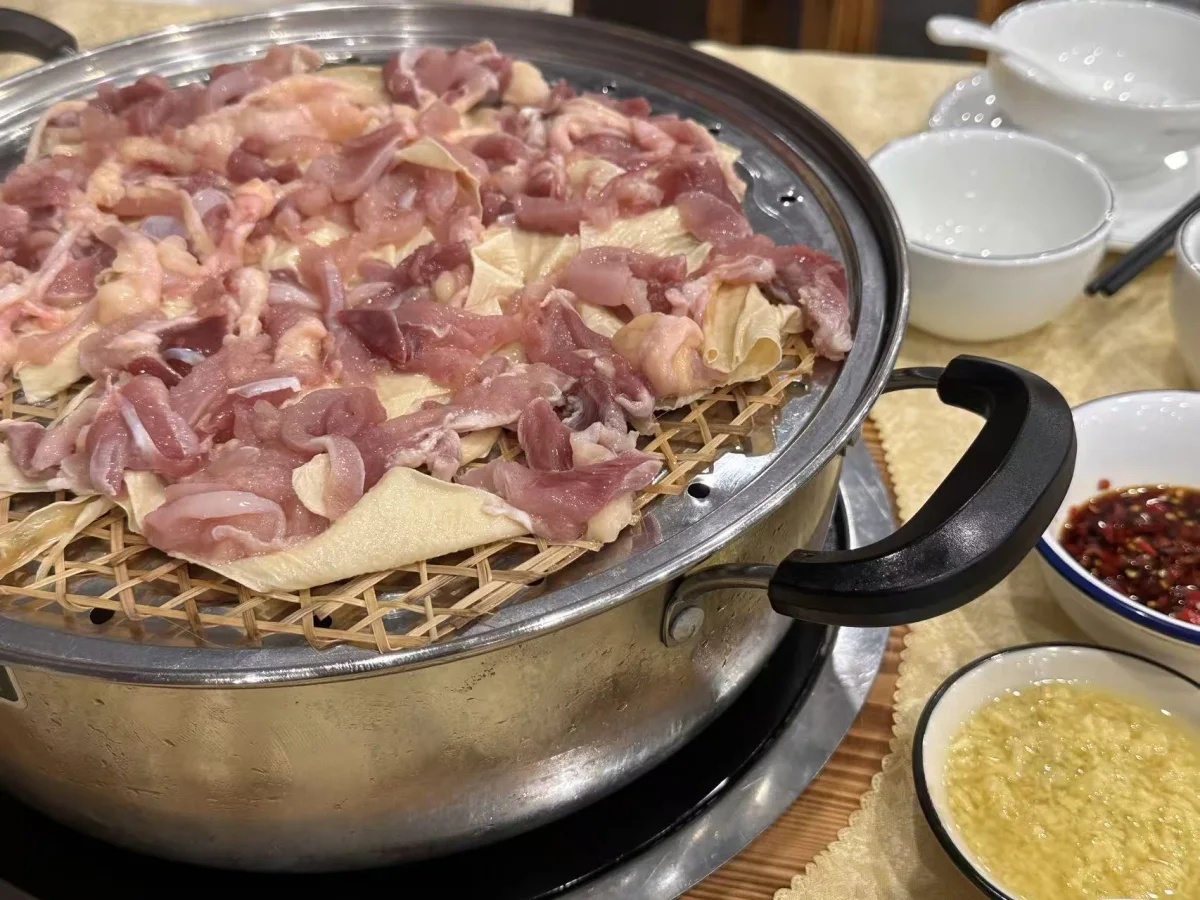
桑拿鸡, “sauna chicken,” is cooked in a two-tier pot at the table. The bottom holds water or broth, often made from the chicken’s own bones; the top is a perforated steaming tray, sometimes lined with a bamboo mat and sheets of tofu skin, corn or vegetables, with a hole in the middle to let the steam through. The chicken is boned and sliced raw, sometimes tossed with a little salt, oil and starch, spread in a single layer on the tray, and covered. Three to five minutes later it is done: just cooked, very juicy, its skin soft.
At a Shunde farm restaurant in 2026, the bird was killed and boned to order for 280 yuan; the bones went into the pot below to make soup, the meat was spread out around the central steam hole, and it was ready after four minutes. Cantonese home cooks make another version in which the bottom pot holds rice boiled with the bones into congee: every drop of juice falling from the chicken ends up in it, and the congee is eaten last, seasoned with scallion, white pepper and sesame oil.
The dip is simple: soy sauce with sand ginger, shredded ginger, peanut oil and fresh chilli.
05
Soy, scallion oil and stir-fried
At Qingyuan’s farm restaurants a bird is often split between dishes.
Farm restaurants around Qingyuan sell the chicken by the bird and cook it as many ways as you like. At one village restaurant in 2026, a bird of just under four jin live weight cost 128 yuan, plus 10 yuan for each style; the diners had two birds made four ways, half white-cut, half with scallion oil, half braised in soy and half stir-fried with chilli, plus the giblets fried with green and bird’s-eye chillies. Three people paid 309 yuan.
Elsewhere Qingyuan chicken is salt-baked, roasted, or cut up for the chicken hot pots that have become popular in Guangdong; Qingyuan’s publicity department notes that one well-known Foshan chain builds its pots on genuine Qingyuan chicken.
06
How to tell a good bird on the plate
Cantonese diners check four things.
Thin, smooth skin
Smooth skin with little fat beneath it; in white-cut chicken it should be glossy and crisp.
Firm, springy meat
Tender but springy, with some bite.
Soft, fine bones
Soft bones; in white-cut chicken a faint pink at the bone is considered ideal.
Sweet broth
Soup made from the bird should taste sweeter than soup from an ordinary farm chicken.
07
Sauna-steamed chicken at home
Any good free-range chicken works; the steamer does the rest.
One free-range chicken of about 1.5 kg (or 4 thighs); 1 teaspoon salt, 1 tablespoon cornstarch, 1 tablespoon peanut oil; a thumb of ginger; 80 g rice; a few sheets of dried tofu skin or slices of corn or loofah; a large pot with a steaming tray and lid. Dip: 3 tablespoons light soy sauce, 1 teaspoon ground sand ginger or finely chopped fresh ginger, 1 tablespoon hot peanut oil, chopped fresh chilli to taste.
- 1. Make the base
Bone the chicken and keep the bones. Blanch the bones, then boil them with sliced ginger and 2 litres of water; add the rice and cook 30 minutes into a thin congee.
- 2. Prepare the chicken
Cut the meat into thin slices, skin on. Toss with the salt, cornstarch and peanut oil and leave 10 minutes.
- 3. Steam
Line the steaming tray with tofu skin or vegetables, spread the chicken over it in one layer, leaving the centre clear. Set it over the boiling congee, cover and steam 4 to 5 minutes, until the meat is just white throughout.
- 4. Eat in two rounds
Eat the chicken with the dip. Then remove the tray, season the congee, now full of chicken juices, with scallion, white pepper and sesame oil, and eat it last.
Do not pile the chicken up: in one layer it cooks evenly and fast. Slices from the leg stay juicier than breast.
08
How to order it
Order by the bird, and decide how to split it.
In Qingyuan
Farm restaurants on the edge of the city sell by the bird, killed to order; in 2026 one charged 128 yuan a bird plus 10 yuan per cooking style.
Split it
For two to four people, half white-cut and half another style (soy, scallion oil, stir-fried) shows the bird at its best.
Sauna chicken
Expect a whole bird per table; a Shunde farm charged 280 yuan for one in 2026. Do not overload the tray, and drink the soup at the end.
Check the claim
Many restaurants across Guangdong advertise Qingyuan or “running” chicken; the genuine article comes from the protected area along the North River.
Expect texture
The meat is firmer than broiler chicken and the bones are fine.
09
More Cantonese chicken
Other pages on the atlas.
White-cut chicken
The full story of Cantonese poached chicken.
Read about white-cut chicken →Cantonese chicken hot pot
The chicken pot boom built on local birds.
Read about chicken hot pot →Wenchang chicken
Hainan’s famous bird, served poached.
Read about Wenchang chicken →Guangdong food
Cantonese, Chaoshan and Hakka cooking.
Explore Guangdong →Guangdong classics
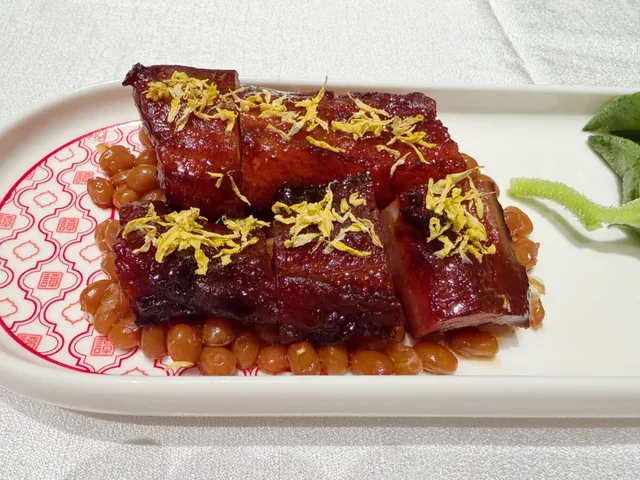
- Char Siu
Roast pork · Lunch or dinner, with rice
- White Cut Chicken
Poached chicken · Lunch or dinner
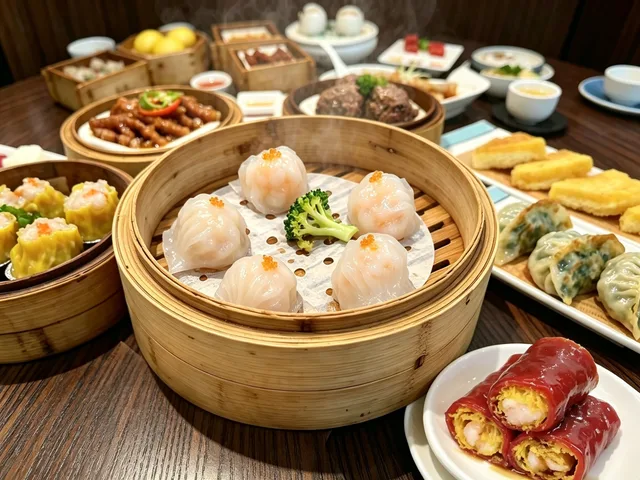
- Cantonese Yum Cha
Yum cha · Morning tea, weekends with family
- Egg Fried Rice
Fried rice · Lunch, dinner, end of a meal
- Beef Chow Fun
Fried rice noodles · Lunch, dinner or late-night supper
- Mooncake
Festival pastry · Mid-Autumn Festival
FAQ
Questions about Qingyuan Chicken
What is Qingyuan chicken?
A small, free-range local chicken breed from Qingyuan in northern Guangdong, protected as a geographical indication and prized for thin skin, firm meat and strong chicken flavour.
Why is it better than ordinary chicken?
It is reared on hillsides for 150 days or more, against 40 to 50 for a broiler, so the meat is denser and tastier, with little fat under the skin.
What is the best way to eat it?
White-cut, poached and served cold with ginger and scallion, shows the bird most clearly; sauna-steaming is the popular modern way.
What is sauna chicken?
Raw sliced chicken steamed for a few minutes on a tray over a pot of broth or congee at the table; the juices drip into the pot, which is eaten last.
How much does a Qingyuan chicken cost?
At a Qingyuan farm restaurant in 2026, 128 yuan a bird plus 10 yuan for each cooking style; restaurant sauna chicken in Shunde was 280 yuan a bird.
Is all “Qingyuan chicken” really from Qingyuan?
Only birds raised in the protected area along the North River qualify; many restaurants use the name loosely.
Can I get it outside China?
Not usually; use a well-raised free-range chicken and cook it the same simple ways.
Sources
Sources and further reading
- 1 Qingyuan’s “running chicken” standard: 150 days, a million steps (April 2026) (in Chinese)Qingyuan Release, Qingyuan municipal publicity department, via The Paper (in Chinese) ↗
- 2 Explore Qingyuan’s scenic views and delicious chicken this summer (2025)South / Newsgd, Guangdong ↗
- 3 Li Hang, The place in China that eats the most chicken, and the billion-yuan bird behind it (2022) (in Chinese)Time Weekly, via Jiemian (in Chinese) ↗
- 4 Chinese Cookbook: Guangdong (中国菜谱·广东), p. 148: white-cut chicken (in Chinese)China Financial and Economic Publishing House (1975), indexed by laocp.tech ↗
- 5 Famous Chinese Dishes, new edition: Guangdong (中国名菜谱·广东风味), p. 75: white-cut chicken (in Chinese)China Financial and Economic Publishing House (1991), indexed by laocp.tech ↗
- 6 A 128-yuan Qingyuan chicken at a village farm restaurant, cooked four ways (video, in Chinese)Dage zai Shanghai (达哥在上海), Bilibili (June 2026) ↗
- 7 Sauna chicken at a Shunde farm restaurant: 280 yuan a bird, four minutes of steam (video, in Chinese)Dage zai Shanghai, Bilibili (June 2026) ↗
- 8 Cantonese steamed chicken, eight ways, including the steam hot pot over congee (video, in Chinese)Mati Chufang (马蹄厨房), Bilibili (November 2023) ↗
Last updated November 2026