
01
Smoky pork, red noodles, sour fire-roasted sauce
The noodles are made with red rice, and the broth is sharpened with vinegar.
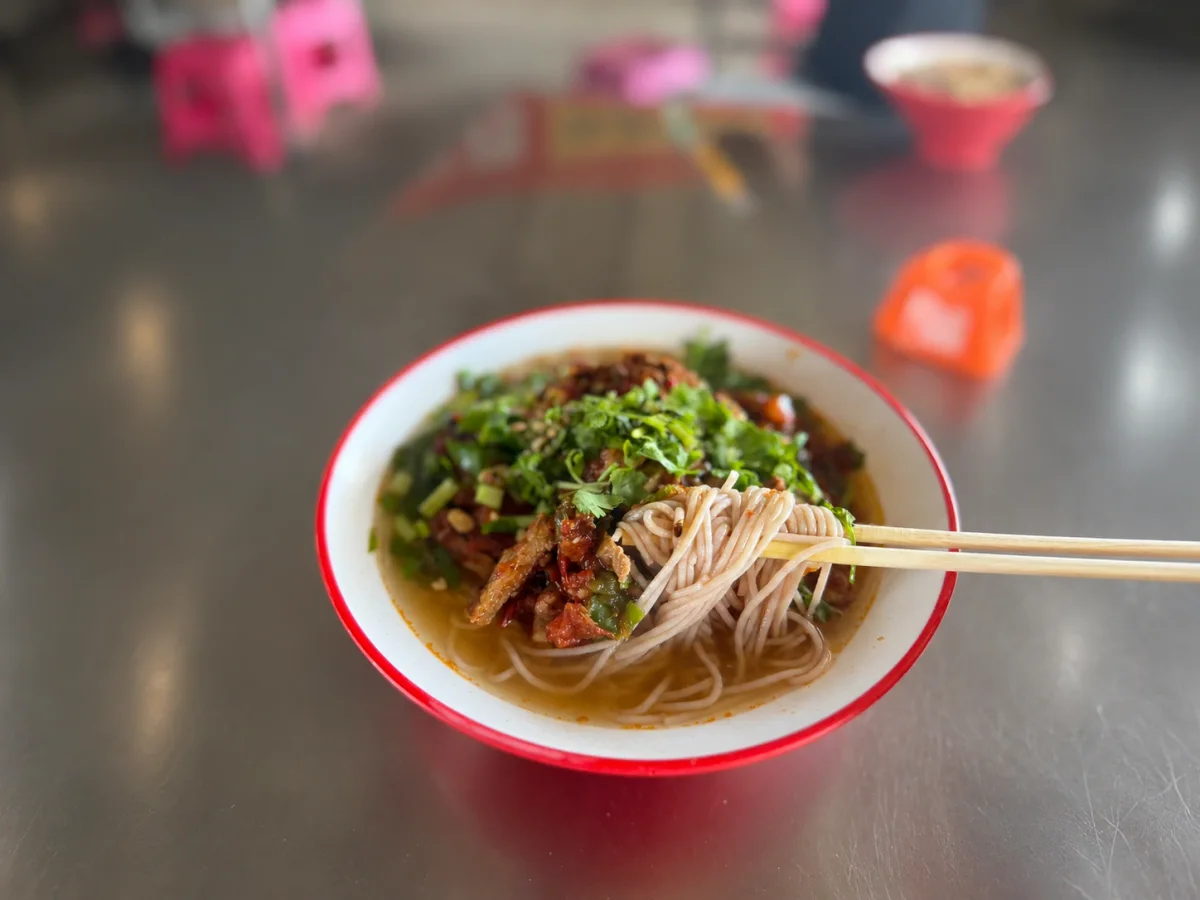
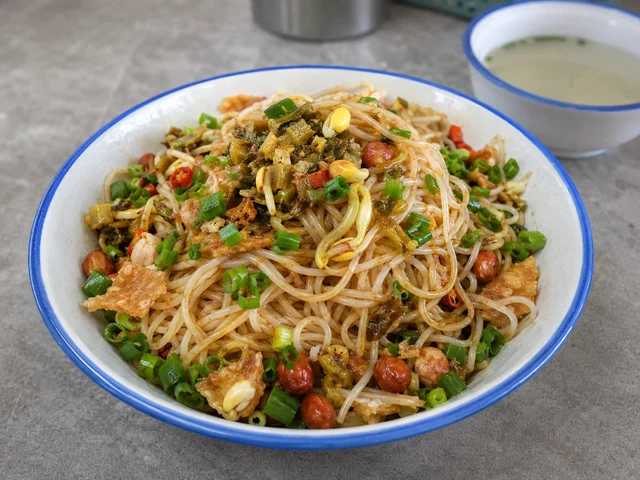
The bowl at the top of this page is a typical one: noodles with a faint reddish-brown tint in a little broth, a heap of chopped, blackened pork, coriander, scallion and peanuts, and a red-flecked sauce soaking into everything. The noodles are made by hand from white and red rice. The pork carries pine smoke, and the thick sauce, sour, hot and faintly sweet, coats the noodles.
The bowl from the market street of Shunjiang, a village in Gudong town north of Tengchong city, is known far and wide. Its secret is pork belly grilled over open pine-wood fire as the topping and a sauce of tomatoes and green chillies roasted in the fire and chopped together; the sourness, heat and scorched flavour of the vegetables and the pine smoke in the meat cannot be reproduced in a city kitchen.
In Yunnan, a rice-noodle topping is called a hat, maozi. Here the hat is the grilled pork.
02
Shunjiang, the market street in Gudong
The dish is tied to one street in one market town.
Shunjiang is a street in Heping village, Gudong town, north of Tengchong city, opposite the town’s middle school. It is an old morning-market street of wooden houses, and on it one shop after another sells grilled pork rice noodles; the smell of pine smoke and roasting pork drifts along the whole street. Shops in Tengchong city often borrow the Shunjiang name on their signs, and Shunjiang is generally said to be where the dish began.
In 2022 one owner had been running the same shop for twenty years; another shop had been open thirty years by 2025, and its owner’s parents had sold rice noodles before that. Locals eat it for breakfast or lunch, and the best things can run out: in 2022 one shop warned that anyone coming in the afternoon would find the braised pork bones gone.
03
Pork belly in the flames
The pork goes straight into the fire.
At the Shunjiang shops the grill is a fire pan of pine logs, or of charcoal and pine at one shop in 2025, burning high, and the pork belly goes straight into the flames, not above them. In five minutes or less a thick slab comes out charred black outside and just cooked inside, smelling of resin and smoke. Locals take their pork grilled for an even shorter time than visitors do. In 2024 and 2025 the Shunjiang shops used fresh pork belly from pigs raised for two years, which gives firm fat that is not greasy. On a street of noodle stalls in 2022, the belly was marinated first, and extra pieces could be ordered for 10, 20 or 30 yuan.
The blackened outside is scraped or cut away where it is burnt, and the meat is chopped into small pieces for the bowl.
04
Roasted tomato and green chilli
The sour-hot sauce is cooked on the same fire.
Whole tomatoes and green chillies are laid on the fire until the skins blister and blacken, then peeled. In 2022 one shop chopped them on a wooden block with a hollow in the middle so that the juice would not run away, into a loose, smoky paste that smelled sharply sour and hot. At one shop a single bowl took a whole tomato and a whole chilli. At another, in 2025, the sauce was chopped by hand, though on busy days a machine did it, and sesame, chilli, Sichuan pepper and other spices went in. At a shop in 2023 the green chillies and tomatoes were roasted over charcoal, and the grilled pork was chopped into them and mixed with the seasonings.
The tomato gives the sourness, but the shops add vinegar too: one in 2025 used three kinds, another in 2024 made its own.
05
Red rice noodles and a dozen jars
Each bowl is assembled from jars.
The noodles are made with red rice, which gives them their pinkish-brown colour; the rice is an old variety, also called mountain rice. They are soft and slippery with a slight stickiness. A dozen jars stand on the counter: crushed peanuts, sesame, garlic, chilli that is fragrant rather than hot, toon shoots, known locally as chunya, and vinegar. In 2022 one shop braised its pork ribs until the meat came away from the bone. The bowl can come with pork-bone broth or dry, tossed with the sauce; the dry version is more flavourful.
| Part | What it is | Notes |
|---|---|---|
| 红米线 red rice noodles | Fresh rice noodles made with red rice | Soft, slippery, slightly sticky |
| 烧肉 grilled pork | Pork belly charred over pine fire, chopped | The “hat” |
| 烧番茄烧辣椒 sauce | Fire-roasted tomato and green chilli, chopped | Sour, hot, smoky |
| 醋 vinegar | Often homemade; sometimes three kinds | More sourness |
| 花生 芝麻 蒜 | Crushed peanuts, sesame, garlic | Crunch and bite |
| 春芽 toon shoots | Young leaves of the Chinese toon tree | A distinctive aroma |
| 骨头汤 broth | Pork-bone or rib broth | Optional; or eat it dry |
06
One hat among many
In Yunnan, a bowl of rice noodles is named after its hat.
In Yunnan the noodles are the constant; what changes is the maozi, the hat. Famous meat dishes from across the province end up as hats: Zhanyi chilli chicken, Yuxi sauce-fried eel, Yiliang crisp pork trotters, Kunming crispy beef, Zhaotong red-braised beef, Yongping braised chicken, and, from the prefecture Tengchong belongs to, Baoshan fire-grilled pork. Many noodle shops have made one hat for two generations and write it on the sign, so you order by the name over the door. In the morning, people in a hurry eat big-pot noodles, scalded and topped with hot broth and a hat; with time to spare, they wait for small-pot noodles cooked to order. The noodles themselves come in two kinds. Ganjiang noodles are finer, springy and smooth, with a sweet scent of rice; suanjiang noodles are naturally sour, thicker and looser, and soak up more sauce. Old Kunming put soup hats on ganjiang noodles and dressed suanjiang noodles cold with soy sauce and vinegar.
Sources [1]
07
What it costs
Bowls cost between 5 and 20 yuan.
In 2022 one shop’s bowls started at 10 yuan, and another charged 20 yuan for a big deluxe bowl and 5 yuan for a small one. In 2024 a Shunjiang shop sold bowls at 15 and 20 yuan, and in 2025 another charged 20 yuan. Extra pieces of grilled pork could be ordered on their own. At one Shunjiang shop in 2024 the noodles were refilled free, and you could go back for several extra helpings.
08
Grilled pork rice noodles at home
A charcoal grill gets you close; the pine smoke is the part you cannot copy.
For 2: 300 g skin-on pork belly in one or two thick slabs; 2 ripe tomatoes; 2 long green chillies; salt; 2 tablespoons rice vinegar; 1 clove garlic, crushed; 400 g fresh rice noodles (or dried, cooked); 2 tablespoons crushed roasted peanuts; sesame seeds; chopped coriander and scallion; a few young toon leaves if you can find them; 500 ml pork or chicken stock, optional.
- 1. Grill
Over very hot charcoal, grill the pork belly close to the coals, turning, until charred outside and just cooked, about 6 to 8 minutes. Grill the tomatoes and chillies at the same time until blackened and soft.
- 2. Sauce
Peel the tomatoes and chillies, chop them together finely with the garlic, and season with salt and vinegar.
- 3. Chop
Scrape off any burnt crust from the pork and chop it into small pieces.
- 4. Assemble
Blanch the noodles, put them in bowls with a little hot stock or none, top with the pork and sauce, and scatter with peanuts, sesame, coriander, scallion and toon.
Add more vinegar if it is not sour enough: the bowl should taste sharp, smoky and hot.
09
How to order it
Go to Gudong in the morning if you can.
Where
Shunjiang Street in Gudong town for the original; shops with Shunjiang on the sign in Tengchong city.
When
Breakfast or lunch; some things sell out by afternoon.
Size
A big bowl means more pork; extra pieces can be ordered separately.
Soup or dry
Ask for broth, or have it dry-tossed with the sauce.
Noodles
Some shops also do it with ersi, rice-cake noodles, instead of rice noodles.
10
More from Yunnan
Other pages on the atlas.
Crossing-the-bridge noodles
Yunnan’s best-known bowl of rice noodles.
Read about crossing-the-bridge noodles →Ersi
Rice-cake noodles, Tengchong’s other staple.
Read about ersi →Mushroom hot pot
Yunnan’s wild-mushroom season in a pot.
Read about mushroom hot pot →Yunnan food
Rice noodles, mushrooms and more.
Explore Yunnan →Yunnan classics
- Mangshi Beef Rice Noodles
Beef rice noodles in clear broth · Breakfast
- Crossing-the-Bridge Noodles
Rice-noodle soup · Lunch or dinner
- Steam Pot Chicken
Soup · Lunch or dinner
- Flower Cake
Rose pastry · Bakery snack or boxed gift
- Mushroom Hot Pot
Wild mushroom hot pot · Rainy season, June to September
- Ersi
Pounded-rice noodles · Mostly breakfast
Noodles from other regions
FAQ
Questions about Tengchong Grilled Pork Rice Noodles
What is shaorou mixian?
Rice noodles topped with pork belly charred over a pine-wood fire and a sauce of fire-roasted tomato and green chilli.
Where does it come from?
Shunjiang, a market street in Gudong town, north of Tengchong city in western Yunnan.
Why are the noodles reddish?
They are made with red rice.
Is it spicy?
Moderately: the green chillies are roasted, and the sauce is more sour and smoky than fiery.
Is it a soup?
It can come with pork-bone broth or dry, tossed with the sauce.
How much does it cost?
About 10 to 20 yuan a bowl in 2022 to 2025.
When do people eat it?
Mostly for breakfast or lunch.
Sources
Sources and further reading
- 1 Zhang Shiqiu, Tabian Qingshan Chifan Qu (踏遍青山吃饭去): “Rice noodles, king of the rice staples” (in Chinese)Yunnan People’s Publishing House, 2025; WeRead edition ↗
- 2 Ten-yuan grilled pork rice noodles in Yunnan: 1,200 km for big pieces of pork belly grilled to order (video, in Chinese)Rourou Da Sousuo (肉肉大搜索), Bilibili (January 2022) ↗
- 3 Shunjiang grilled pork rice noodles: pork belly over a pine fire at an old shop in a Tengchong market town (video, in Chinese)A Xing Tan Dian (阿星探店), Bilibili (March 2022) ↗
- 4 A day of eating meat in Tengchong: grilled pork rice noodles, copper-ladle beef and Yunnan barbecue (video, in Chinese)Mixue Shiji (米雪食记), Bilibili (April 2025) ↗
- 5 Grilled pork rice noodles in Tengchong: 20 yuan a bowl, noodles refilled free (video, in Chinese)Xunchang Jiemei (寻尝姐妹), Bilibili (June 2024) ↗
- 6 The grilled pork rice noodles I keep going back to Tengchong for (video, in Chinese)Yesheng Jun A Liang (野生君阿良), Bilibili (March 2023) ↗
Last updated November 2026