
01
Sweet, thick, and full of things
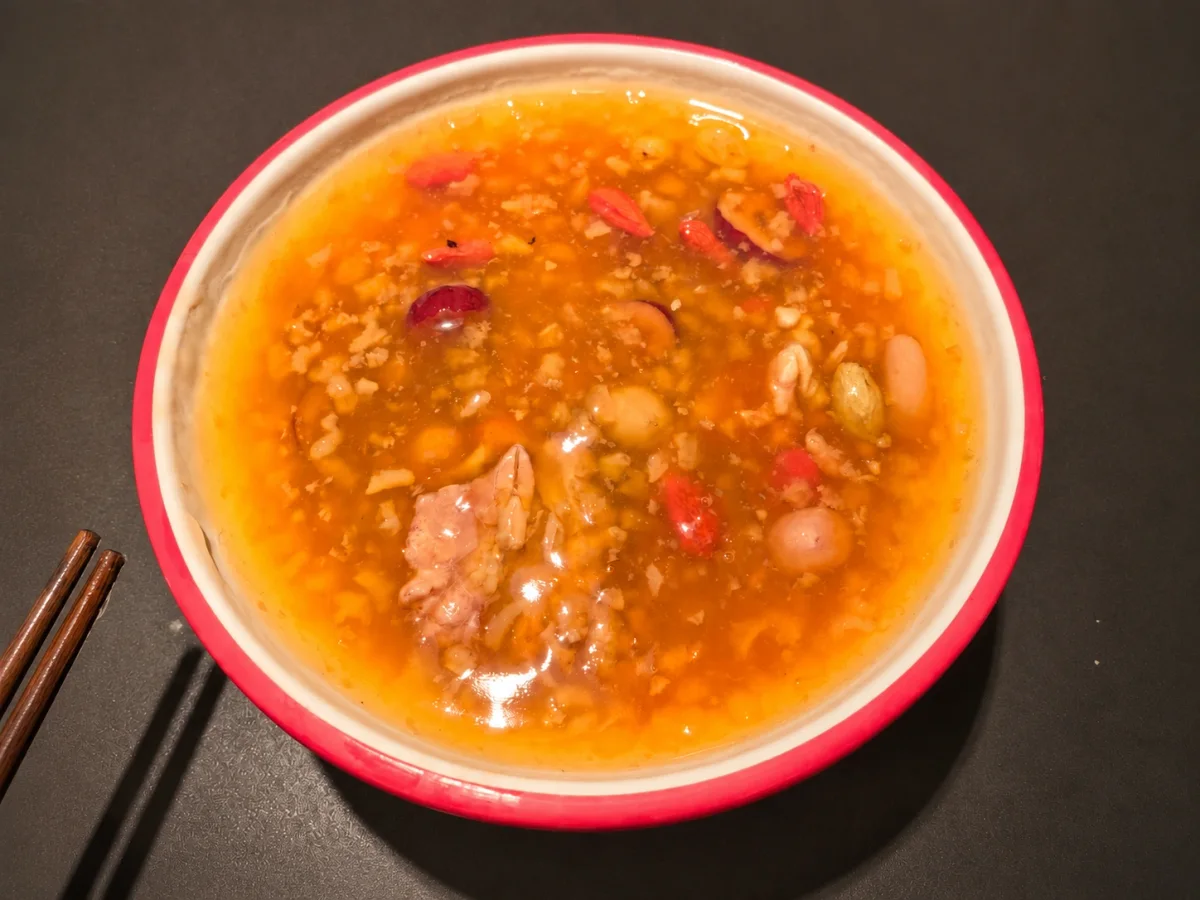
One 2022 bowl held eight kinds of ingredients and was thick but not too sweet.
It arrives as a deep bowl of something halfway between a porridge and a sweet soup: glossy, golden-orange, thick enough to hold up a spoon for a moment. Grains of glutinous rice hang suspended in it with red dates, goji berries, peanuts, lotus seeds, pieces of lily bulb and walnuts, and on top there may be raisins, sunflower seeds, black sesame or little red chips of dried hawthorn.
The name is misleading if you know Cantonese congee. Xifan, 稀饭, usually means rice cooked long in plenty of water until it breaks down. This is cooked in minutes. Its thickness comes from starch, not from long boiling, and the method is much closer to mixing a bowl of lotus-root starch than to making congee: the pot is stirred steadily as the starch slurry goes in.
The taste is sweet and fragrant rather than heavy: the osmanthus and rose jams give it a floral note, the hawthorn and dates a little sourness. A bowl is good after greasy food.
02
Huanggui: osmanthus, Xi’an style
Huanggui, 黄桂, is what Xi’an calls sweet-scented osmanthus preserved for cooking.
Osmanthus jam, huanggui jiang, and rose jam, meigui jiang, are the two perfumes of Xi’an sweets. A 1985 collection of Shaanxi snacks fills the city’s famous persimmon cakes with sugar, walnuts and lard worked together with both jams; the same book finishes Xi’an’s thick glutinous rice wine, huanggui chou jiu, by stirring osmanthus jam into the hot wine. The Xi’an food writers Su Yuhai and Cheng Peng explain that the wine takes its name from the jam, and retell a legend that Yang Guifei, the Tang emperor’s consort, handed a wine-seller a sprig of osmanthus to scatter in his wine.
The porridge belongs to the same family. Shops add a spoonful of osmanthus jam, a spoonful of rose jam, or both, and the jams give the porridge its golden-red colour as well as its scent.
03
One small pot at a time
At a good shop each bowl is made to order.
At a back-street barbecue shop in 2022, the cook made each order in a small copper pot with a copper ladle. Water went on to boil with pre-soaked glutinous rice, then red dates, goji berries, peanuts, sunflower seeds, almonds and walnuts, a spoon of osmanthus jam and a spoon of rose jam. A slurry of starch went in last, stirred until the liquid thickened and turned glossy, and the bowl was finished with raisins and hawthorn. At another shop in 2025 the order was slightly different, jams, water and sugar first, then sliced dried dates and the soaked rice, then starch, and the toppings were sunflower seeds, crushed peanuts, hawthorn, raisins and black sesame. Every shop has its own mix.
04
What is in the bowl
“Eight treasures” is a figure of speech; the count varies.
Toppings differ from shop to shop. In 2023 one bowl came covered in sesame and sunflower seeds, with dates, goji and lily inside.
| Ingredient | Role | Notes |
|---|---|---|
| Glutinous rice (江米) | Body | Soaked, then cooked briefly; stays chewy |
| Starch | Thickener | Potato or other starch; gives the glossy set |
| Osmanthus and rose jam | Fragrance and colour | Turn it golden-red |
| Red dates, goji | Sweetness, colour | Dates often sliced |
| Peanuts, walnuts, almonds | Crunch | Peanuts sometimes boiled first |
| Lotus seeds, lily bulb | Soft texture | Boiled in the water first |
| Raisins, hawthorn, sesame, sunflower seeds | Toppings | Hawthorn adds sourness |
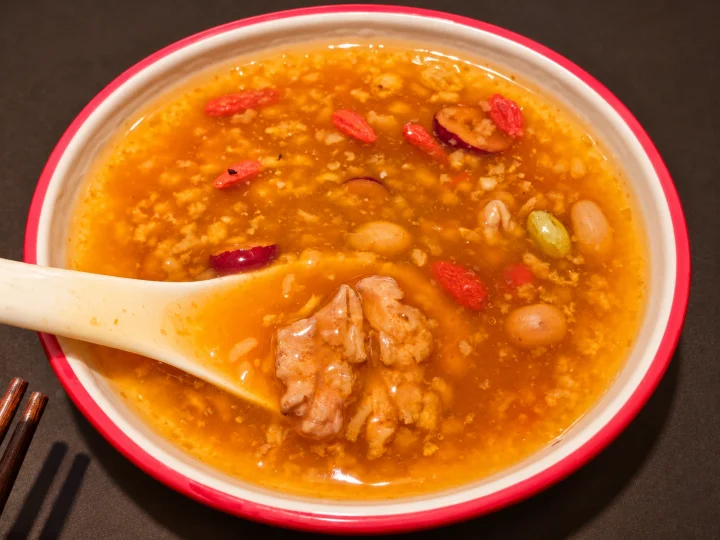
A spoonful closer
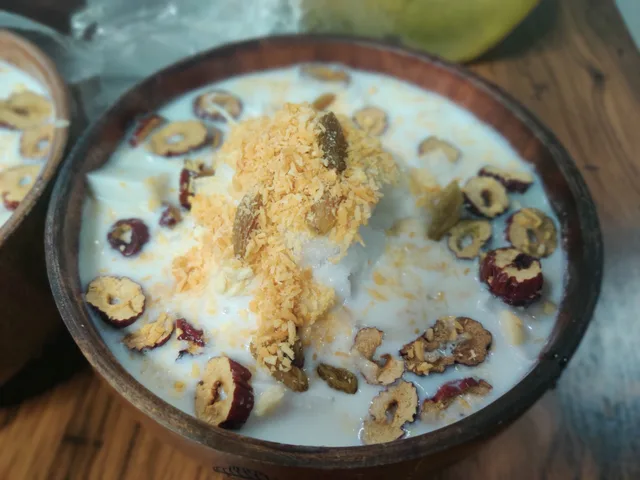
Our own photograph of the same bowl.
05
Which eight treasures?
In Shaanxi cookbooks the treasures are a set of sweet fruits and nuts, and the set can change.
The same treasures fill Shaanxi’s eight-treasure rice, 八宝饭, the steamed glutinous-rice pudding. A Shaanxi cookbook gives it as one jin of glutinous rice, six liang of sugar, a liang of lard and three liang in all of lotus seeds, lily, walnut kernels, red dates, raisins, longan, ginkgo nuts and the red and green candied peel shreds called qinghong si. The rice is steamed for forty minutes, mixed with sugar and lard, packed into oiled bowls over the fruit and steamed for another hour. The book adds that the fruit can be changed according to place and season, which is exactly how the porridge shops treat it.
Other provinces make an eight-treasure porridge of their own, and the comparison shows how unusual Xi’an’s is. A 1984 book of Hubei snacks cooks it for fifty bowls at a time from five jin of glutinous rice, a jin each of lotus seeds and Job’s tears, red dates, candied green plum, candied winter melon, candied tangerine cake and honeyed osmanthus. The lotus seeds are first boiled with soda so their skins rub off; the rice, Job’s tears and dates are then boiled only until the grains just burst, and the osmanthus and candied peel are stirred in until it becomes a thick porridge, served with sugar and candied plum on top. There is no starch: the body comes from the rice itself. Xi’an’s version keeps the osmanthus and the dried fruit but takes the shortcut of a starch slurry, which is why it can be made to order in a few minutes.
06
Sweet after salty: the barbecue bowl
In Xi’an the porridge is a barbecue-shop staple.
Xi’an’s barbecue shops sell skewers for about a yuan each, kidneys and grilled bread, and many of them also sell this porridge. The logic is the same as a dessert: after a pile of salty, oily skewers and bread, a few spoonfuls of something warm, sweet and slightly sour settles the stomach. A large bowl cost 7 yuan at one barbecue shop in 2022 and 8 yuan at another in 2023.
It also comes cold. In summer some shops chill it, and it becomes a thick, sweet, slightly sour drink.
07
In snack shops
Barbecue shops are not the only place to find it.
Xi’an is known as a kingdom of snacks, and its snack shops sell the porridge too. In 2022 it was on the menu at a small shop that specialised in steamed pork in rice meal, 粉蒸肉, made to order at 8 yuan a bowl and served chilled in summer. Next to salty food it plays the same part as at the barbecue shop: a sweet, slightly sour bowl after something greasy.
08
Eight-treasure porridge at home
Quick to make once the rice is soaked.
For 4 bowls: 50 g glutinous rice, soaked 2 hours; 1 litre water; 70 g sugar; 20 g each peanuts and lotus seeds (soaked); 10 g each dried lily bulb and walnuts; 6 red dates, sliced; a small handful of goji; 1 teaspoon osmanthus jam (or osmanthus syrup) and 1 teaspoon rose jam; 3 tablespoons potato starch mixed with 5 tablespoons water; raisins, sunflower seeds, black sesame and dried hawthorn to finish.
- 1. Boil
Bring the water to a boil with the sugar, peanuts, lotus seeds, walnuts and dates. Simmer 10 minutes, until the lotus seeds are tender.
- 2. Rice
Drain the rice, add it with the lily, and boil hard for 5 to 8 minutes until the grains are cooked but whole.
- 3. Thicken
Stir the jams in. Stir the starch slurry again, pour it in slowly while stirring, and keep stirring until the porridge turns glossy and thick. Add the goji.
- 4. Finish
Ladle into bowls and scatter with raisins, seeds, sesame and hawthorn.
09
How to order it
Look for 八宝稀饭, 黄桂稀饭 or 黄桂粥 on the menu.
Where
At many Xi’an barbecue shops, and at some snack shops.
Price
7 to 8 yuan a bowl in 2022 to 2025.
Made to order
Many shops cook each bowl in its own small copper pot, so expect a few minutes’ wait.
Hot or cold
Hot in winter; some shops chill it in summer.
Not a breakfast congee
It is sweet; if you want plain rice porridge, ask for 白米稀饭 or 小米粥 instead.
10
More from Xi’an
Other pages on the atlas.
Zenggao
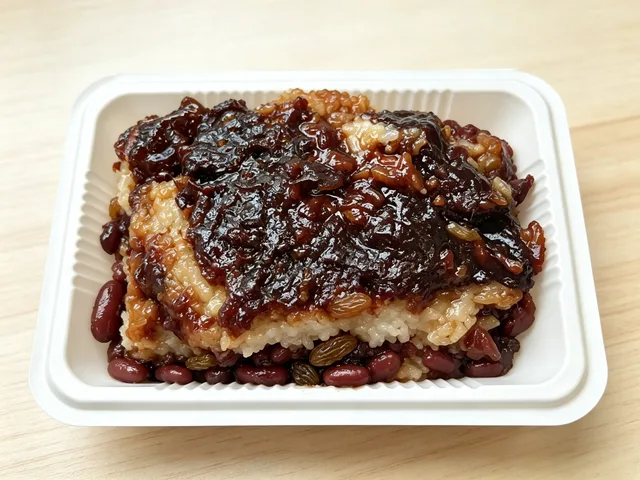
Xi’an’s steamed sticky rice and dates, sold by the slice for breakfast.
Read about zenggao →Roujiamo
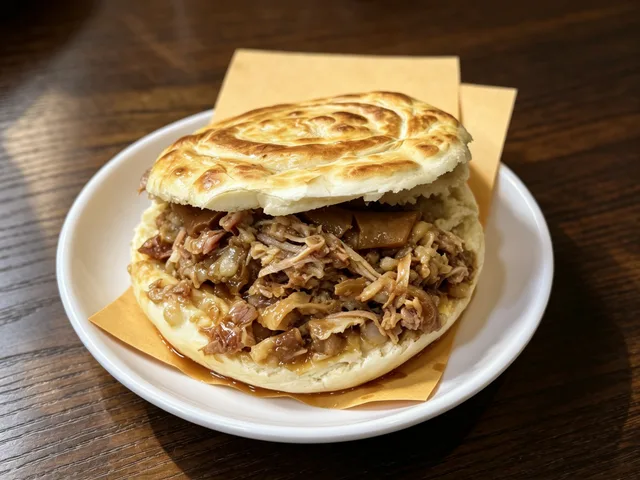
Braised meat in a crisp bread.
Read about roujiamo →Xi’an meatball hulatang
The peppery, thick breakfast soup.
Read about hulatang →Shaanxi food
Noodles, paomo and snacks from Xi’an and beyond.
Explore Shaanxi →Shaanxi classics
- Zenggao
Sticky-rice breakfast · Early breakfast
- Roujiamo
Filled flatbread · Quick meal, often with liangpi
- Liangpi
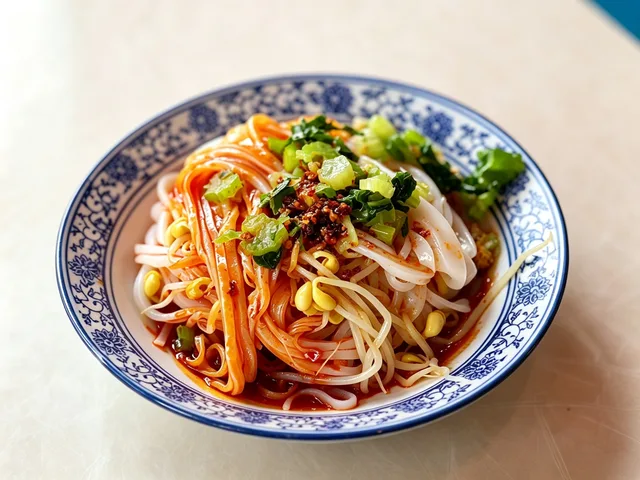
Cold-dressed noodle sheets · Lunch or snack, often with roujiamo
- Yangrou Paomo
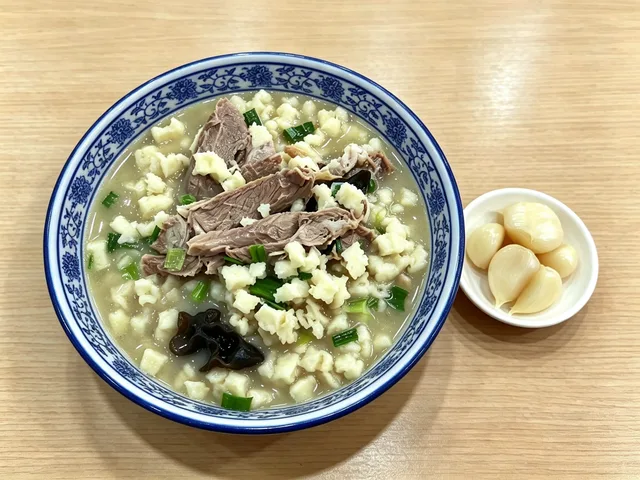
Bread in lamb soup · Breakfast or lunch
- Xi’an Sesame Tripe Skewers
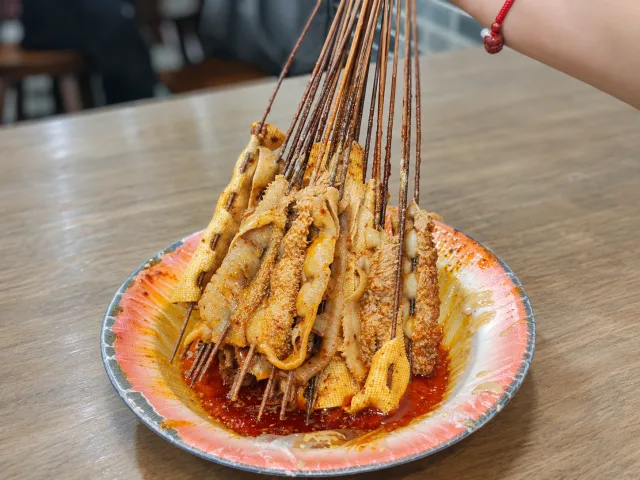
Tripe skewers in sesame sauce · Night markets and barbecue shops
- Youpo Noodles
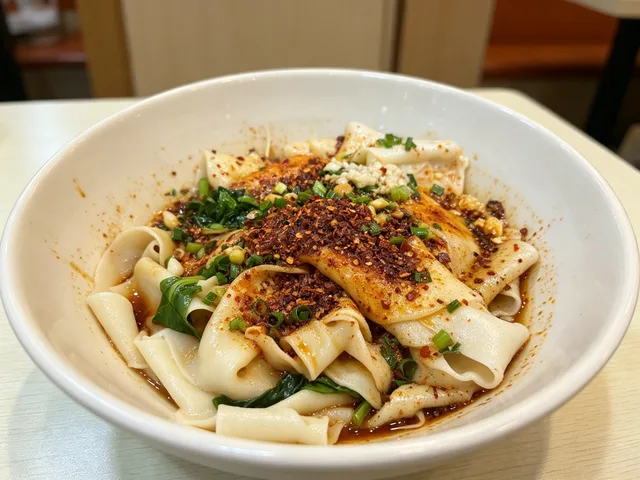
Wide noodles · Lunch or dinner
Sweets from other regions
FAQ
Questions about Xi’an Eight-Treasure Porridge
What is huanggui xifan?
A sweet Xi’an porridge of glutinous rice, dates, goji, nuts, lotus seeds and lily, thickened with starch and flavoured with osmanthus and rose jam.
Is it the same as babao xifan?
In Xi’an the names are used for the same kind of sweet, thick porridge; huanggui zhou is another name.
What does huanggui mean?
Sweet-scented osmanthus preserved as a jam, a classic Xi’an sweet seasoning also used in persimmon cakes and thick rice wine.
Why is it so thick?
It is thickened with starch, not boiled for hours like congee.
Why do people drink it with barbecue?
A sweet, slightly sour bowl balances salty, oily skewers.
How much does it cost?
About 7 to 8 yuan a bowl in 2022 to 2025.
Can I make it at home?
Yes: soak glutinous rice, boil it briefly with nuts and dried fruit, thicken with potato starch and add osmanthus and rose jam.
Sources
Sources and further reading
- 1 Su Yuhai and Cheng Peng, Shaanxi People and Shaanxi Food (陕人陕菜): Xi’an food culture; osmanthus thick rice wine (in Chinese)Northwest University Press, 2018; WeRead edition ↗
- 2 Chinese Snacks: Shaanxi Flavours (中国小吃·陕西风味), p. 121: Xi’an osmanthus persimmon cakes; p. 102: osmanthus thick rice wine (in Chinese)China Financial and Economic Publishing House (1985), indexed by laocp.tech ↗
- 3 Chinese Snacks: Hubei Flavours (中国小吃·湖北风味), p. 131: eight-treasure porridge (in Chinese)China Financial and Economic Publishing House (1984), indexed by laocp.tech ↗
- 4 Shaanxi Cookbook, vol. 3 (陕西菜谱 第三册), p. 90: eight-treasure rice (in Chinese)Indexed by laocp.tech ↗
- 5 Back-street barbecue at 1.2 yuan a skewer, and eight-treasure porridge made to order in a copper pot (video, in Chinese)Jun zai Xi’an (君在西安), Bilibili (November 2022) ↗
- 6 Back in Xi’an: 1.2-yuan grilled tendon and an 8-yuan eight-treasure porridge made in a small pot (video, in Chinese)Jun zai Xi’an (君在西安), Bilibili (June 2025) ↗
- 7 Eight-treasure porridge made to order, 8 yuan a bowl: counting what goes in (video, in Chinese)Jun zai Xi’an (君在西安), Bilibili (January 2022) ↗
- 8 A barbecue shop at night with a child: 1-yuan skewers, a meatball clay pot and an 8-yuan eight-treasure porridge (video, in Chinese)Jun zai Xi’an (君在西安), Bilibili (December 2023) ↗
- 9 A small barbecue shop: kidneys, eight-treasure porridge and sesame-sauce tripe (video, in Chinese)Jun zai Xi’an (君在西安), Bilibili (May 2022) ↗
Last updated November 2026