
01
A stir-fry where the greens matter
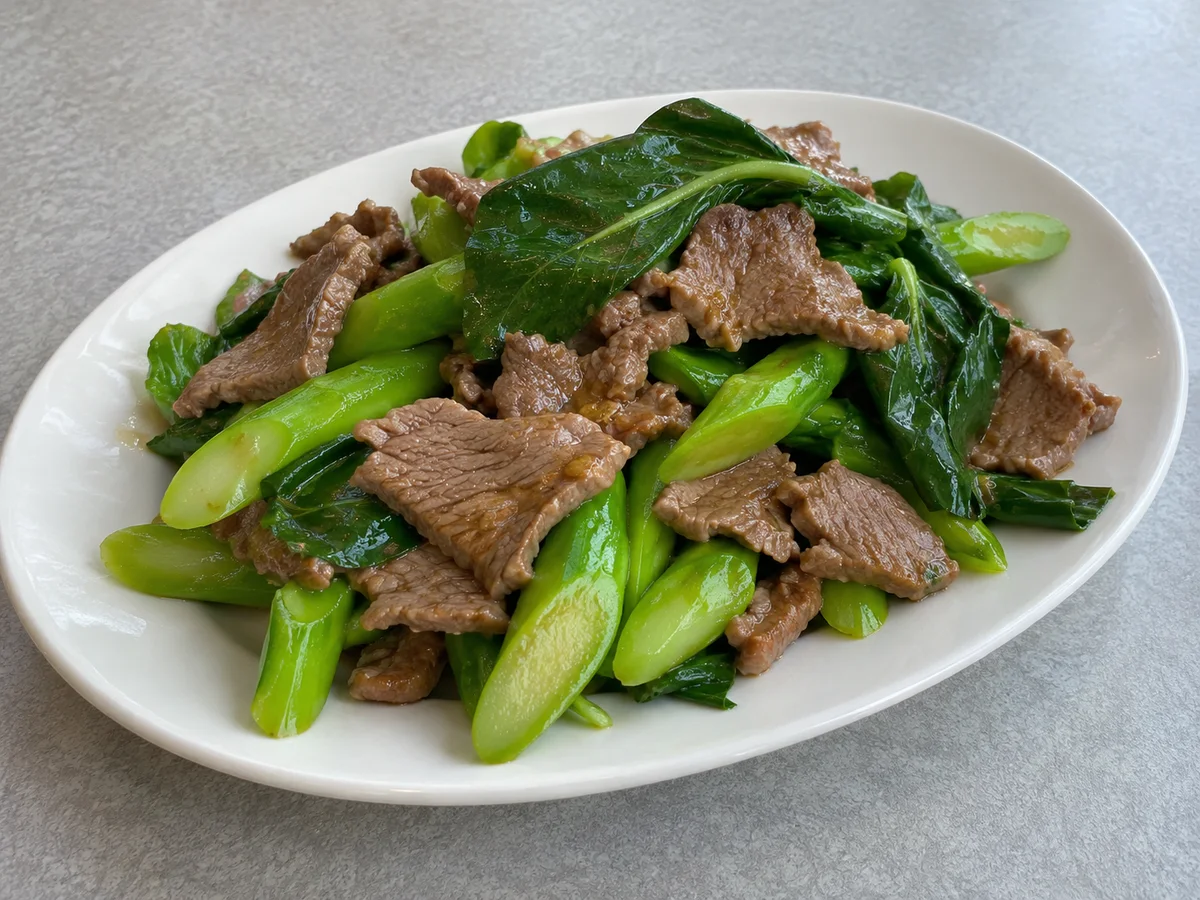
Gai lan beef is a quick Cantonese stir-fry of tender sliced beef and crisp green stems, with just enough sauce to make the plate shine.
The Chinese name, 芥兰炒牛肉, means “beef stir-fried with gai lan,” and the dish has three parts. The beef is sliced thin across the grain and marinated with soy sauce, a pinch of baking soda, starch and water, then passed briefly through oil. The gai lan, a green with thick, juicy stems, is stir-fried separately with salt and a little stock until almost done, and drained. Then both go back into the wok with ginger and garlic, a splash of Shaoxing wine and a spoonful of thickened stock or oyster sauce. A Guangdong cookbook of 1976 judges the result by sight and bite: bright color, smooth and tender beef, and greens that stay green and crisp.
The vegetable usually outweighs the meat. That 1976 restaurant recipe uses 200 grams of greens to 150 of beef, and a South China sample menu in China’s 2026 national diet guide for stroke patients sets out gai lan beef as 100 grams of gai lan, 60 of beef and 20 of carrot. American beef and broccoli turns the balance round: it is heavy on beef, uses broccoli florets, often adds carrot, bell pepper or onion, and comes coated in a savory-sweet brown sauce. The names overlap because gai lan is sold in America as “Chinese broccoli,” and the two plants are varieties of the same species, Brassica oleracea.
02
Is beef and broccoli Chinese?
The idea is Cantonese; the takeout plate is Chinese American.
Beef stir-fried with green vegetables is ordinary Chinese cooking. The Guangdong volumes of China’s standard cookbooks, published in 1959 and 1976, both print oyster-sauce beef and beef stir-fried with the tender tips of greens, and in Guangdong gai lan beef is home cooking and street food, not a banquet dish or any restaurant’s famous signature. Western broccoli is no stranger in China either. Called 西兰花 or 西蓝花, it is an everyday vegetable: the 2026 national diet guide puts it in sample menus for all seven of its regions, from the Northeast to South China, fried with pork, shrimp, peppers or tofu, and home cooks stir-fry it with beef, in roughly equal weights, as a quick dish to eat with rice.
What China does not have is the American plate as a fixed dish: beef and broccoli florets in a thick, sweet-savory sauce, sold as a standard takeout item. That form grew up in Chinese restaurants in the United States. The usual explanation is that Cantonese cooks there made gai lan beef with broccoli when gai lan was hard to find. It is a reasonable guess, since the first Chinese cooks in America came from the Pearl River Delta and cooked Cantonese food, but nobody wrote down when or where the switch happened, and almost no record survives of what those cooks made.
03
Gai lan: crisp stems with a bitter edge
Gai lan is a South China vegetable eaten mainly for its stems.
Gai lan is written 芥兰 in Guangdong and usually 芥蓝 in standard Chinese. It has broad, waxy, blue-green leaves and smooth, fleshy stalks, and tastes mineral, nutty and slightly bitter. The plant originated in South China, where most of its varieties are still grown, and spread from there through Southeast Asia. Growers tell the varieties apart by flower color, white or yellow; by whether they are grown for stalk, leaf or both; and by stalk color, green or red.
It has a long record in Guangdong. In 1095, exiled to Huizhou, east of Guangzhou, the poet Su Shi walked through his vegetable plot after rain and wrote that 芥蓝 was like mushrooms, “crisp and delicious, crunching between the teeth.”
Cantonese cooks prize the top of the stalk. The 1976 Guangdong cookbook calls this cut 菜薳: the tenderest six centimeters or so of a green’s flowering stem, with the flowers and the tough lower stalk trimmed away. It fries gai lan tips with salt, a splash of ginger wine, made by steeping grated ginger in rice wine and squeezing it out, stock and a pinch of sugar until nine-tenths cooked, then drains them before they meet the meat. Plain blanched gai lan, 白灼芥兰, is a standard South China side dish. In Chaoshan, in eastern Guangdong, gai lan is one of the great winter vegetables, and the commonest way to cook it there is with beef.
04
Oyster sauce, invented in 1888
The sauce most people associate with the dish is younger than its main ingredients.
Lee Kum Kee, the Hong Kong sauce company, dates oyster sauce to 1888 and its founder, Lee Kum Sheung, who cooked and sold oysters in Nanshui, a village that is now part of Zhuhai, west of Macau. The story is that he left a pot of oysters boiling too long, smelled something rich, and found a thick brown sauce at the bottom. The business moved to Macau in 1902, began exporting oyster sauce to the United States through importers in 1920 and moved its headquarters to Hong Kong in 1932, so oyster sauce was crossing the Pacific within about thirty years of its invention.
Oyster-sauce beef, 蚝油牛肉, became a Cantonese restaurant classic. The 1959 Guangdong volume of Famous Chinese Dishes prints the recipe of Fat Kee (发记) in Guangzhou, whose sliced beef in oyster sauce was “smooth and not tough” and as good with wine as with rice. A 1991 Guangdong cookbook says the sauce was made mainly from the juice of fresh oysters from Shajing, on the eastern shore of the Pearl River estuary, with wheat starch, sugar and salt, and warns against cooking it long at high heat; the cookbooks add it only in the final sauce. Gai lan beef can be finished either way: with a clear gloss of seasoned stock, as in the 1976 cookbook’s beef with greens, or with oyster sauce, about 12 grams to 300 grams of beef in the same book’s oyster-sauce beef.
05
Baking soda, starch and a bath of warm oil
Cantonese restaurant beef owes its silky texture to baking soda, starch, water and a short bath in oil.
Both Cantonese cookbooks treat the beef in much the same way. Fat Kee’s 1959 recipe trims off the tendons, slices the beef thin and in large pieces across the grain, never along it, and works in baking soda, dry starch, Shaoxing wine, soy sauce and cold water by hand before adding a little oil and leaving it for ten minutes. The 1976 cookbook gives a standard marinade for beef or lamb slices: for 500 grams of meat, 10 grams of light soy sauce, 6 grams of baking soda, 25 grams of dry starch and 75 grams of water, stirred to a paste and mixed in, then 25 grams of peanut oil, left for 30 minutes. Neither adds salt. In both, the baking soda comes to about 1.2 to 1.3 percent of the weight of the beef.
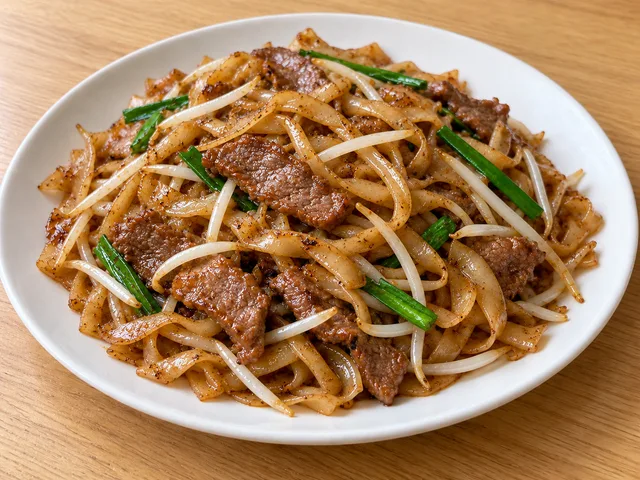
The beef is then passed through oil, 泡油. Fat Kee heats the wok hard but slides the beef into oil only about 40 percent hot, “fierce wok, cool oil,” stirs the slices apart and lifts them out when they are about 80 percent cooked. The 1976 recipe for beef with greens uses hotter oil, about 60 percent, and takes the beef to nine-tenths. On the cookbook’s scale, 50 to 60 percent is “hot oil” and 30 to 40 percent “warm oil.” The beef finishes cooking in the last toss with the greens and sauce, which takes seconds, and the 1959 recipe warns that a slow hand costs the beef its smoothness. Beef chow fun starts from beef treated the same way and depends on the same smoky breath of a hot wok, wok hei.
06
Home kitchens, Chaoshan rice bowls and Hong Kong restaurants
Gai lan beef is everyday food, not the signature of any famous restaurant.
Its first home is the family kitchen. China’s 2026 national diet guide describes the South China way of eating as Cantonese: morning tea, slow-boiled soups, freshwater fish and seafood, plenty of fresh vegetables and fruit, steaming and blanching, and light seasoning with little salt or oil. Its South China sample menus put gai lan beef on the table as a plain lunch dish with rice, next to celery with lily bulbs and a soup.
In Chaoshan, in eastern Guangdong, gai lan and beef are the standard winter pairing, and the dish is cheap everyday food outside the home too. In 2021 a Chaoshan fast-food shop sold a plate of gai lan beef for 35 yuan. Street stalls sell 芥蓝牛肉饭, stir-fried beef and gai lan piled on rice, for 15 yuan a bowl in November 2024, and the price was still 15 yuan in November 2026.
In Hong Kong the same stir-fry is also made with 菜远, the tender tips of other greens. At Canton Koon, a Cantonese restaurant in a public housing estate, a plate of beef with greens tips used to be six parts vegetable to four of beef. In 2012 the chef raised it to about seven to three, because customers were asking for more vegetables and less oil, salt and sugar, and because meat and cooking oil kept getting dearer.
07
How gai lan beef became beef and broccoli
The American dish has no recorded birthday.
Chinese workers began arriving in coastal California from the Pearl River Delta in the mid-nineteenth century, and the cooking they brought was Cantonese. Beef, gai lan and oyster sauce are the ingredients food historians think appeared in the earliest versions of beef and broccoli, and the first recipes suited Chinese tastes before shifting toward American ones. Beyond that there is little to go on, because almost nothing was written down about what those workers cooked.
The usual explanation for the broccoli is supply. The food historian Anne Mendelson, author of Chow Chop Suey, believes labor contractors gave migrants sailing from Hong Kong to San Francisco the seeds of crops that grow in both Guangdong and California, probably including gai lan, so the vegetable reached America early. Later, as Chinese families moved out to the suburbs, cooks with no Asian produce supplier nearby used broccoli, a plant of the same species that looks much the same. It is a likely account rather than a documented one: no menu or letter records the moment of change.
Over time the plate moved toward American tastes. Takeout beef and broccoli today is heavy on beef, uses florets instead of stalks and leaves, often adds carrot, bell pepper or onion, and is coated in a savory-sweet sauce thickened with cornstarch. Chinese home versions keep the vegetable in charge: equal weights of beef and broccoli, or more greens than meat.
08
Gai lan beef and beef and broccoli side by side
Same family, different balance.
The quickest test is the plate: in the Cantonese dish you see mostly green stems and a thin shine of sauce; in the American one, beef and florets coated in brown sauce.
| Gai lan beef 芥兰炒牛肉 | American beef and broccoli | |
|---|---|---|
| Vegetable | Gai lan stalks and tips, cut in lengths | Broccoli florets, often with carrot, onion or bell pepper |
| Balance | More vegetable than beef | More beef than vegetable |
| Beef | Thin slices marinated with soy sauce, baking soda, starch and water, passed through oil | Marinated with soy sauce and cornstarch, then seared |
| Sauce | A thin gloss of seasoned stock or oyster sauce; nothing pools on the plate | More sauce, savory-sweet, thickened with cornstarch |
| Where you find it | Home kitchens, Chaoshan rice bowls, Cantonese restaurants | Chinese American takeout and restaurants |
09
Gai lan beef at home
This follows the 1976 Guangdong cookbook’s beef with greens tips, made with gai lan tips as the same book uses them elsewhere, and its standard beef marinade scaled to one plate.
For two, with rice: 150 g lean beef, membrane trimmed off; 200 g gai lan, the top 6 cm or so of the stalks, or thicker stalks cut to the same length; 2 or 3 thin slices of ginger; a little crushed garlic. Marinade: 3 g (½ teaspoon) light soy sauce, 2 g (a scant ½ teaspoon) baking soda, 8 g (1 tablespoon) cornstarch, 22 g (1½ tablespoons) water, 8 g (2 teaspoons) peanut oil. To finish: 2.5 g (½ teaspoon) salt, 100 ml stock for the greens, 1 teaspoon Shaoxing wine, and a sauce of 1½ tablespoons stock, 1 teaspoon cornstarch slurry, a pinch of white pepper and a few drops of sesame oil.
- 1. Slice
Cut the beef across the grain into large, thin slices, never along the grain.
- 2. Marinate
Stir the soy sauce, baking soda, cornstarch and water into a paste, work it into the beef by hand, then mix in the oil. Leave for 30 minutes. Do not add salt.
- 3. Cook the greens
Heat a little oil over medium heat, add the gai lan, salt and stock, with a splash of ginger juice in rice wine if you like, and stir-fry until almost tender. Tip into a sieve to drain.
- 4. Pass the beef through oil
Heat 2 to 3 cm of oil to medium-hot, about 60 percent in Cantonese kitchen terms. Slide in the beef, stir the slices apart and lift them out as soon as they are nearly cooked. Pour off the oil.
- 5. Bring it together
With a spoonful of oil, fry the garlic and ginger, return the gai lan and the beef, splash in the wine, stir in the sauce, toss for a few seconds and plate. Work fast, or the beef loses its smoothness.
For an oyster-sauce version, stir 6 g (1 teaspoon) oyster sauce and 2.5 g (½ teaspoon) dark soy sauce into the sauce, the proportions of the same book’s oyster-sauce beef. The plate should be glossy, not wet.
10
How to order it in China and Hong Kong
Use the Chinese name.
In Guangdong and Hong Kong
Ask for 芥兰炒牛肉, or simply 芥兰牛肉 (gaai3 laan2 ngau4 juk6), at a small stir-fry restaurant. Expect more green than beef, whole lengths of stalk and only a light gloss of sauce.
In Chaoshan
Look for 芥蓝牛肉饭 at street stalls: beef and gai lan over rice, 15 yuan a bowl in 2024 and in 2026. A plate of gai lan beef at a fast-food shop cost 35 yuan in 2021.
If the menu says 菜远牛肉
That is beef with the tender tips of other greens, the same method with a different vegetable.
If you want broccoli
Ask for 西兰花炒牛肉, beef stir-fried with Western broccoli.
When to go
In Chaoshan gai lan is a winter vegetable, at its best in the cold months.
11
More Cantonese dishes and their American cousins
Other pages on the atlas.
Beef chow fun
The same tender beef and wok hei, fried with wide rice noodles.
Read about beef chow fun →Sweet and sour pork
Another Cantonese dish that changed on its way to America.
Read about sweet and sour pork →Chow mein
China’s fried noodles and the American version.
Read about chow mein →Chaoshan beef hot pot
Eastern Guangdong’s other great beef dish.
Read about Chaoshan beef hot pot →Guangdong classics
- Char Siu
Roast pork · Lunch or dinner, with rice
- White Cut Chicken
Poached chicken · Lunch or dinner
- Cantonese Yum Cha
Yum cha · Morning tea, weekends with family
- Egg Fried Rice
Fried rice · Lunch, dinner, end of a meal
- Beef Chow Fun
Fried rice noodles · Lunch, dinner or late-night supper
- Mooncake
Festival pastry · Mid-Autumn Festival
FAQ
Questions about Beef and Broccoli
Is beef and broccoli Chinese?
The takeout dish is Chinese American. Its usual ancestor is Cantonese gai lan beef, 芥兰炒牛肉, an everyday stir-fry in Guangdong. When and how broccoli replaced gai lan in America was never recorded.
What is gai lan, and is it the same as broccoli?
Gai lan, “Chinese broccoli,” is a South China green eaten for its thick, crisp stalks, with a slightly bitter taste. It belongs to the same species as broccoli, Brassica oleracea, but is a different variety.
Can you get beef and broccoli in China?
The American takeout plate is not a standard Chinese dish, but Chinese home cooks stir-fry beef with Western broccoli, 西兰花炒牛肉, and in Guangdong you can order beef with gai lan.
Why is the beef in Chinese restaurants so tender?
It is marinated with baking soda, starch, water and a little soy sauce, about 1.2 to 1.3 percent baking soda by weight in two Cantonese cookbooks, then passed briefly through warm oil before the final stir-fry.
Does gai lan beef use oyster sauce?
Often, but not always. Old Cantonese cookbooks finish beef with greens in a clear sauce of seasoned stock, and oyster-sauce beef with about 12 grams of oyster sauce to 300 grams of beef.
Who invented oyster sauce?
Lee Kum Kee credits its founder, Lee Kum Sheung, who sold cooked oysters in Nanshui, now part of Zhuhai, in 1888.
How much does gai lan beef cost in China?
At Chaoshan street stalls, a bowl of beef and gai lan over rice cost 15 yuan in 2024 and still 15 yuan in November 2026; a plate at a Chaoshan fast-food shop cost 35 yuan in 2021.
Sources
Sources and further reading
- 1 Su Shi, “Walking in the vegetable garden after rain” (雨後行菜圃), in Zha Shenxing, Su Shi Buzhu (蘇詩補註), vol. 39: poems written at Huizhou in 1095 (in Chinese)Wikisource (Siku Quanshu text) ↗
- 2 Diet Guide for Adults After Stroke, 2026 edition (成人脑卒中食养指南), appendix 3: sample menus for seven regions, table 3.7 South China (in Chinese)General Office of the National Health Commission (April 2026) ↗
- 3 CookSmart (營廚), issue 15: Canton Koon and chef Luk Po-cheung (in Chinese)EatSmart@restaurant.hk, Department of Health, Hong Kong (2012) ↗
- 4 Lei Yanpeng, “The two faces of a Hong Kong billionaire family” (“双面”香港千亿富豪家族): Lee Kum Sheung and the first oyster sauce (in Chinese)The Paper, Paike channel (August 2, 2021) ↗
- 5 Lan Lam, “Chasing Beef and Broccoli”: the dish’s Cantonese roots, gai lan and the switch to broccoliCook’s Illustrated, America’s Test Kitchen (March 2022) ↗
- 6 Chinese Cookbook: Guangdong (中国菜谱·广东), pp. 33–34: oyster-sauce beef and beef with greens tips (菜薳炒牛肉); p. 194: gai lan tips with ginger wine (in Chinese)Chinese Cookbook editorial group, China Financial and Economic Publishing House (1976), indexed by laocp.tech ↗
- 7 Chinese Cookbook: Guangdong (中国菜谱·广东), kitchen notes: oil temperatures (p. 8), greens tips (p. 341), marinated beef slices (p. 343), seasoned stock (p. 344), ginger wine (p. 346) (in Chinese)Chinese Cookbook editorial group, China Financial and Economic Publishing House (1976), indexed by laocp.tech ↗
- 8 Famous Chinese Dishes, vol. 5: Guangdong (中国名菜谱·第五辑), p. 87: Fat Kee’s oyster-sauce beef, Guangzhou (in Chinese)Catering Services Administration, Ministry of Commerce; Light Industry Press (1959), indexed by laocp.tech ↗
- 9 Famous Chinese Dishes, new edition: Guangdong (中国名菜谱·广东风味), p. 58: oyster-sauce beef, with a note on oyster sauce (in Chinese)China Financial and Economic Publishing House (1991), indexed by laocp.tech ↗
- 10 History of Lee Kum Kee, 1888–1987Lee Kum Kee (official corporate site) ↗
- 11 Lei Jianjun, Chen Guoju, Chen Changming and Cao Bihao, “Germplasm Diversity of Chinese Kale in China”Horticultural Plant Journal 3 (3): 101–104 (2017) ↗
- 12 Gai lan beef over rice at a Chaoshan stall, 15 yuan a bowl (video, in Chinese)Xiao Mo Yu Ye (小魔鱼耶), Bilibili (November 5, 2024) ↗
- 13 Chaoshan gai lan beef rice, still 15 yuan a bowl (video, in Chinese)A Le Chi Bian Lubiantan (阿乐吃遍路边摊), Bilibili (November 6, 2026) ↗
- 14 Gai lan beef, a seasonal Chaoshan home dish (video, in Chinese)Chaozhou Shan Ge (潮州山哥), Bilibili (December 26, 2019) ↗
- 15 Beef with broccoli, an easy dish to eat with rice: 300 g beef to 300 g broccoli (video, in Chinese)Delike De Chufang (德里克的厨房), Bilibili (September 7, 2023) ↗
- 16 A Chaoshan fast-food shop’s gai lan beef, 35 yuan a plate (video, in Chinese)Chaoshan Niurouwan Jiadi (潮汕牛肉丸嘉弟), Bilibili (April 5, 2021) ↗
Last updated November 2026