
01
Hot milk, ginger juice, and a spoon that does not sink
There is no gelatin, starch or egg in ginger milk curd. The ginger juice does the setting.
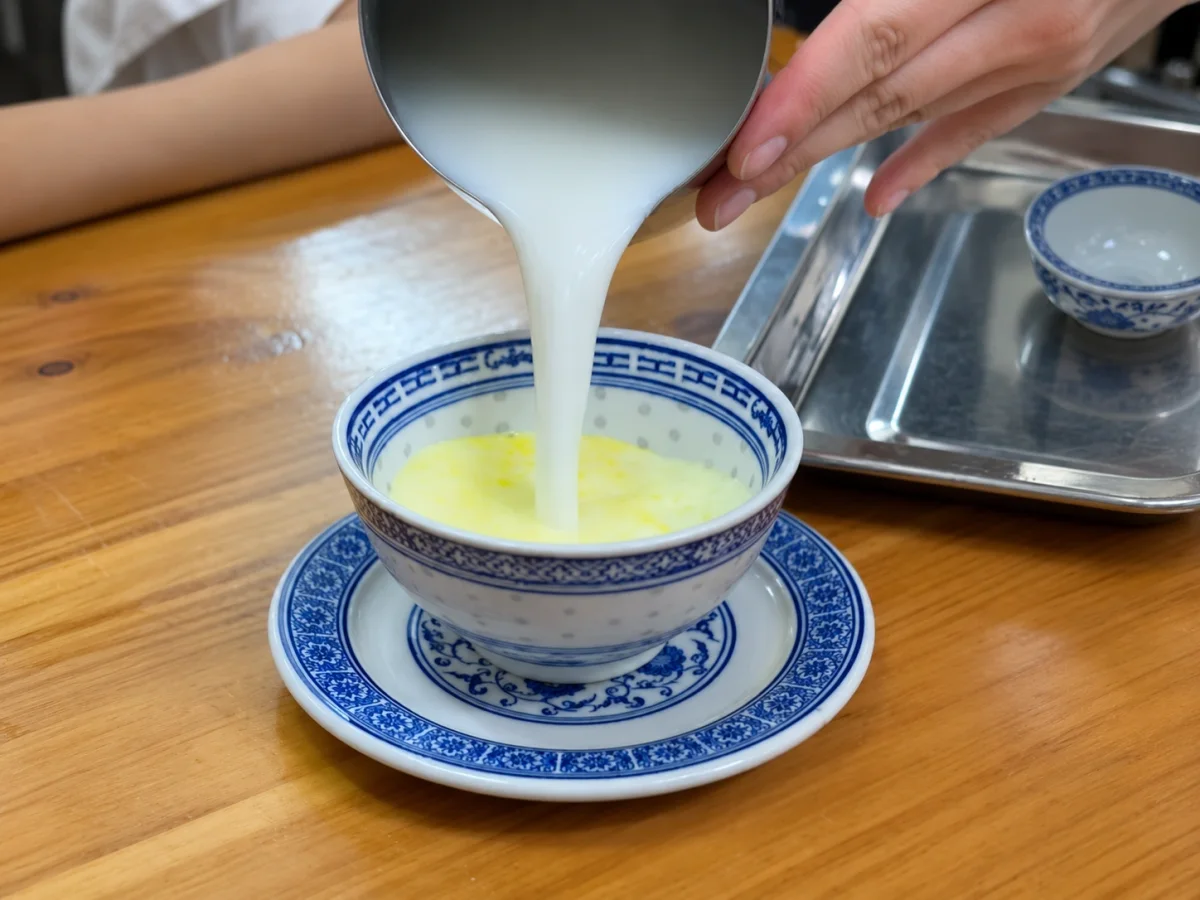
A small bowl holds a spoonful or two of freshly squeezed ginger juice. Milk sweetened with sugar is brought to a boil, cooled for a moment, and poured into the bowl in one quick stream. Then nobody touches it. In a minute or two the liquid stops moving. Tip the bowl and the surface holds; lay a spoon across it and the spoon rests on top instead of sinking. That spoon test is how shops in Guangdong show a customer that the curd has set properly.
The texture sits somewhere between soft tofu pudding and steamed egg, but smoother than either. The first spoonful tastes of sweet, rich milk. The ginger arrives a second later, not as a burn on the tongue but as warmth at the back of the throat. That contrast is the point of the dish, and it is why Cantonese families think of it as a winter dessert, eaten hot.
Because the milk is poured into the ginger rather than the other way round, many shops make it in front of you. One shop in Sanshui, Foshan, pours hot milk into each bowl of juice as the order comes in, puts a lid on, and brings it out about two minutes later.
02
Why ginger juice turns milk into curd
Fresh ginger contains a protein-cutting enzyme that works like the rennet used in cheesemaking.
Milk stays liquid because its casein proteins sit in tiny bundles, each wrapped in an outer layer called κ-casein that keeps them apart. Grated ginger releases a protease, an enzyme that cuts proteins. When warm milk meets the juice, the protease trims that outer layer. The exposed casein bundles then link up with the calcium in the milk into a loose net, and the net holds the liquid in place as a gel.
Temperature decides whether this happens. The enzyme works fastest when the milk is hot, but too much heat destroys it, and then the milk never sets. Too cool and it works slowly, so the curd takes a long time and comes out weak. A 2013 study in Food Chemistry that compared plant extracts found ginger’s milk-clotting activity peaked at about 63 °C and dropped off on either side of a fairly narrow range. A Guangzhou explainer gives 60–70 °C as the target for the milk in the bowl, and a ratio of about one part juice to twenty parts milk.
The pour matters for the same reason. Shawan cooks pour fast so the enzyme reaches all the milk at once and the whole bowl sets evenly. Pouring from a height also cools the milk a few degrees on the way down. Whether you hold the pan at any particular angle does not affect the set; that part is showmanship.
03
Shawan, buffalo milk, and jiang mai nai
In Shawan the dessert is called jiāng mái nǎi (姜埋奶), not jiāng zhuàng nǎi.
Shawan is an old town in Panyu District, south of central Guangzhou, on a web of rivers and fields where farmers have long kept water buffalo. Buffalo milk is richer than cow’s milk, with more fat and protein and less water, and locals call it “drip-bead milk” because it is so thick. A late Qing gazetteer of Panyu County already records households in Shawan keeping more than a hundred animals and producing more than a thousand jin of milk a day. With that much milk, the town developed a whole set of buffalo-milk snacks: a golden egg-and-milk paste, pressed milk-and-rice cakes, salty milk discs to eat with congee, and ginger milk curd.
Zeng Huizhuang, a municipal-level heritage bearer for Shawan buffalo-milk snacks, has run her dessert shop near the old town since 1992. She explains the name this way: mái in Cantonese means to come together, as in jyu mai. Customers who watched the milk being poured onto the juice thought it looked like a collision, zhuàng, and that word spread across Guangdong and beyond. Panyu’s own information office puts it more pointedly: the town prefers a word for joining over a word for crashing.
The usual origin story says a daughter-in-law was making ginger juice for her mother-in-law’s cough, the juice was too fiery to drink, and some hot milk went into the bowl by accident and set. A Guangzhou food writer points out that the story has no historical basis, and that nobody knows when or by whom the dessert was first made. What is certain is that it was made in Shawan with Shawan buffalo milk, and spread from there across the Pearl River Delta.
05
Why it fails at home
When ginger milk curd stays liquid, the milk was usually too hot.
Home cooks find ginger milk curd harder than it looks, and the reasons are well tested. In one set of trials with three brands of boxed whole milk, milk that had just come to a boil and was poured straight in did not set at all. Milk that had cooled to about 70 °C set and held a spoon. Milk at about 60 °C set best, soft and smooth, within three to ten minutes. Without a thermometer, the milk should feel very hot to a fingertip but bearable for a moment.
The milk matters next. A cook who tried to copy a shop’s one-minute curd found that buffalo milk bought online and ordinary boxed milk both took ten to fifteen minutes to set and came out weak or thin in flavor. The shop’s own fresh raw milk, boiled and then cooled to around 70 °C, set within a minute. Fresh, full-fat milk works best; heavily processed milk sets slowly or not at all. A Guangzhou explainer is clear that cow’s milk or even milk powder can work, and that buffalo milk simply makes a richer, smoother curd.
Then the ginger. Shawan cooks use small yellow ginger, which is rich in starch, rather than the large, juicy ginger sold in most markets; large watery ginger sets milk poorly. Shops also prefer old ginger for its bite. Grate it, squeeze the juice through cloth, use it straight away, and stir it once more just before the milk goes in.
| What happened | Likely cause | Try next time |
|---|---|---|
| Stayed completely liquid | Milk too hot, or the ginger juice was old | Cool the milk to 60–70 °C; squeeze the juice fresh |
| Set at the bottom, liquid on top | Poured too slowly, or the juice was not stirred | Stir the juice, pour in one quick stream |
| Took 15 minutes and was weak | Milk too cool, low in fat, or heavily processed | Use fresh full-fat milk and pour it hotter |
| Tastes bitter or harsh | Too much juice for the milk | Use about one part juice to ten to twenty parts milk |
06
Making ginger milk curd at home
Make one bowl at a time until you know how your milk behaves.
For one bowl: a thumb-sized piece of fresh, firm ginger (small yellow ginger if you can find it), 200–250 ml fresh whole milk or buffalo milk, and 1 tablespoon sugar. A kitchen thermometer helps.
- 1. Make the juice
Scrub the ginger and grate it finely without peeling. Squeeze the pulp through muslin or a clean cloth into a warmed bowl. You want about 15–25 g of juice.
- 2. Heat the milk
Warm the milk with the sugar over medium heat, stirring until the sugar dissolves and small bubbles form around the edge.
- 3. Let it cool a little
Pour it back and forth between the pan and a jug a few times to cool it to about 65–70 °C, the way Shawan cooks “pull” the milk.
- 4. Pour and wait
Stir the ginger juice, then pour all the milk into the bowl in one quick stream from about 15 cm above. Cover and leave it completely still for 2–10 minutes.
Do not stir or shake the bowl while it sets. When a spoon laid on the surface stays up, it is ready. Eat it warm.
Guangdong classics
- Mooncake
Festival pastry · Mid-Autumn Festival
- Double-Skin Milk
Milk pudding · Dessert, hot or cold
- Cantonese Yum Cha
Yum cha · Morning tea, weekends with family
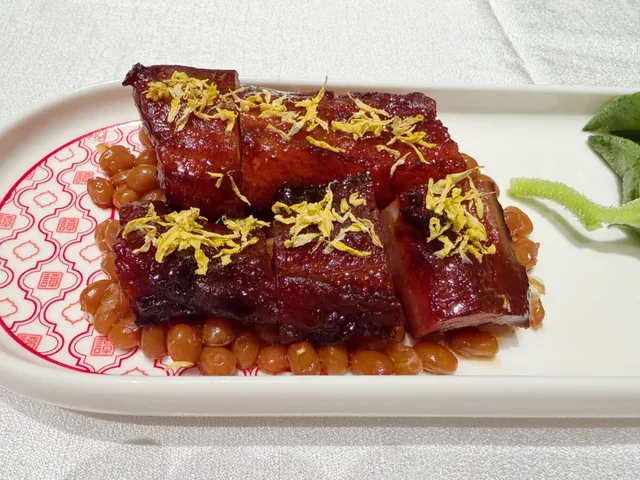
- Char Siu
Roast pork · Lunch or dinner, with rice
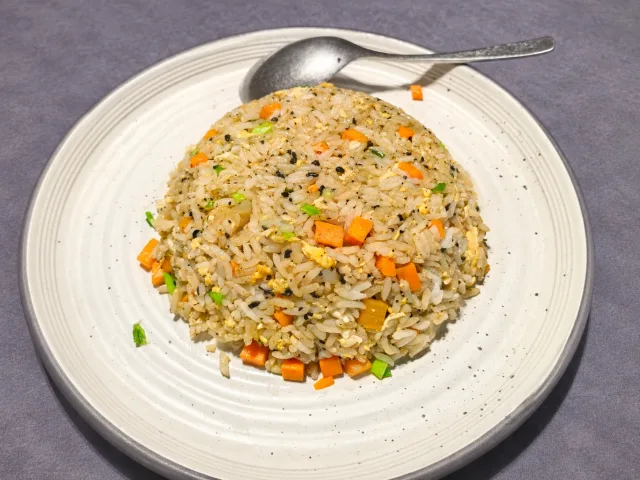
- Egg Fried Rice
Fried rice · Lunch, dinner, end of a meal
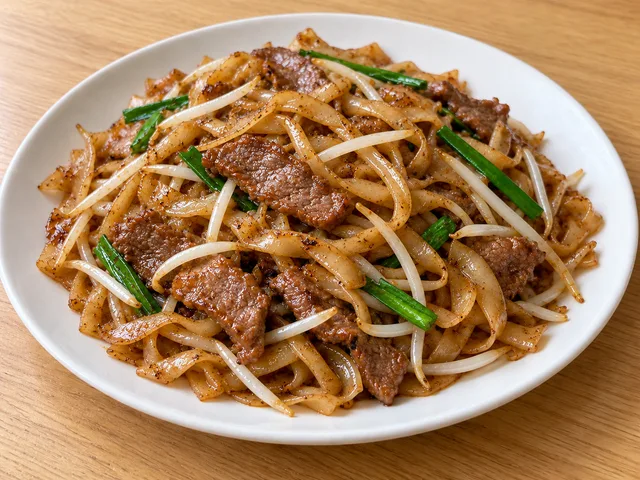
- Beef Chow Fun
Fried rice noodles · Lunch, dinner or late-night supper
Sweets from other regions
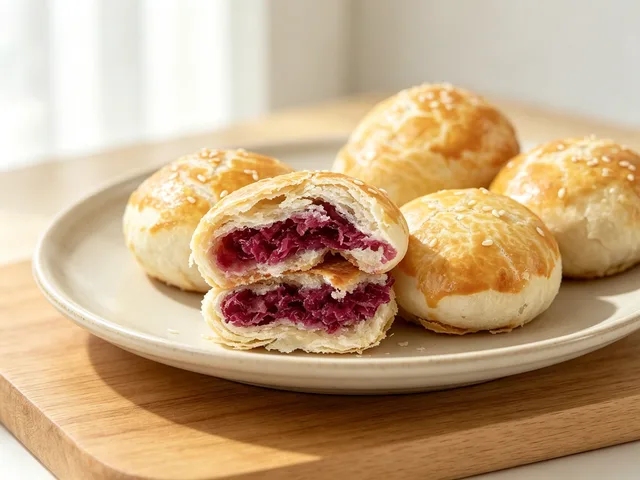
FAQ
Questions about Ginger Milk Curd
What is ginger milk curd?
A Cantonese dessert made by pouring hot sweetened milk onto fresh ginger juice. An enzyme in the ginger sets the milk into a soft curd within minutes.
Does ginger milk curd contain gelatin or egg?
No. It is only milk, sugar and ginger juice. The ginger protease does the setting.
Why did my ginger milk curd not set?
Usually the milk was too hot and destroyed the enzyme. Cool it to about 60–70 °C, use fresh juice and fresh whole milk, and pour quickly.
Can I use regular milk instead of buffalo milk?
Yes. Fresh full-fat cow’s milk works. Buffalo milk is richer and sets into a smoother curd, which is why Shawan uses it.
Where is ginger milk curd from?
Shawan in Panyu District, Guangzhou, where it is called jiang mai nai. It has since spread across the Pearl River Delta.
What is the difference between ginger milk curd and double-skin milk?
Ginger milk curd is set by ginger juice and poured to order. Double-skin milk is set with egg white and steamed, with a skin of milk on top.
Is ginger milk curd eaten hot or cold?
Usually warm, soon after it sets. The ginger warmth in the throat is part of its appeal in winter.
How much ginger juice do you need?
Roughly one part juice to ten to twenty parts milk. More juice makes it harsher without setting it better.
Sources
Sources and further reading
- 1 How does ginger set milk? Ginger protease, temperature and the 1:20 ratio (in Chinese)Hui Chang Hao Chi, via Guangzhou Cyberspace Administration (2020) ↗
- 2 Comparison of the milk-clotting properties of three plant extractsMazorra-Manzano et al., Food Chemistry 141(3) (2013) ↗
- 3 A Sanshui milk-dessert shop: old ginger, fresh buffalo milk and a two-minute wait (in Chinese)Guangfo Dushi Wang, via Sina Guangdong (2016) ↗
- 4 Ginger Milk Pudding: invented in Shawan, made with Panyu buffalo milkeguangzhou.gov.cn, via China Daily Guangzhou (2017) ↗
- 5 Shawan buffalo milk and the heritage cook behind its ginger milk curd (in Chinese)Liang Xin, 21st Century Business Herald (2022) ↗
- 6 Shawan’s buffalo-milk snacks: why locals say jiang mai nai (in Chinese)Panyu District information office (广州番禺发布), via NetEase (2022) ↗
- 7 Shunde’s double-layer milk: Jinbang lane and a ginger milk custardTony Boey, Tony Johor Kaki Travels for Food (2025) ↗
- 8 Ginger milk curd with several supermarket milks: temperature decides it (video, in Chinese)Xia Ma Chufang (夏妈厨房), Bilibili (2023) ↗
- 9 Can ginger milk set in one minute? A week of tests with yellow ginger and three milks (video, in Chinese)Xiaomili Weishi Ji (小米粒喂食记), Bilibili (2024) ↗
- 10 Four Panyu and Shunde dessert shops: what a shop selling ginger milk curd tells you (video, in Chinese)Mixue Shiji (米雪食记), Bilibili (2023) ↗
- 11 Eating through Shunde, including a double-ginger ginger milk curd (video, in Chinese)Mi Zijun (密子君), Bilibili (2025) ↗
Last updated November 2026