
01
A basin of blood curd under chilli oil
Duck blood curd and a crowd of other ingredients in a red, numbing broth.
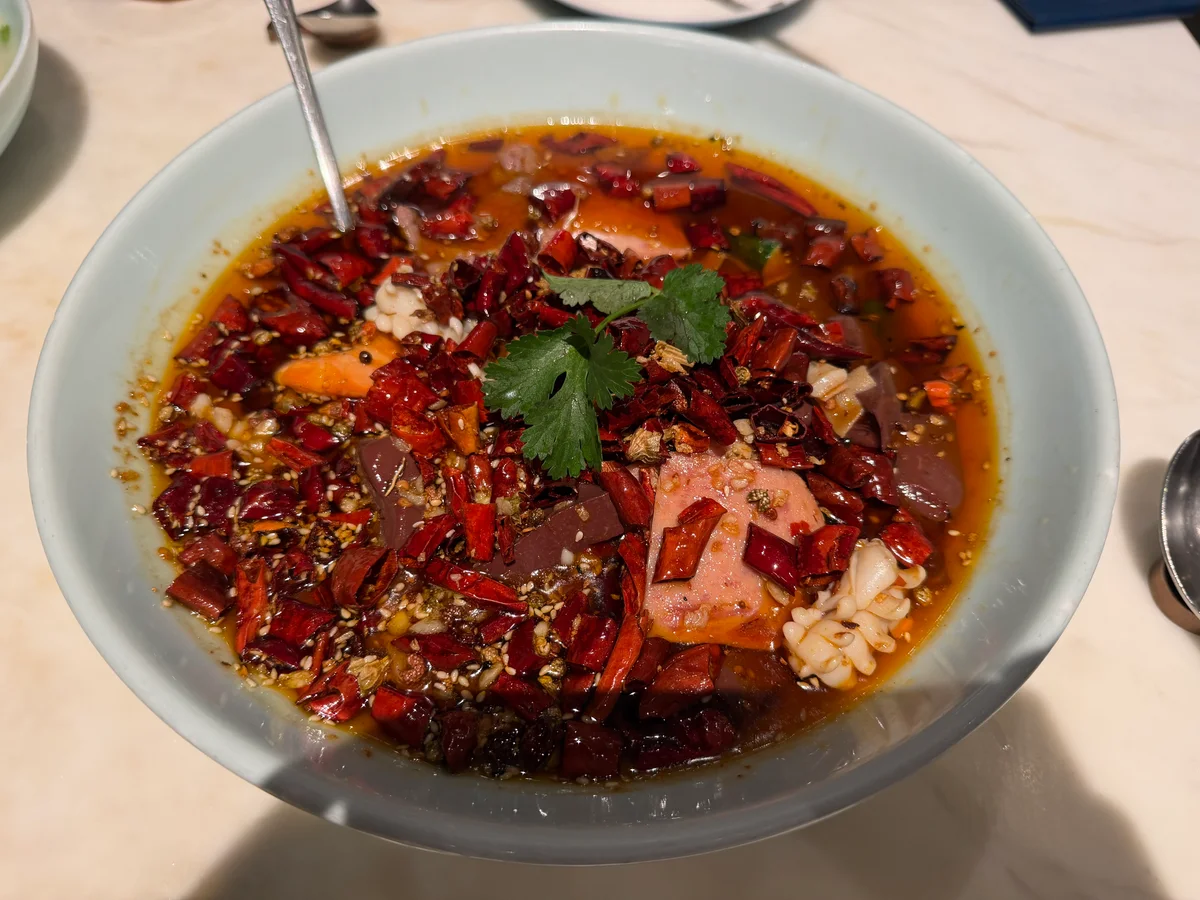
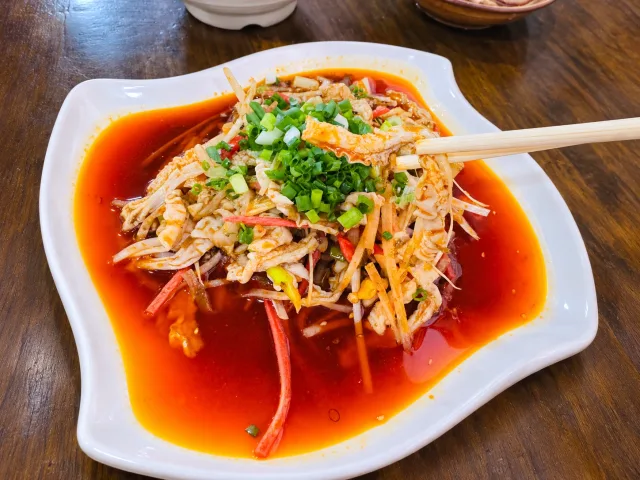
Our photograph shows how it reaches the table: a wide, pale bowl filled almost to the rim with red oil, its surface covered with cut dried chillies, Sichuan pepper and white sesame, a sprig of coriander in the middle. Through the chillies show pink slices of luncheon meat, dark brown slabs of duck blood curd and curled pieces of scored squid; more lies underneath in the broth.
The heart of the dish is 血旺, the Sichuan and Chongqing name for blood curd: fresh duck blood, or in some places pig blood, set into soft blocks and cut into thick slabs. Around it go cheap, quick-cooking meats. Restaurant cooks call four of them the 四大件, the “four big pieces”: duck blood, beef tripe, eel and huanghou (黄喉), a pig’s aorta, which looks like a windpipe but is a blood vessel. Luncheon meat, ham sausage, omasum, squid and pork intestines are almost as common, and soybean sprouts or lettuce tops line the bottom of the basin.
The flavour is the Sichuan and Chongqing combination of numbing, hot, fresh and fragrant. Chilli and Sichuan pepper are fried into the broth; then garlic, chilli flakes, sesame and dried chillies are scattered on top and scalded with oil heated until it smokes. It is a shared dish, brought to the table fully cooked in one big basin and eaten with rice, and so much oil goes into it that the basin stays hot through a long meal, which makes it a winter favourite.
02
Mao, meaning rough
The name describes the cooking more than the ingredients.
The 毛 at the front is Chongqing dialect for rough or careless, done without fuss. A 2020 Xinmin Weekly feature on the food of Ba and Shu, the old names for eastern and western Sichuan, says it plainly: the name does not mean that pig hair went into the pot, only that everything was boiled together any old way. The dish is also written 冒血旺, with 冒 in the same sense. Other explanations exist. English Wikipedia glosses 毛 as raw, because the blood curd goes into the pot uncooked, and some Chinese writers tie it to the tripe, 毛肚, that goes into the basin.
Guiyang, the capital of neighbouring Guizhou, uses the same name for a different dish. The Guizhou cookbook Qiancai Jijin (2002) gives Guiyang maoxuewang as a cold dish: strips of chicken blood curd, blanched and laid on a plate with slices of cooked chicken and coriander, dressed with red chilli oil, soy sauce, vinegar, sugar, ginger, garlic and ground Sichuan pepper, and scattered with fried peanuts. The book adds that the traditional Guiyang version was not blanched at all, only dressed and eaten.
03
From the Ciqikou docks
Every version of the story begins at Ciqikou, on the Jialing River.
Ciqikou is an old river town in Shapingba district, now inside Chongqing’s central city. It was founded in the Song dynasty under the name Longyin, grew into a trading port on the Jialing River in the Ming, and took its present name, “porcelain harbour”, from the porcelain made and shipped there; it has been a centre of porcelain production and transport since 1918.
The usual story is set there in the 1940s. A butcher at the docks sold off the offal he could not otherwise sell; his wife boiled it into a cheap soup for dock and boat workers and at some point put blood curd into the pot, where it turned more tender the longer it cooked. The World of Chinese tells this as legend, and no record fixes the year or the names. A 2020 Xinmin Weekly feature gives the same setting without the butcher: boatmen at the Chongqing docks could not afford meat dishes, and vegetables did not fill them up, so pig lungs, intestines and blood went into one pot.
Those early pots were soup. Cooks who trace their recipes to Ciqikou describe the first maoxuewang as a broth of offal and blood; the spicy, oil-topped dish known today came later, when restaurants turned it into a hot version to suit the market, close to hot pot in flavour though less fiery. In 2023 Chongqing Daily, reporting on the Ciqikou historic district, named maoxuewang together with Shaci random-stitch embroidery and Sichuan opera as intangible heritage still carried on in the old town.
04
A founding dish of jianghu cooking
江湖菜 is Chongqing’s name for the rough, generous cooking of roadside restaurants.
Jianghu dishes, 江湖菜, literally “rivers-and-lakes dishes”, are the cooking that grew up in roadside stalls and small taverns on the edge of Chongqing: big plates, big basins, handfuls of chilli, ladles of Sichuan pepper and ingredients from anywhere, as long as the result tastes good and the price stays low. Locals call the style 乱劈柴, “chopping firewood at random”, for its lack of fixed rules. Many jianghu dishes are named after the outlying places they came from, such as Gele Mountain spicy chicken and Laifeng fish, and most of them faded after a few years in fashion.
Maoxuewang is described as one of the founding dishes of the style, and one of the few, with boiled pork slices, Gele Mountain spicy chicken and pickled-cabbage fish, that lasted and spread across the country. The World of Chinese reports that on Meituan-Dianping data it was the best-selling dish in restaurants and delivery in China’s first-tier cities in 2017, and that the municipal authorities included it among twelve signature Yu dishes, the cooking of Chongqing, that were given standard recipes in 2012. Chongqing had become a municipality separate from Sichuan province in 1997.
05
Duck blood, cooked gently
The blood curd should stay smooth and tender.
Duck blood is now the usual choice, preferred to pig blood for its fresher taste and softer texture, though pig and chicken blood are used too. Whatever the blood, the rule cooks repeat is not to boil it hard.
Cooks at Ciqikou start with raw duck blood. It goes into cold, salted water and is brought up slowly over low heat, never allowed to boil, for fifteen to twenty minutes until it has set and cooked through. Blood curd bought already set needs only a short dip: one home recipe blanches large slabs for thirty seconds in salted boiling water, and warns against cutting them small, because small pieces break up in the basin.
Older Sichuan cookbooks treat duck blood more simply. Dazhong Chuancai (2001), a book of everyday Sichuan dishes, has a braised duck blood, 烧鸭血: 500 g of blood boiled briefly, cooled in water and cut into 1.6 cm cubes, then simmered for about five minutes in stock with Pixian chilli bean paste, ginger, garlic and scallion, thickened, and sprinkled with ground Sichuan pepper. The book notes that chicken blood can be cooked the same way. Maoxuewang takes the same blood curd and adds a crowd of other ingredients and a great deal more oil.
06
Tripe, eel, aorta and the rest
Beyond the four big pieces, cooks add whatever they like.
A good restaurant basin still has the four big pieces. The tripe is beef tripe, preferably untreated rather than bleached, cut into pieces and only scalded, for about ten seconds, so it stays crisp. Huanghou gets the same quick scald. Eel is killed and boned fresh, cut into short lengths and blanched for half a minute in water with cooking wine to take away its muddy smell. Luncheon meat or ham sausage adds salt and softness; squid, scored so that it curls, adds bite.
The rest is up to the cook. One well-known Chongqing restaurant’s basin in 2022 held duck blood, luncheon meat, kelp, soybean sprouts, tripe, potato slices, wood ear, squid, huanghou, sliced pork and button mushrooms. The World of Chinese recipe for home cooks keeps it short: duck blood, tripe, ham and squid. What stays constant is the blood curd and the broth; everything else changes with the price and the kitchen.
07
Fry the base, simmer briefly, pour on hot oil
Most of the work is the base; the meats cook in a minute or two.
The vegetables go in first. Soybean sprouts and lettuce tops are stir-fried with a little salt until just cooked and laid in the bottom of the basin. Then rapeseed oil is heated until it smokes; green Sichuan pepper, ginger, garlic and chillies go in, followed by a beef-tallow hot pot base and about 20 g of Pixian chilli bean paste, fried until fragrant and the fat turns red. Water goes in, about four times the volume of the base, seasoned with salt, white pepper and a little sugar. The blanched ingredients simmer in it for about a minute and are poured over the vegetables.
The finish gives the dish its look. Garlic, chilli flakes, toasted sesame and cut dried chillies are scattered over the basin, and a full ladle of oil heated until very hot, 七成热 or about seventy percent in Chinese kitchen terms, is poured over so that it sizzles; coriander or celery leaves go on last. Ciqikou cooks count this as the most important step. They make their own chopped chilli, 刀口辣椒, from several kinds of dried chilli fried slowly and chopped by hand, add a ciba chilli paste of soaked, pounded chillies, and use beef tallow for depth.
There is also a drier jianghu version, closer to a stir-fry: eel, huanghou, tripe and duck blood are fried hard with ginger, garlic, two kinds of Sichuan pepper, pickled radish, hot pot base and chilli bean paste, seasoned with a little vinegar and sugar, and finished with raw scallion and celery. Either way, the dish comes to the table fully cooked, in one basin, and is not kept simmering the way a hot pot is.
08
From under ten yuan to over four hundred
The price depends on what goes in beyond the blood curd.
In 2022 a well-known maoxuewang restaurant on Yaoba Street in Chongqing charged 200 yuan for a basin that fed two, and a meal for two there came to 226 yuan. On delivery apps in 2023 an ordinary basin cost about 80 to 100 yuan. The cheapest that year was a boxed version at 9.7 yuan, stir-fried with hot pot base, with konjac in place of tripe; at the other end, a basin with abalone, sea cucumber, lobster, eel and duck intestines cost 442 yuan with the delivery fee and fed three or four. The basin in our photograph cost 68 yuan in November 2026, at a Hong Kong-style restaurant in Shenzhen, and was enough for two alongside other dishes.
09
Maoxuewang at home
About half an hour, most of it blanching and frying the base.
For four: 500 g duck blood curd; 300 to 500 g beef tripe; 2 pieces of pork huanghou; 300 g fresh eel, boned (optional); a ham sausage or a little luncheon meat; a handful of soybean sprouts and two lettuce tops; 20 g each of garlic, ginger and fresh bird’s-eye chillies, chopped; 60 g beef-tallow hot pot base and 20 g Pixian chilli bean paste; 20 g dried chillies, cut into short lengths; green Sichuan pepper, white sesame, chilli flakes and coriander; rapeseed oil; salt, white pepper, sugar and cooking wine.
- 1. Blanch
Cut the blood curd into thick slabs and blanch them for 30 seconds in salted boiling water. Scald the tripe and huanghou for 10 seconds. Blanch the eel for 30 seconds with a splash of cooking wine and rinse it.
- 2. Line the bowl
Stir-fry the sprouts and lettuce with a pinch of salt for a minute and lay them in a large bowl.
- 3. Fry the base
Heat a few spoonfuls of rapeseed oil until it smokes. Fry the Sichuan pepper, ginger, garlic and chillies, then the hot pot base and bean paste, until the oil turns red.
- 4. Simmer
Add about 500 ml of water, bring it to the boil and season with salt, white pepper and a pinch of sugar. Add the blood curd, meats and sausage, simmer for a minute, and pour everything over the vegetables.
- 5. Pour on the oil
Scatter garlic, chilli flakes, sesame and the dried chillies on top, heat a ladle of oil until very hot, pour it over, and finish with coriander.
Do not cut the blood curd small or boil it hard; it breaks up and toughens.
10
Ordering it
On the menu
Look for 毛血旺, sometimes written 冒血旺.
How much
One basin feeds two to four. Order rice and a mild vegetable dish with it.
The oil
Lift the meats and blood curd out of the oil; the oil on top is there for flavour and heat.
The extras
Seafood and luxury add-ons multiply the price; the classic four pieces are the dish.
11
More from Sichuan and Chongqing
Malatang
Skewers and vegetables boiled in a numbing broth, another dish of the river docks.
Read the malatang guide →Jiangyou intestines
Pork intestines braised spicy, offal cooked with care.
Read the Jiangyou intestines guide →Sichuan hot pot
The same beef-tallow base, simmered at the table.
Read the hot pot guide →Sichuan food
Hot pot, noodles and the rest of Sichuan and Chongqing.
Explore Sichuan food →Sichuan classics
- Dan Dan Noodles
Small dressed noodles · Snack
- Zhong Dumplings
Boiled dumplings · Snack
- Leshan Qiaojiao Beef
Beef and offal in herbal bone broth · Breakfast or lunch, shared pot
- Jiangyou Intestines
Pork intestines, braised and cold-dressed · Breakfast and lunch with rice
- Sweet Water Noodles
Thick dressed noodles · Breakfast or a snack
- Tangyou Guozi
Fried glutinous rice snack · Street snack, markets
FAQ
Questions about Maoxuewang
What is maoxuewang?
A Chongqing dish of duck blood curd simmered with tripe, eel, huanghou and luncheon meat in a numbing chilli broth, covered with dried chillies and scalded with very hot oil.
What does 毛 mean in 毛血旺?
Rough or careless, in Chongqing dialect: everything boiled together without fuss. The dish is also written 冒血旺.
Is it duck blood or pig blood?
Usually duck blood, which is smoother and milder. Pig blood is used in some places, and chicken blood also works.
What is huanghou?
A pig’s aorta, the pale, crunchy tube that is one of the four classic ingredients. It looks like a windpipe but is a blood vessel.
Is Guiyang maoxuewang the same dish?
No. Guiyang uses the name for a cold dish of chicken blood curd and cooked chicken dressed with chilli oil and peanuts.
Sources
Sources and further reading
- 1 Ciqikou Historical and Cultural Block in Chongqing (2020)China Daily ↗
- 2 “A Chongqing morning starts with a bowl of xiaomian”, on hot pot and jianghu dishes (2019) (in Chinese)Qingchun Beijing, on The Paper ↗
- 3 Tan Yunfei, “Red Recipe” (2020)The World of Chinese ↗
- 4 Shen Xiaojia and Li Qiuran, report on the Ciqikou historic district (2023) (in Chinese)Chongqing Daily, 8 August 2023, p. 6 ↗
- 5 “Ba–Shu: maoxuewang for survival, malatang for living” (2020) (in Chinese)Xinmin Weekly, 21 December 2020 ↗
- 6 Mao xue wangWikipedia ↗
- 7 Qiancai Jijin (黔菜集锦), p. 104: Guiyang maoxuewang (in Chinese)Guizhou Nationalities Publishing House (2002), indexed by laocp.tech ↗
- 8 Dazhong Chuancai (大众川菜), p. 218: braised duck blood (in Chinese)Sichuan Science and Technology Press (2001), indexed by laocp.tech ↗
- 9 Head chef’s home-style maoxuewang (video, in Chinese)Meishi Zuojia Wang Gang (美食作家王刚R), Bilibili (March 2020) ↗
- 10 A Ciqikou heritage cook makes maoxuewang (video, in Chinese)Dashi de Cai (大师的菜), Bilibili (September 2023) ↗
- 11 Maoxuewang the jianghu way: heavy oil, heavy mala (video, in Chinese)Meishi Zuojia Wang Gang (美食作家王刚R), Bilibili (October 2022) ↗
- 12 Yaoba Street maoxuewang, ¥226 (video, in Chinese)Zhentan Tang Renjie (真探唐仁杰), Bilibili (August 2022) ↗
- 13 A 450-yuan and a 9-yuan maoxuewang delivered (video, in Chinese)Chuan Maoku de Xiao Laze (穿毛裤的小拉泽), Bilibili (August 2023) ↗
Last updated November 2026