
01
A stir-fry of pork, egg and wood ear
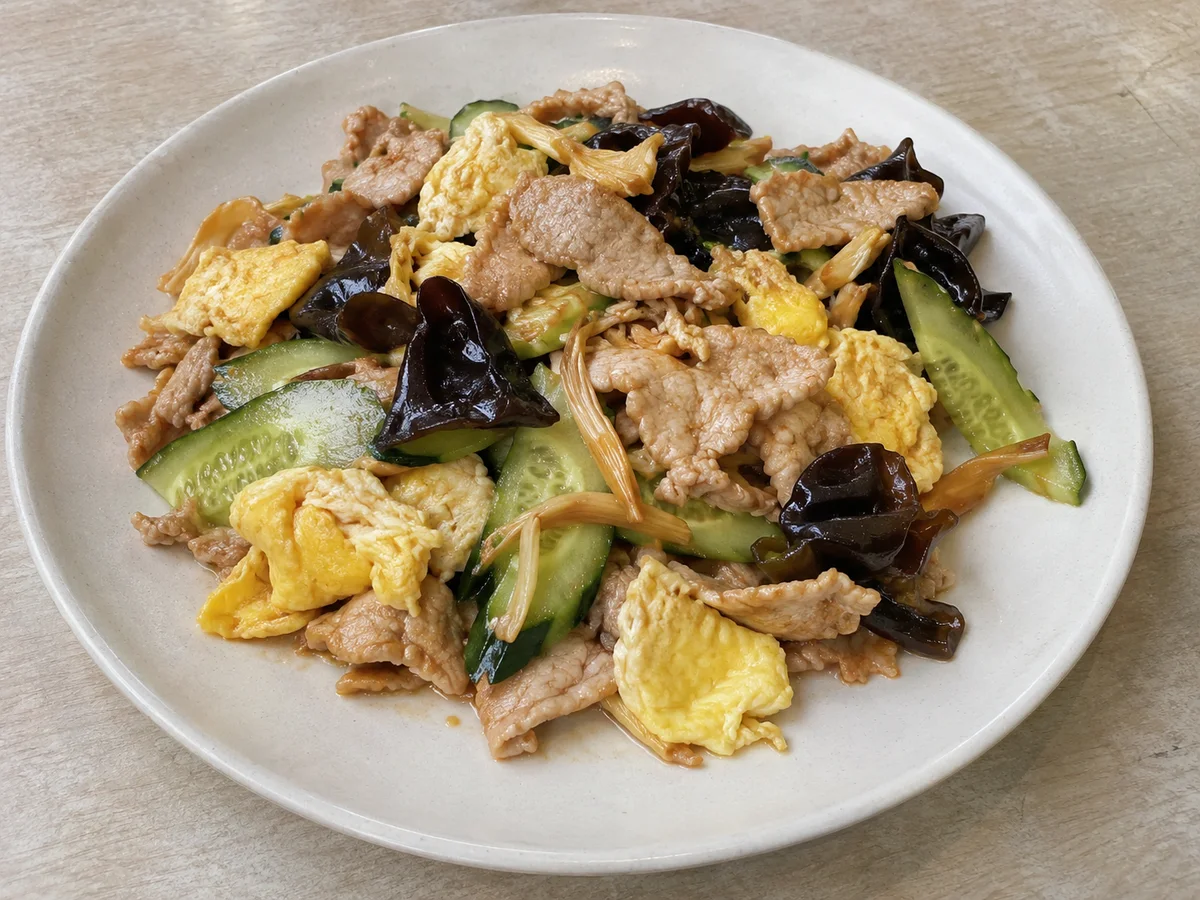
In China, 木须肉 is an everyday stir-fry of shredded pork and scrambled egg with wood ear, eaten with rice rather than wrapped.
Two things never change. One is lean pork, cut into thin shreds or slices and stir-fried; the other is egg, scrambled in hot oil into soft yellow curds, lifted out, and folded back in at the end. Around them goes a changing set of vegetables. Black wood ear fungus (木耳) is nearly always there, for its crunch. Dried daylily buds (黄花菜, the “golden needles” of old American recipes), cucumber and bamboo shoots are the commonest additions, and carrot and garlic shoots turn up too. The seasoning is light: soy sauce, Shaoxing wine, scallion and ginger, and in the Shandong and Tianjin versions a spoonful of sweet flour sauce fried with the pork.
It is home cooking and cheap restaurant food across the north, from Shandong and Beijing to Tianjin and the northeast: in 2025 a plate cost 8 yuan at a small restaurant. Chinese cookbooks treat it as a plated stir-fry to share with rice; the trade cookbooks of the 1960s and 1970s described below all serve it without pancakes.
Beijing’s official guide to English menu names, drawn up by the city government before the 2008 Olympics, lists it as “Moo Shu Pork (Sautéed Sliced Pork, Eggs and Black Fungus),” keeping the American name just as it keeps Kung Pao Chicken, Chop Suey and Wonton. In America, though, that name stands for a rather different meal, described below.
02
Osmanthus, not whiskers: the name
The name describes the egg, and hides the word for it.
木樨 (mùxī) is osmanthus, 桂花, a tree whose tiny yellow and cream flowers scent the Chinese autumn. Egg scrambled into small golden pieces looks like a scatter of those flowers. An early description of the dish, written in 1845, explains that northern inns fried egg with meat and called it 木樨肉 “because it has broken yellow bits.” Tianjin’s 1977 trade cookbook spells the comparison out: golden osmanthus is orange-yellow, silver osmanthus a pale yellowish white, and dishes made with egg take on the colours of both.
There was also a word to avoid. Northern curses were built on 蛋, egg (浑蛋, “bastard,” and 倒蛋, “troublemaker,” among them), so Beijing kitchens kept it off the menu. In the late Qing, eggs were 鸡子儿, “chicken seeds”; preserved eggs were 松花, “pine flowers”; scrambled eggs 摊黄菜, “spread yellow greens”; eggs in a thickened sauce 溜黄菜; a whole egg cooked in water 沃果儿; and egg-drop soup 木樨汤, osmanthus soup, because the egg in it is as yellow as the flower. Only tea eggs, 茶鸡蛋, kept the word.
Where the habit began is less certain. The Beijing opera scholar Qi Rushan (1875–1962) traced it, on the word of an elderly Beijing restaurant owner, to the eunuchs of the Ming palace, who were feared, touchy and averse to the word for egg; restaurants in the capital and along the roads they travelled renamed every egg dish, calling those made with the white 芙蓉, hibiscus, and those made with the yolk 桂花, osmanthus. Most of those names died out after 1912, but 木须肉 was one that stayed. Shandong cooks still use the same code: golden scrambled egg is 木樨, egg white alone is 芙蓉, as in 芙蓉鸡片, egg-white chicken slices.
The spelling 须, “whiskers,” came from speech. Said quickly, the rounded vowel of 木 pulls 樨 from xī toward xū, and menus followed the sound. The Beijing service bureau’s recipe in the 1966 national cookbook Dazhong Caipu (大众菜谱) is already headed 炒木须肉, with a footnote that the character should really be 樨 but that local usage had been kept; Tianjin’s 1977 book still insisted that 木须肉 be corrected to 木犀肉. Shandong cooks also write 苜蓿肉, “alfalfa pork,” for the same sound. American menus turned 木须 into moo shu, mu shu and moo shi.
03
From Qing inns to Beijing’s Shandong kitchens
The dish is on record in north China from the 1840s, and it belongs to the Shandong cooking that shaped Beijing’s restaurants.
The 1845 record is a joke at a southerner’s expense. The Qing writer Liang Gongchen tells of a traveller from the south who would not eat eggs and would not admit that he did not know northern menus. At a roadside inn he asked what was good, was offered 木樨肉, and ordered it at once; it was pork fried with egg. He asked for something else and was offered 摊黄菜, which was scrambled egg; he asked for a snack and was brought 窝果子, eggs cooked whole. Too embarrassed to say anything, he left hungry.
Two decades later the dish was on the emperor’s table. Gongwei Mimu (宫闱秘幕), a memoir of the late Qing court by Mu Shiqiao, who says he moved in the palace as a relative of the imperial household in the Tongzhi and Guangxu reigns, records that the Tongzhi Emperor (r. 1861–1875) loved 木樨肉, “egg fried with shredded pork,” and had it set out at every meal; the Guangxu Emperor’s favourite was steamed duck.
Its roots are in Shandong. In the Ming and Qing many Shandong cooks and dishes entered the palace kitchens, and the “eight great halls” (八大楼), Beijing’s grand restaurants from the late Qing on, cooked a Beijing style of Shandong food. Cookbooks keep 木樨肉 in that line. The 1978 Shandong volume of the national Chinese Cookbook series lists it among its pork dishes; the 1966 Dazhong Caipu prints three versions on facing pages, sent in by Beijing’s municipal service bureau, Hangzhou’s catering company and Shandong’s commerce bureau; and Tianjin’s 1977 cookbook has its own. By then the dish had long since spread beyond Beijing.
04
How Chinese cooks make it
Every version scrambles the egg first and puts it back last.
The egg goes into plenty of hot oil and is pushed about until it sets in large, soft curds, then comes out of the wok. The 1966 recipes from Beijing and Hangzhou both warn against too fierce a flame, which toughens the egg and sticks it to the pan; Hangzhou’s takes it out the moment it turns golden. The pork, shredded about five centimetres long, goes into fresh oil and is stir-fried until it changes colour; the seasoning and vegetables follow, the egg goes back in, and a spoonful of stock or water pulls everything together. In Shandong the pork is pushed to the side of the wok while a spoonful of sweet flour sauce fries in the oil until fragrant, and only then is the soy sauce added.
The quantities in the old trade books are small and exact, set for a single restaurant plate. Beijing’s is the plainest of all: in 1966 the city’s service bureau used just 100 grams of pork with some fat on it, 150 grams of egg and a little scallion, seasoned with soy sauce, wine and ginger juice.
| Recipe | Pork and egg | Vegetables | Seasoning |
|---|---|---|---|
| Beijing, 1966 | 100 g pork, 150 g egg | Scallion | Soy sauce, Shaoxing wine, ginger juice, salt, a little stock |
| Hangzhou, 1966 | 75 g lean leg pork, 75 g egg | Daylily, wood ear | Soy sauce, yellow wine, sugar, sesame oil |
| Tianjin, 1977 | 125 g pork, 3 eggs | Bamboo shoot, cucumber, wood ear | Sweet flour sauce, soy sauce, wine, Sichuan pepper oil, a light starch glaze |
| Shandong, 1978 | 100 g pork, 3 eggs | Dried bamboo shoot, wood ear, garlic shoots | Sweet flour sauce, soy sauce, lard |
| Home cooking, 2018 | 100 g lean pork, 2 eggs | Wood ear, cucumber, carrot | Soy sauce, wine, salt, scallion, ginger |
05
Pork and egg rolled in bread: the Chinese precedents
The pancake is the American part, but northern China has long rolled pork and egg in bread.
In the late Qing the plain griddle bread of the north, 家常饼, was a meal in itself: dishes were laid on it and rolled up, most often 炒里脊丝, shredded lean pork stir-fried with chive shoots and wood ear, or 摊黄菜, scrambled egg spread on the plate like a yellow lotus leaf. Those are the two halves of 木樨肉, eaten in bread. Spring pancakes, 春饼, beaten very thin and griddled, were rolled around stir-fried shredded pork. In Wu Jianren’s 1906 novel Hen Hai (恨海), a family fleeing Beijing in 1900 stops at a crowded village inn, and their carter orders a pot of wine and rolls a plate of scrambled egg in griddle bread to eat with it.
The closest Chinese meal to moo shu pork today is still the spring pancake. Beijing eats it at Lichun, the start of spring in early February: a stack of pancakes thin as a cicada’s wing, each one rolled at the table around 合菜, a stir-fry of mung bean sprouts, glass noodles, egg and shredded pork, with scallion, sauce and sliced cooked meats. Some suburban restaurants make a feast of it; in 2025 an all-you-can-eat spring pancake spread in Kangling, on the edge of Beijing, cost 45 yuan.
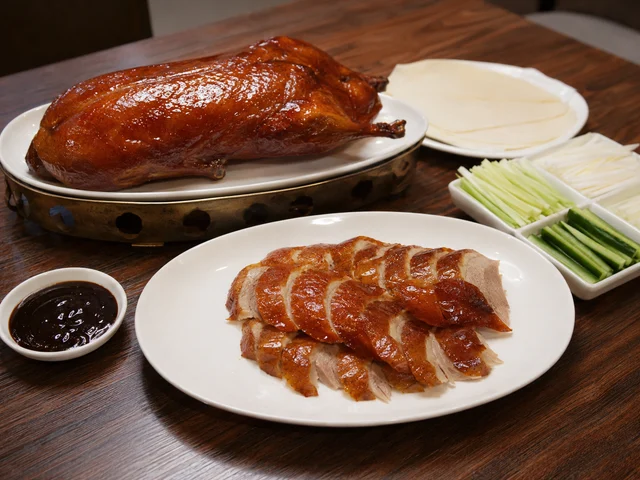
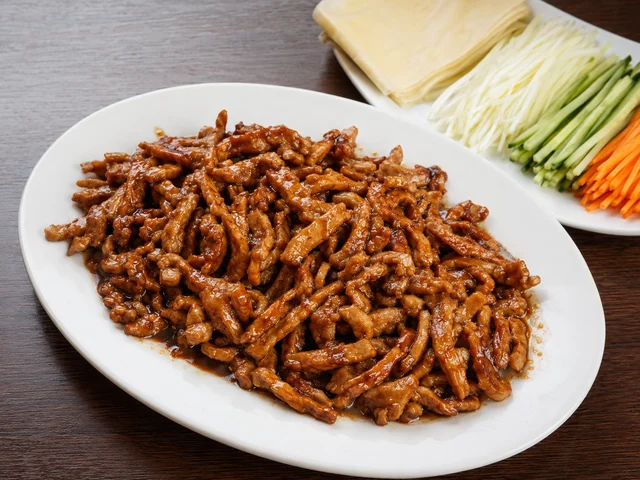
Two other Beijing dishes are rolled at the table. Jingjiang shredded pork (京酱肉丝), slivers of pork in sweet flour sauce, is wrapped with raw scallion in tofu skin or thin pancakes, and Peking duck is rolled in lotus-leaf pancakes. Those thin “Mandarin pancakes,” presented in America as one of the popular foods of Peking, are the ones American restaurants put beside moo shu pork.
06
How it became moo shu pork in America
Moo shu pork reached America with the northern-style restaurants that opened after the Second World War, not with the Cantonese chop suey houses.
One of the first was the Peking Restaurant, opened in 1947 at 5522 Connecticut Avenue in Washington by Chuon Ming Lo, a Cantonese cook who had come to the city in 1941 as chef at the Chinese embassy. Lo billed it as the first restaurant in the country to serve northern Chinese food, with Peking duck and moo shu pork among its “Peking-style” dishes. In February 1955 the Washington Evening Star described its “Moo Shi Pork” of shredded meat, black mushrooms, Chinese cabbage, bamboo shoots and green onion, to be laid in the middle of one of the restaurant’s steamed pancakes and rolled up. Cabbage and pancakes were part of the American dish from its first recorded appearance.
The person who did most to spread it was Joyce Chen. Born in Beijing in 1917, she left China in 1949 for Cambridge, Massachusetts, and in 1958 opened a 250-seat restaurant at 617 Concord Avenue. Its menu offered Moo Shi Pork, shredded pork, eggs and Chinese vegetables with six pancakes, for $2.95, with extra pancakes at 10 cents each; chop suey and chow mein, on the first menu, were gone by the second printing. Her Joyce Chen Cook Book of 1962 presented the Mandarin thin pancake as something served with dishes such as moo shi pork, and when her public-television series Joyce Chen Cooks began at WGBH in 1967, the Boston Globe printed her recipe, presenting it as a famous Peking dish traditionally eaten with Mandarin pancakes: pork and egg with dried wood ears and “golden needles,” daylily buds, the restaurant version adding mushrooms, bamboo shoots and cabbage, and a soup on the side because the pancakes are dry. When the US Postal Service put her on a stamp in 2014, it credited her with introducing many Northeasterners to Peking duck, moo shu pork and hot-and-sour soup.
New York took it up in the mid-1960s. In 1966 the New York Times described the dish at Mandarin House East as a North China egg dish of shredded pork wrapped in thin pancakes, and in November 1967 Craig Claiborne gave a whole column to its “phenomenal” popularity in Manhattan, noting that menus spelled it mo-shu-ro, moo-shu-ro or moo-shi pork. One of the first to serve it was Emily Kwoh, owner of the Mandarin House, Mandarin East and Great Shanghai, who had practically lived on it as a student at Yenching University in Peking, because it was the cheapest thing to eat. The dish Claiborne described was still close to the Chinese one: shredded pork, daylily flowers, wood ear and scrambled egg seasoned with soy sauce, wrapped in a hot steamed pancake.
It spread west and changed as it went. A Peking restaurant in Inglewood, California, served it in 1964, and Chicago’s Dragon Inn offered it with thin pancakes in 1965; by 1979 the Los Angeles Times was calling it a Chinese “burrito.” Over the following decades cabbage took over more of the filling, hoisin sauce brushed on each pancake became the usual sauce, and egg and wood ear became optional. Cook’s Illustrated’s 2015 “Chinese American–style” mu shu pork bulks out the vegetables with green cabbage and bamboo shoots and spreads hoisin on every pancake, and in 2024 a Philadelphia restaurant served a version with no wood ear, egg, daylily or cucumber at all.
07
Moo shu pork and 木须肉 side by side
Same name, two meals.
Shredded pork is the only part the two always share; nearly everything around it differs.
| 木须肉 in China | Moo shu pork in America | |
|---|---|---|
| Name | 木须肉, older 木樨肉; also 苜蓿肉 in Shandong | Moo shu, mu shu or moo shi pork |
| Core | Shredded pork and scrambled egg | Shredded pork; egg and wood ear sometimes left out |
| Vegetables | Wood ear, with daylily, cucumber, bamboo shoot or garlic shoots | Mostly cabbage, with mushrooms, bamboo shoots and scallion |
| Sauce | Soy sauce and wine in the wok, sometimes a little sweet flour sauce | Hoisin brushed on the pancake |
| Served | On a plate, with rice and other dishes | With thin pancakes, rolled at the table |
| Price | 8 yuan a plate at a small restaurant (2025) | $2.95 with six pancakes at Joyce Chen’s, Cambridge (1958) |
08
What to order in China
Ask for 木须肉 if you want the stir-fry; for the wrapped meal, order one of Beijing’s dishes that come with pancakes.
Muxu rou, 木须肉
On the menu of almost any home-style northern restaurant, written 木须肉 and now and then 木樨肉; Beijing menus in English may call it Moo Shu Pork. Expect a plate to eat with rice, not a pile of pancakes.
Spring pancakes, 春饼
The nearest thing to a moo shu meal: thin pancakes rolled at the table around 合菜, egg, scallion, sauce and cooked meats, eaten above all around Lichun in early February. In 2025 a spring pancake buffet on the outskirts of Beijing cost 45 yuan.
Read about spring pancakes and spring rolls →Jingjiang shredded pork, 京酱肉丝
Pork slivers in sweet flour sauce with raw scallion, wrapped in tofu skin or pancakes.
Read about jingjiang shredded pork →Peking duck, 北京烤鸭
Sliced duck with sauce, scallion and cucumber in lotus-leaf pancakes, the kind of pancake American restaurants serve with moo shu pork.
Read the Peking duck guide →09
Making 木须肉 at home
A home version for two, with the egg cooked first and the pork kept tender by a short marinade.
Daylily buds are optional, though the 1966 Hangzhou recipe and Joyce Chen’s American one both used them; use dried buds, soak them and pull off the hard stem ends. The cucumber goes in last, so it stays crisp.
For two: 100 g lean pork; 2 eggs; 10 g dried wood ear; 1 cucumber; 1 carrot; a small handful of dried daylily buds (optional); Shaoxing wine, light soy sauce, salt and cooking oil; scallion and ginger.
- 1. Soak
Soak the wood ear, and the daylily if using, in water until soft. Rinse, tear the wood ear into small pieces and pull the hard tips off the daylily.
- 2. Marinate
Cut the pork into thin slices or shreds and mix with a little wine, soy sauce and oil. Leave for 10 to 15 minutes.
- 3. Cut
Slice the cucumber and carrot.
- 4. Egg
Beat the eggs with a pinch of salt. Scramble them in hot oil over moderate heat, lifting them out as soon as they set in golden curds; too fierce a flame makes them tough.
- 5. Pork
Stir-fry the pork until it changes colour and is cooked through, and set it aside.
- 6. Vegetables
With a little oil left in the wok, fry the scallion and ginger until fragrant, then add the wood ear, daylily and carrot and cook until the carrot softens.
- 7. Finish
Add the cucumber, pork and egg, season with salt and toss; if it looks dry, add a spoonful of water or stock. Serve with rice.
10
More egg dishes and Chinese food abroad
Other pages on the atlas.
Egg drop soup
The soup old Beijing called 木樨汤, osmanthus soup.
Read about egg drop soup →Tomato and egg
The other egg stir-fry nearly every Chinese family cooks.
Read about tomato and egg →Chow mein
Another Chinese dish that took a new shape in America.
Read about chow mein →Beijing classics
- Beijing Roast Duck
Roast duck · Shared meal
- Jingjiang Shredded Pork
Main dish · Lunch or dinner, shared
- Beijing Copper-Pot Mutton
Lamb hot pot · Winter, shared
- Beijing Zhajiang Noodles
Home-style noodles · Everyday meal, best in summer
- Beijing Quick-Blanched Tripe
Tripe snack · Snack, one plate at a time
- Baozi
Steamed filled bun · Breakfast
FAQ
Questions about Moo Shu Pork
What is moo shu pork?
The American name for 木须肉, a northern Chinese stir-fry of shredded pork, scrambled egg and wood ear fungus, often with daylily buds, cucumber or bamboo shoots. In America it is rolled in thin pancakes with hoisin sauce.
What does moo shu mean?
It comes from 木樨, osmanthus. The broken yellow egg looks like osmanthus flowers, and Beijing kitchens used the flower’s name instead of the word for egg. The spelling 木须, “wood whiskers,” follows the sound.
Is moo shu pork Chinese or American?
The stir-fry is Chinese, from Shandong and Beijing cooking, and on record since the 1840s. Serving it with pancakes and hoisin is American, from the northern-style restaurants of the 1950s and 1960s.
Do people in China eat moo shu pork in pancakes?
Not as a rule. In China it is a plated dish eaten with rice, though northern home cooks have long rolled pork and egg in griddle bread. Pancakes come with spring pancake meals, jingjiang shredded pork and Peking duck.
What are moo shu pancakes?
Thin wheat pancakes, called Mandarin pancakes in America, of the kind Beijing serves with Peking duck and at spring pancake meals.
What sauce goes with moo shu pork?
American restaurants brush hoisin sauce on the pancakes. In China the dish is seasoned in the wok with soy sauce and wine, and Shandong and Tianjin cooks add a little sweet flour sauce.
What are the black and yellow strips in moo shu pork?
The black ones are wood ear fungus; the yellow strands are dried daylily buds, sold in America as golden needles or tiger lily buds. The soft yellow pieces are scrambled egg.
Who brought moo shu pork to America?
Northern-style Chinese restaurants: the Peking Restaurant in Washington served it by 1955, Joyce Chen put it on her Cambridge menu in 1958, and Mandarin restaurants in New York made it popular in the mid-1960s.
Is 木须肉 the same as 木樨肉?
Yes. 木樨肉 is the older spelling and 木须肉 the common one today; Shandong cooks also write 苜蓿肉.
How much does muxu rou cost in China?
It is cheap home-style food: 8 yuan a plate at a small restaurant in 2025.
Sources
Sources and further reading
- 1 Liang Gongchen, Beidongyuan Bilu, third series (北東園筆錄三編), vol. 3, “Pretending to know” (諱不知) (in Chinese)Wikisource; 1845 ↗
- 2 Xu Ke, Qing Bai Lei Chao (清稗類鈔), food section: “Food in the capital” (京師食品) (in Chinese)Wikisource; first published 1917 ↗
- 3 Xu Ke, Qing Bai Lei Chao (清稗類鈔), food section: “Home-style bread” (家常餅) and “Spring pancakes” (春餅) (in Chinese)Wikisource; first published 1917 ↗
- 4 Mu Shiqiao, Gongwei Mimu (宮闈秘幕), “Waste in the imperial kitchens” (天廚之暴殄) (in Chinese)From Fangpingxinshi Biji; late Qing to Republican era, Wikisource ↗
- 5 Wu Jianren, Hen Hai (恨海), chapter 2 (in Chinese)Wikisource; 1906 ↗
- 6 “Shandong cuisine: pure, savory and true to its ingredients” (鲁菜:咸鲜纯正,突出本味) (in Chinese)Beijing Tourism Website, Beijing Municipal Culture and Tourism Bureau (August 23, 2018) ↗
- 7 Zhang Xiaofang, “Eating in Beijing: Laolao Jia spring pancakes” (吃在北京之“中华小吃”——姥姥家春饼店) (in Chinese)Beijing Tourism Website, Beijing Municipal Culture and Tourism Bureau (February 4, 2018) ↗
- 8 English translations of Chinese menus (中文菜单英文译法): translation principles; pork dishesForeign Affairs Office of the Beijing Municipal Government and Beijing Municipal Commerce Bureau (December 2007) ↗
- 9 Victor Mair, “Muxu meat dishes: the art of bricolage”Language Log, University of Pennsylvania (July 30, 2024) ↗
- 10 Qi Rushan, “On muxu fried rice and the Ming eunuchs” (谈炒木须饭及明朝太监), excerpt from Zhongguo Zhuanxiu Tan (中国馔馐谭), Huazhong University of Science and Technology Press (2015) (in Chinese)Shuzhai (书摘), Guangming Daily group (August 2015) ↗
- 11 Sun Qian, “Fine names in fine characters: Chinese names and the choice of characters” (嘉名用美字——汉语名称与汉字选用) (in Chinese)Guangming Daily, p. 5 (June 30, 2024) ↗
- 12 Liu Xiaona, “Recipe: muxu pork” (美味菜谱:木须肉) (in Chinese)Life Times (生命时报), via People’s Daily Online (June 15, 2018) ↗
- 13 Craig Claiborne, “No Matter How You Spell It, It’s Still Mo-Shu-Ro”The New York Times, p. 56 (November 2, 1967) ↗
- 14 Dazhong Caipu (大众菜谱), p. 84: stir-fried muxu pork (炒木须肉), Beijing Municipal Service Bureau (in Chinese)Light Industry Press (1966), indexed by laocp.tech ↗
- 15 Dazhong Caipu (大众菜谱), p. 85: muxi pork (木樨肉), Hangzhou Catering Service Company; and stir-fried muxu pork, Shandong Provincial Commerce Bureau (in Chinese)Light Industry Press (1966), indexed by laocp.tech ↗
- 16 Chinese Cookbook: Shandong (中国菜谱·山东), p. 20: stir-fried muxi pork (炒木樨肉) (in Chinese)Chinese Cookbook editorial group, China Financial and Economic Publishing House (1978), indexed by laocp.tech ↗
- 17 Tianjin Caipu, vol. 1 (天津菜谱·第一册), p. 121: muxi pork (木犀肉) (in Chinese)Tianjin Catering Service School and Tianjin Catering Service Company (1977), indexed by laocp.tech ↗
- 18 John DeFerrari, “Chinese Restaurants in D.C. at Mid-Century”Streets of Washington (November 22, 2021) ↗
- 19 Richard Auffrey, “The Origins of Moo Shu Pork in the U.S.”, quoting the Evening Star (1955), Joyce Chen’s 1958 menu and the Boston Globe (1967)The Passionate Foodie (January 28, 2025) ↗
- 20 Barry Popik, “Chinese Burrito” or “Chinese Taco” (Moo Shoo Pork or Moo Shu Pork or Moo Shi Pork), citing the Joyce Chen Cook Book (1962), the New York Times (1966) and the Los Angeles Times (1979)The Big Apple ↗
- 21 Deb Mandel, “Joyce Chen Restaurant”History Cambridge (2022) ↗
- 22 Celebrity Chefs Forever stamps: Joyce Chen, James Beard, Julia Child, Edna Lewis, Felipe Rojas-LombardiUnited States Postal Service (2014) ↗
- 23 Andrea Geary, “Mu Shu Pork”Cook’s Illustrated, March/April 2015; America’s Test Kitchen (January 6, 2015) ↗
- 24 Muxu pork, musu pork, muxi pork: one Shandong dish, cooked the traditional way by a veteran Shandong chef (video, in Chinese)Lu Cai Xingzhe (鲁菜行者), Bilibili (November 17, 2021) ↗
- 25 Muxu pork for 8 yuan? Prices in the northeast (video, in Chinese)Te Chu Wei Wei (特厨魏味), Bilibili (December 6, 2025) ↗
- 26 A 45-yuan spring pancake buffet on the outskirts of Beijing (video, in Chinese)Chuanzhang Mishi Ji (船长觅食记), Bilibili (March 1, 2025) ↗
Last updated November 2026