
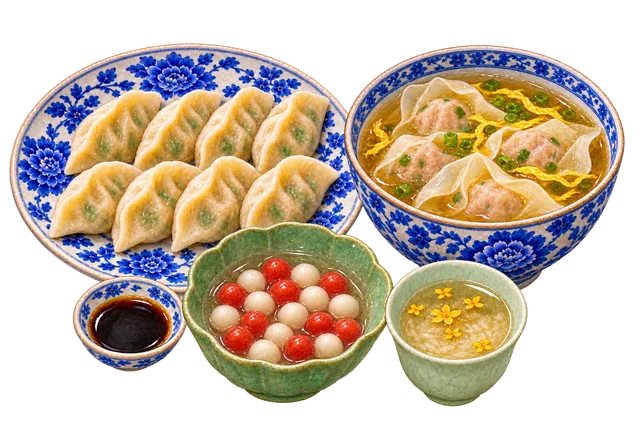
Three to start with
Jiaozi in the north, tangyuan in the south, and the wontons that came first
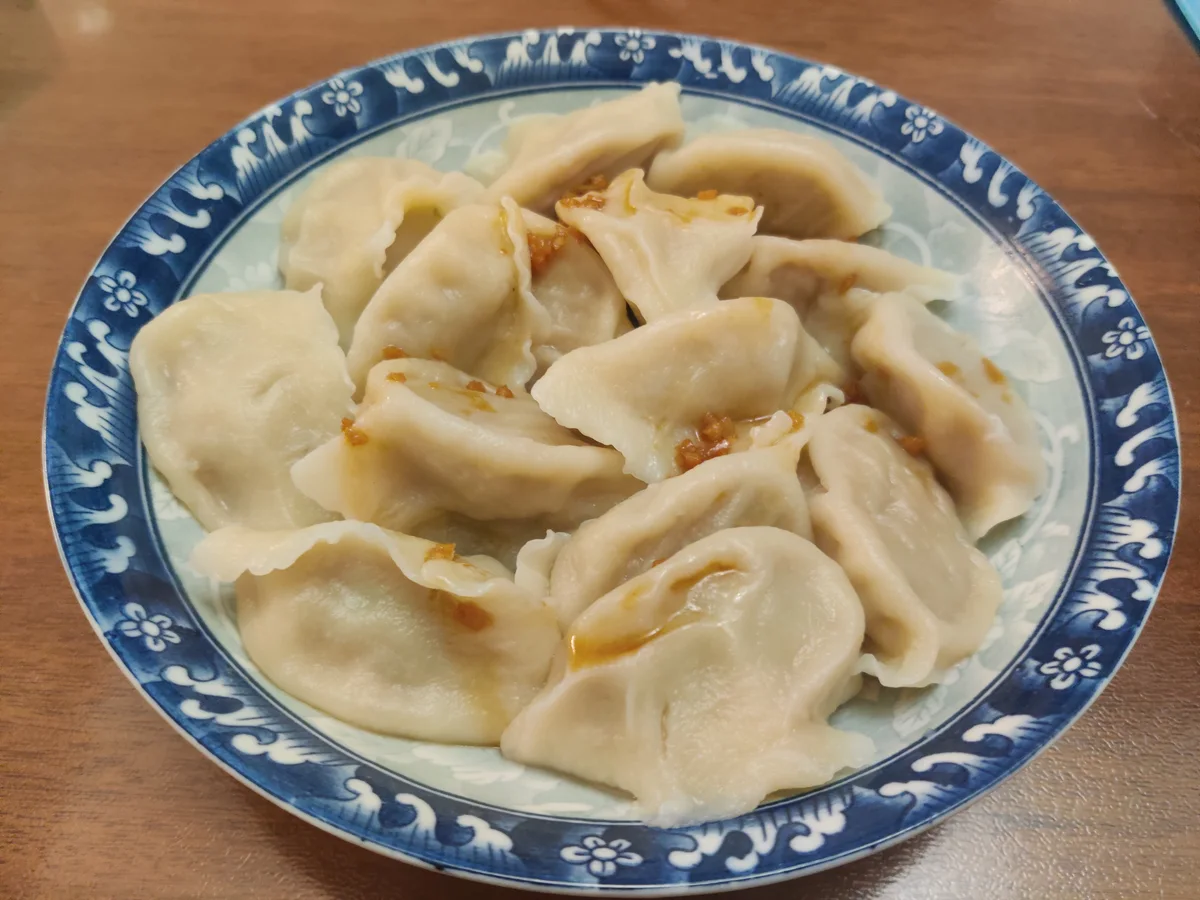
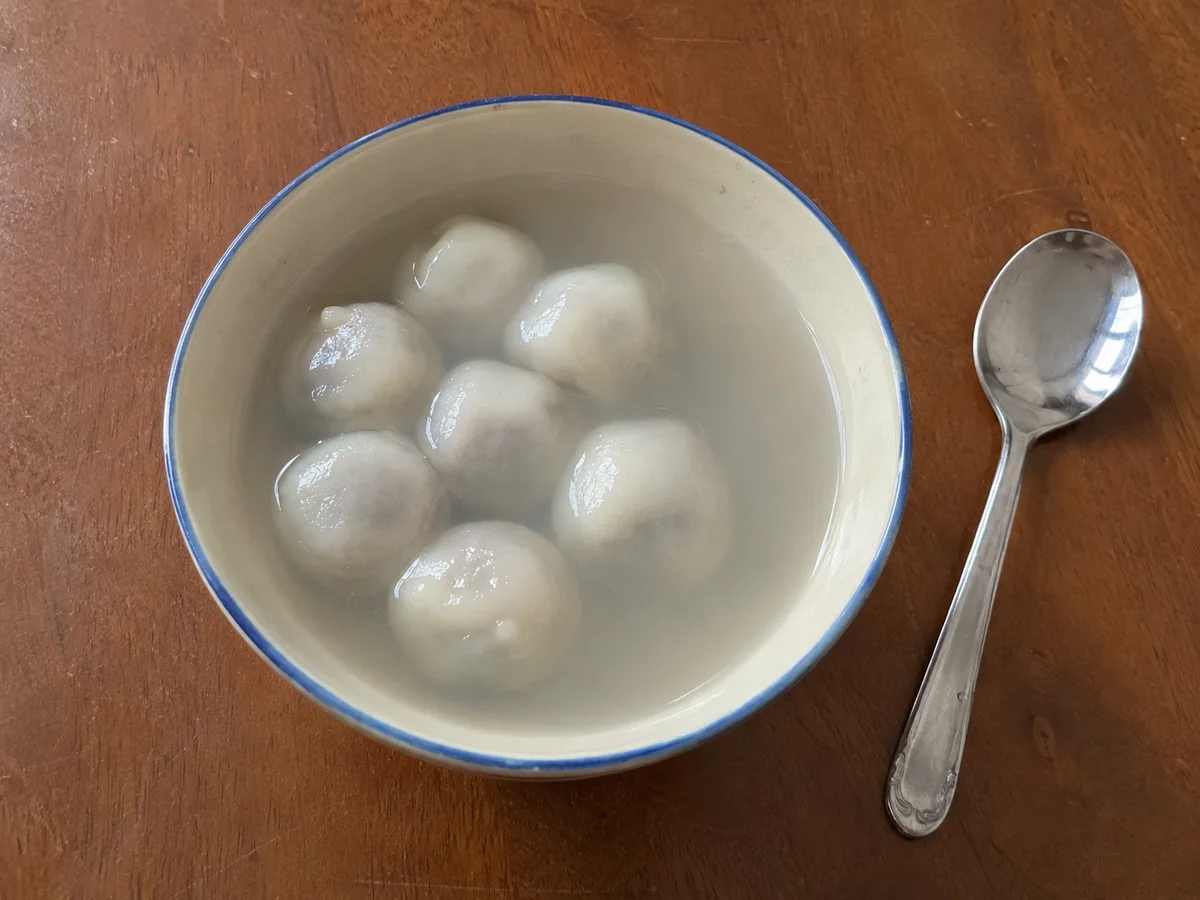
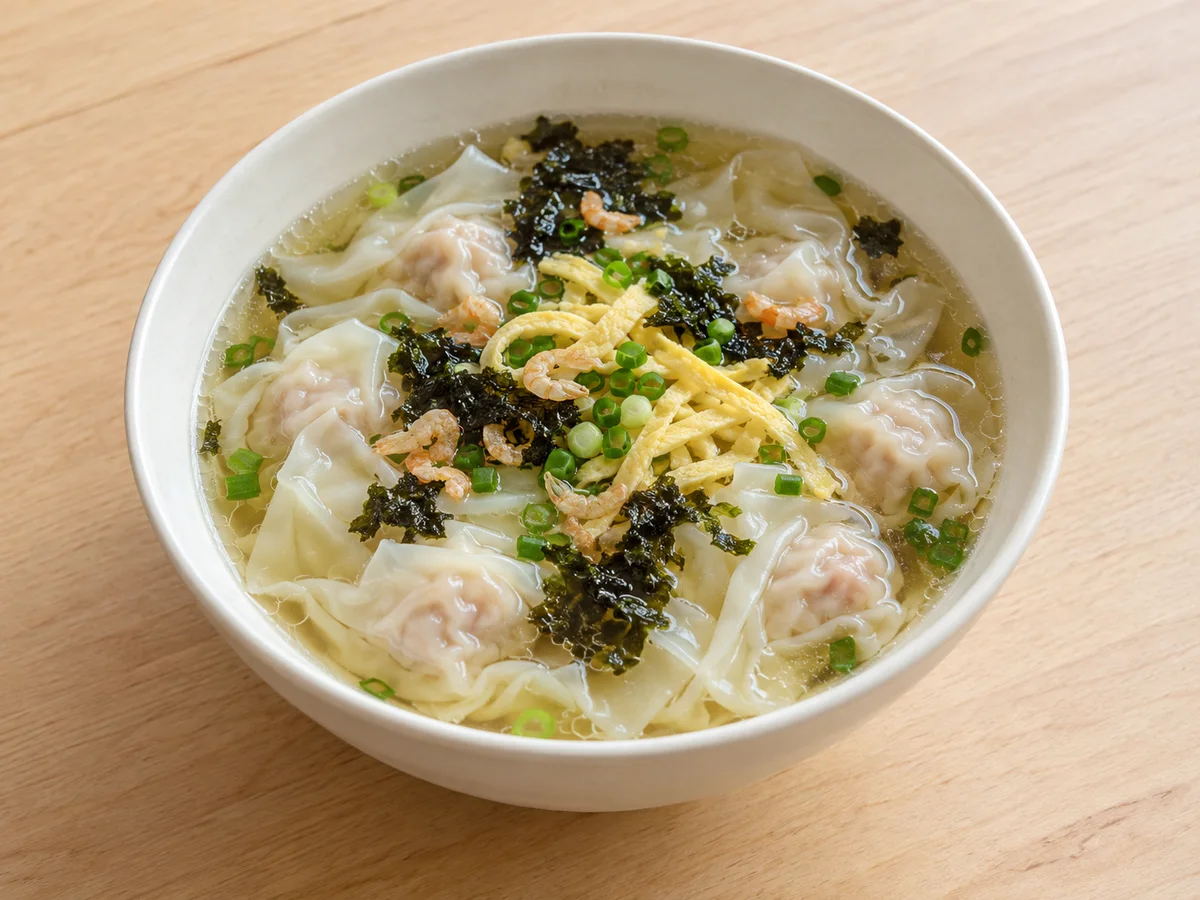
Jiaozi are the north’s solstice food and tangyuan the south’s. Wontons are the older custom: offered to the ancestors at the solstice in Song-dynasty Hangzhou, and still the Beijing solstice food in 1900.
01
Fifteen winter solstice foods and where they are eaten
Most solstice foods belong to one region, so the table starts with where. Several come with a saying, given here in Chinese.
| Food | Chinese | Where | Why it is eaten | Note |
|---|---|---|---|---|
| Jiaozi | 饺子 | The north | 冬至不端饺子碗,冻掉耳朵没人管: skip them and your ears freeze | No record of them as a solstice food before the late Qing |
| Wontons | 馄饨 | Old Beijing; Song-dynasty Hangzhou | 冬至馄饨夏至面: wontons at the winter solstice, noodles at the summer one | Said to look like 混沌, the primal chaos |
| Mutton soup | 羊肉汤 | Tengzhou, southern Shandong | The solstice is Tengzhou’s “little New Year” | Booked ahead and carried home in pots |
| Tangyuan, solstice balls | 汤圆、冬至团 | Jiangnan, Guangdong, Fujian, Taiwan | Round, for reunion; eating them “adds a year” | In old Suzhou, filled ones for the ancestors, plain ones for the gods |
| Winter-brewed wine | 冬酿酒 | Suzhou | Drunk at the dinner on the solstice eve | Sweet rice wine with osmanthus, about 2–4% alcohol |
| Cold braised dishes | 羊糕、酱鸭、酱方 | Suzhou | Seven or eight cold plates open the solstice-eve dinner | Lamb terrine, braised duck, braised pork belly |
| Red-bean glutinous rice | 赤豆糯米饭 | Jiangnan, Shanghai | Red beans scare off a plague demon, in a 6th-century story | Once a red-bean congee |
| Nian gao | 年糕 | Hangzhou | 年年高, higher every year | Eaten at all three meals |
| Sweet potato and rice-ball soup | 番薯汤果 | Ningbo | 番 sounds like 翻: turning bad luck over | With fermented rice, 浆板, for 涨, rising |
| Cured-meat glutinous rice | 腊味糯米饭 | Guangzhou, the Pearl River Delta | An old Cantonese solstice dish | On a Guangzhou list of solstice customs from 1956 |
| Fish sashimi | 鱼生 | Guangzhou, Shunde | 冬至鱼生处处同: sashimi everywhere at the solstice, in a Qing verse | Many families now cook the fish in a hot pot |
| White-cut chicken, roast goose | 白切鸡、烧鹅 | Guangdong, Hong Kong | The family solstice dinner, 团冬 or 做冬 | With lettuce, 生菜, for 生财, making money |
| Dongjie wan | 冬节丸 | Chaoshan | Rolled in mixed sizes: “father, son, grandfather and grandson” | The first bowl goes to the ancestors |
| Dongzhi yuan | 冬至圆、冬节圆 | Southern Fujian, Taiwan | “Eat them and you are a year older” | Small, red and white, no filling |
| Mutton hot pot, ginger duck | 羊肉炉、姜母鸭 | Taiwan | Winter tonics, 进补 | With 十全大补汤, a soup of ten tonic herbs |
02
When is Dongzhi in 2026?
In 2026 the winter solstice falls on Tuesday, 22 December, at 04:50 Beijing time.
Unlike the Spring Festival or the Mid-Autumn Festival, Dongzhi is not a lunar date. It is one of the twenty-four solar terms, which mark the sun’s progress through the year in steps of fifteen degrees, and it arrives when the sun stands over the Tropic of Capricorn: the shortest day of the year in the northern hemisphere. That keeps it between 21 and 23 December. The Hong Kong Observatory puts the 2026 solstice at 04:50 on 22 December, Hong Kong time, which is also Beijing time; on the lunar calendar that is the fourteenth day of the eleventh month. UNESCO added the twenty-four solar terms to its list of the intangible cultural heritage of humanity in 2016.
On the mainland the solstice is an ordinary working day, so the family meal is in the evening, and in Suzhou on the evening before. Hong Kong gives it more room. The Chinese Winter Solstice Festival is one of its statutory holidays, which an employer may give instead of Christmas Day, and most offices let staff go home early on the day so they can be at dinner.
The solstice also starts the count of the nines. From that day the winter is reckoned in nine spells of nine days, eighty-one days in all, after which, says an 1830 Suzhou almanac, the cold is over; the third nine is said to be the coldest. Old Beijing kept a chart for the count, nine squares of nine circles, filling in one circle each day and marking it for cloud, sun, wind, rain or snow. Counted from 22 December 2026, the third nine runs from 9 to 17 January 2027 and the ninth ends on 12 March.
Chinese New Year food
Just over three weeks after the solstice comes Laba congee, the first food of the New Year season; the 2027 calendar runs to the Lantern Festival.
Open the New Year food calendar →03
“As big as the New Year”: the solstice in old Kaifeng, Hangzhou, Suzhou and Beijing
In Song-dynasty Kaifeng even the poorest families saved and borrowed all year to eat well at the solstice.
Meng Yuanlao, writing in 1147 about the Northern Song capital he had left behind, says Kaifeng valued the winter solstice above every other festival. Even the very poor saved and borrowed through the year so that on that day they could put on new clothes, lay in food and drink and make offerings to their ancestors, and people went round with greetings “just as at the New Year.” In Hangzhou, the Southern Song capital, Zhou Mi records that the ancestors were offered wontons, which gave rise to the saying 冬馄饨,年馎饦, “wontons at the solstice, noodle soup at New Year,” and that rich households, chasing novelty, filled a single bowl with more than ten kinds and called it “hundred-flavour wontons.”
An older solstice food is red beans. Zong Lin’s sixth-century record of the year in Jingchu, on the middle Yangtze, says families cooked red-bean congee on the solstice to ward off pestilence. The commentator Du Gongzhan, writing around 600, supplies the story: a worthless son of the ancient figure Gonggong died on the winter solstice and became a plague demon, and the demon was afraid of red beans. The red-bean glutinous rice of Jiangnan is the same idea.
The phrase that sums up the festival in the south comes from Suzhou. Gu Lu’s almanac of 1830 says the people of the prefecture valued the solstice above everything. On the day before, relatives and friends sent one another food in baskets and boxes that crowded the streets; the eve was called “solstice night” and families took turns feasting; and every household, large or small, bought food to offer its ancestors, “hence the saying that the winter solstice is as big as the New Year.” Every house also ground rice flour for 冬至团, solstice balls, filled with sugar, meat, vegetables, fruit, cowpea paste or shredded radish, and a poem quoted in the notes explains that the large filled ones were offered to the ancestors on the eve and the small plain ones to the gods in the morning.
Beijing was cooler about it. Fucha Dunchong, writing in 1900, says the solstice was the day of the emperor’s sacrifice to Heaven and of the officials’ congratulations to the throne, but ordinary people did not keep it as a festival: “they merely eat wontons, as they eat noodles at the summer solstice,” hence the Beijing saying 冬至馄饨夏至面. His explanation is a pun on shape. A wonton looks like a hen’s egg, and so like 混沌, hundun, the undivided chaos before heaven and earth separated, and that is why it is eaten on the solstice.
Wontons
Thin wrappers round a little meat, eaten in broth: Shanghai’s big and small wontons, Cantonese yuntun and Chengdu chaoshou.
Read about wontons →04
The north: jiaozi, a frostbite legend and Tengzhou’s mutton soup
冬至不端饺子碗,冻掉耳朵没人管: “Don’t hold a bowl of jiaozi at the solstice, and no one will care when your ears freeze off.”
That northern saying comes with a story. Zhang Zhongjing, the Eastern Han physician later called the Sage of Medicine, is said to have come home from his post as prefect of Changsha in winter and found poor people along the Bai River with frostbitten ears. He stewed mutton with warming herbs, chopped it, wrapped it in dough folded into the shape of an ear and handed the “tender ears,” 娇耳, out free from the solstice until New Year’s Eve; 娇耳 became 饺耳 and then 饺子. Xinhua tells it as a legend, and the folklorist Zheng Yan of the Shandong Academy of Social Sciences calls it a folk tale. In Henan, eating dumplings at the solstice is called 捏冻耳朵, “pinching frozen ears.”
The record is much shorter than the legend. The Ming and Qing sources mention no dumplings at the solstice, only the wontons of 冬至馄饨夏至面, and scholars date the jiaozi custom to the late Qing or the early Republic. One explanation is migration: Beijing and the country round it took in many people from Henan, and the capital’s solstice food drifted from wontons to dumplings.
Today jiaozi are the north’s solstice meal. Beijing dumpling shops sell several times their usual number on the day; in 2020 the founder of the Xiaoheng chain put it at seven or eight times, with queues from opening time. In the northeast the cold helps. For the 2025 solstice, villagers in Xingshisi, a village in Gannan county near Qiqihar, wrapped dumplings together and set them outside at minus 20 to 30°C to freeze hard, then bagged them to cook as needed. Beijing has not given up its wontons either: in 2023 the old-name restaurant Shaguoju sold solstice wontons from breakfast time, citing the old saying, and expected dumplings and wontons to sell two to four times their normal amount.
Tengzhou, in southern Shandong, drinks mutton soup. There the solstice is called the “little New Year.” Families book mutton or soup from a soup house in advance and carry it home in their own pots, or have it packed to give to relatives, and younger people take mutton to their elders. The soup is boiled from mutton bones and meat with pan-fried crucian carp until it turns milky; liver, lung and tripe are blanched and sliced separately, and each bowl is finished with coriander and a drop of vinegar and eaten with shaobing. Many keep drinking it from the solstice through the first three nines, and at the 2024 solstice one soup-house cook said they were boiling more than twenty sheep a day.
Jiaozi
The northern dumpling calendar, from the coin in the New Year’s Eve batch to the fifth day and the winter solstice.
Read the jiaozi calendar →Northeastern sauerkraut dumplings
Big jiaozi of fermented napa cabbage and fatty pork, dipped in vinegar with garlic.
Read about sauerkraut dumplings →Types of Chinese dumplings
Jiaozi, wontons, xiaolongbao and baozi side by side: wrappers, folds and how each is cooked.
Open the dumpling guide →05
Suzhou, Shanghai, Hangzhou and Ningbo: solstice night, winter wine and tangyuan
In Suzhou the big meal is the night before the solstice, and it opens with seven or eight cold plates.
Suzhou still calls the eve 冬至夜, solstice night, and treats it as the festival proper. Families make their offerings to heaven, earth and the ancestors that evening and then sit down to a dinner that many Suzhou people rank above the one on New Year’s Eve. It opens with seven or eight cold braised dishes, among them lamb terrine, braised pork, braised duck, salted chicken, char siu, five-spice beef, smoked fish and 酱方, a braised square of pork belly, followed by a hot pot. At a Suzhou solstice food fair in 2025, lamb terrine sold for ¥60 a jin. A local rhyme sets the stakes: 有得吃吃一夜,呒不吃冻一夜, “if you have food, eat all night; if you have none, freeze all night.” The solstice balls Gu Lu described in 1830 are still made, now filled with fresh pork, red bean paste, sesame or shredded radish.
The drink is 冬酿酒, winter-brewed wine: a sweet glutinous rice wine steeped with osmanthus, at about 2 to 4 percent alcohol, brewed once a year and sold only in the days before the solstice. The old shop Yuandachang on Guanqian Street opened its 2025 sale on 9 December and sold until the 20th, loose at ¥6 per 500 ml or at ¥22 a bottle. Its Gongxiang branch gave out 600 numbered tickets a day, with a limit of 10 jin a person; one buyer who joined the queue at four in the morning had the wine at nine. People bring kettles and empty cola bottles to be filled. In Gu Lu’s 1830 almanac winter-brewed wine appears under the tenth month as a farmhouse wine, with no mention of the solstice.
Shanghai eats tangyuan and red-bean glutinous rice at the solstice, the red beans a descendant of the old congee against the plague demon. It is also a day for tonics, a spoon of herbal paste or a cup of tonic wine, for visiting family graves, and for getting home early in the evening.
Hangzhou eats nian gao, 年糕, for 年年高, “higher every year,” in a three-meal form: nian gao with osmanthus and rose sugar in the morning, stir-fried with winter bamboo shoots and shredded pork at noon, and in a soup with small bok choy in the evening. The rice-cake custom is said to date from the late Ming; before that Hangzhou ate wontons, as Zhou Mi recorded. Old Hangzhou families buy nian gao, oranges and water caltrops ahead and offer them to the ancestors on the day. Ningbo eats 番薯汤果: chunks of sweet potato and small rice balls with fermented rice, called 浆板 in Ningbo dialect. The puns do the work: 番, sweet potato, sounds like 翻, turning bad luck over, and 浆 sounds like 涨, rising.
Tangyuan
Why the solstice and the Lantern Festival both call for tangyuan, and how wrapped tangyuan differ from rolled yuanxiao.
Read about tangyuan’s festivals →Savory tangyuan in Shanghai
Pork and shepherd’s purse, shredded radish and crab: the savory side of Jiangnan tangyuan.
Read about Shanghai tangyuan →Chinese desserts for beginners
Eight-treasure rice, osmanthus lotus root and the other glutinous-rice sweets of Shanghai, Suzhou and Hangzhou.
Read about Jiangnan sweets →06
Guangdong and Hong Kong: “winter is bigger than New Year”
Cantonese say 冬至大过年, the solstice is bigger than New Year, and 肥冬瘦年, a fat solstice and a lean New Year.
In Guangzhou what matters most is getting the family round one table, 团冬. A list of the old customs printed by Guangzhou Daily in 1956 runs: offerings to the ancestors, tangyuan, cured-meat glutinous rice, and chickens and ducks killed for a stew of eight treasures. Tangyuan eaten that day were called 添岁, “adding a year.” The reunion dinner once ran to nine dishes, with chickens and geese killed, roast pork bought and dace salted in advance, and a home-poached white-cut chicken is still part of it. A Qing gazetteer of Huaxian, now Huadu district of Guangzhou, records rice-flour balls served at the meal and called 团冬. Some in the province say the solstice outweighs the New Year itself.
Guangzhou also ate fish sashimi at the solstice: 冬至鱼生处处同, runs a Qing bamboo-branch verse, “at the solstice there is sashimi everywhere.” Raw freshwater fish carries a parasite risk, and many Guangzhou families now cook their solstice fish in a hot pot instead. Around the province the dish changes. Yangjiang makes salty, unfilled tangyuan; Hakka families in Meizhou stew mutton with angelica-type herbs and their own rice wine, and brew rice wine that day; Huizhou makes radish kueh; Shunde cooks a hot pot with a congee base; and the Pearl River Delta keeps its cured-meat glutinous rice.
Hong Kong calls the dinner 做冬, “making winter.” In the days before, families stock up on chicken, duck, seafood and cured meats, and on lettuce, 生菜, which sounds like 生财, making money; the roast-meat stalls in the markets sell roast goose and char siu. In restaurants the meal runs to white-cut chicken and steamed coral grouper and ends with tangyuan, and large families often choose poon choi or a hot pot. Hong Kong’s savory tangyuan are filled with meat and served in clear broth. Offices let staff leave early, and even a market fishmonger shuts his stall early to get home.
White-cut chicken
A whole chicken steeped, iced and chopped on the bone: how it is cooked, why the bones are red, and the best dips.
Read about white-cut chicken →Roast goose
Cantonese roast goose, seasoned inside, glazed, air-dried and roasted, and where Guangzhou buys it.
Read about roast goose →Savory tangyuan on the southern coast
Plain rice balls added to a soup of pork, dried shrimp, shiitake and radish, from Taishan and the Pearl River Delta.
Read about savory tangyuan →07
Chaoshan, southern Fujian and Taiwan: rice balls that add a year
On the night before the solstice, Chaoshan and southern Fujian families sit round a tray and roll rice balls.
In Chaoshan they are 冬节丸, solstice balls, rolled by the whole family round a wide bamboo tray on the eve and made in uneven sizes on purpose, big and small together, which is why they are called 父仔公孙丸, “father, son, grandfather and grandson balls.” Early next morning they are boiled, and the first bowl is set before the ancestral tablets. Families used to stick a few on the door lintel, the roof beams and the rice jar, some even on an ox’s forehead and tail; that is rarely seen now.
Southern Fujian calls the solstice 冬节 and treats it as a small year’s end: 冬至小年兜. The balls here, 冬节圆, are red and white, unfilled and smaller than ordinary tangyuan, rolled on the eve; 冬节圆吃落去就加一岁, eat them and you are a year older. Some families once stuck red balls on their children’s beds. The solstice is one of southern Fujian’s four great days for ancestor offerings, with Qingming, the Ghost Festival and New Year’s Eve, and a Qing gazetteer of Quanzhou notes that people there did not call on one another with greetings but made offerings at their ancestral halls. On the coast the reunion dinner brings oyster omelette, fried mud crab and roast eel, and families take tonic dishes of pork, beef, mutton, rabbit, chicken, duck or goose.
Taiwan keeps the same saying, 冬至圓仔呷落加一歲, and families once rolled the balls together at night. The solstice is also a time for 进补, eating for winter strength: the first choices are mutton hot pot, ginger duck and 十全大补汤, a soup of ten tonic herbs.
New Year in southern Fujian and Chaoshan
Steamed kueh, the reunion round the brazier and seven-vegetable soup: what the same families eat about six weeks later.
Read the New Year chapter →08
Smoked pork in Hunan and the “three whites”
Away from the two big camps, the solstice marks work in the kitchen as much as a meal.
In Hunan the solstice is when the smoking of cured pork begins, “in every part of Hunan,” as a dictionary of Hunan culture puts it, so that the meat hangs ready for the New Year. Elsewhere the solstice table is plain on purpose: some places eat the “three whites,” napa cabbage, white radish and tofu. The national shorthand is four characters, 南圆北饺: round balls in the south, dumplings in the north.
Steamed Hunan cured meats
Smoked pork, fish and chicken from the winter curing, steamed together in one bowl.
Read how Hunan cures meat →Pork rib and lotus root soup
Wuhan’s clay-pot soup of pork ribs and powdery lotus root, set in the middle of the table when the family gathers.
Read about lotus root soup →09
Eating out at the solstice: queues, tickets and early closing
On the mainland the solstice is a working day, so the rush comes at breakfast and dinner, and the special foods run short.
In Beijing the dumpling and wonton shops are busiest on the day itself, from opening time, when queues form for takeaway jiaozi, so a mid-afternoon visit is easier. In Suzhou the winter wine is sold for about ten days before the solstice, by numbered ticket at Yuandachang, and loose wine is poured into whatever you bring, so carry a bottle and go early in the sale rather than in the last days. In Tengzhou the soup houses stay full from the solstice through the first nines, and local families book ahead or bring a pot.
Hong Kong is the easiest place to see the festival as a public event: offices let staff go early, restaurants fill with families eating poon choi and hot pot, and the markets are crowded in the days before. In Guangdong you may still be offered fish sashimi at the solstice, but raw freshwater fish carries a real parasite risk, and a hot pot is the safer way to eat the solstice fish.
FAQ
Frequently asked questions
What do Chinese people eat on Dongzhi, the winter solstice?
In the north, jiaozi; in the south, tangyuan, round glutinous rice balls. Regional customs add wontons in Beijing, mutton soup in Tengzhou, winter-brewed osmanthus wine and cold braised dishes in Suzhou, red-bean glutinous rice in Jiangnan, nian gao in Hangzhou, cured-meat sticky rice and white-cut chicken in Guangdong, and small red-and-white rice balls in southern Fujian and Taiwan.
Why do northern Chinese eat dumplings at the winter solstice?
A northern saying warns that anyone who skips them will have their ears freeze, and a legend credits the Han doctor Zhang Zhongjing with ear-shaped dumplings of mutton and warming herbs for frostbitten villagers. The custom itself appears in the record only from the late Qing; before that Beijing ate wontons.
Why are tangyuan eaten at the winter solstice?
They are round, for reunion, and eating them is said to add a year to your age. In old Suzhou the large filled ones were offered to the ancestors on the eve and the small plain ones to the gods in the morning.
When is Dongzhi in 2026?
Tuesday, 22 December 2026, at 04:50 Beijing and Hong Kong time, the fourteenth day of the eleventh lunar month.
Is the Dongzhi Festival a public holiday?
Not on the mainland, where it is a working day. In Hong Kong the Chinese Winter Solstice Festival is a statutory holiday that employers may give instead of Christmas Day, and most offices let staff leave early.
What does “the winter solstice is as big as the New Year” mean?
It is a Suzhou saying, recorded in 1830, for how seriously the city keeps the festival: gifts of food, offerings to the ancestors and a family feast on the eve. Cantonese say much the same, 冬至大过年.
What is Suzhou winter-brewed wine?
冬酿酒, a sweet glutinous rice wine steeped with osmanthus, about 2 to 4 percent alcohol, sold only in the days before the solstice and drunk at the solstice-eve dinner. In 2025 the old shop Yuandachang sold it loose at ¥6 per 500 ml.
What do people eat for the winter solstice in Hong Kong?
A family dinner called 做冬: white-cut chicken, roast goose or char siu, steamed fish, lettuce for its money pun, often poon choi or a hot pot, and tangyuan to finish, including savory ones filled with meat.
Sources
Sources and further reading
- 1 Dongjing menghua lu (1147), vol. 10, “Winter solstice”: Kaifeng’s greatest festival, kept even by the poorest (in Chinese)Meng Yuanlao; Siku Quanshu text on Wikisource ↗
- 2 Wulin jiushi (late 13th century), vol. 3, “Winter solstice”: wontons for the ancestors and the saying “solstice wontons, New Year botuo” (in Chinese)Zhou Mi; Siku Quanshu text on Wikisource ↗
- 3 Jingchu suishi ji (6th century): red-bean congee on the solstice, with Du Gongzhan’s note on Gonggong’s son (in Chinese)Zong Lin, annotated by Du Gongzhan; Chinese original on Wikisource ↗
- 4 Qingjia lu (1830), vol. 11: “The solstice is as big as the New Year,” “Solstice balls” and “Counting the nines” (in Chinese)Gu Lu; Qing woodblock edition, Peking University Library, on Internet Archive ↗
- 5 Yanjing suishi ji (1900): “Winter solstice” (wontons, and the Beijing saying) and “The nine-nines chart” (in Chinese)Fucha Dunchong; Chinese original on Wikisource ↗
- 6 The 24 solar terms of 2026: the winter solstice at 04:50 on 22 December, solar longitude 270° (in Chinese)Hong Kong Observatory, Astronomical Almanac 2026 ↗
- 7 The Twenty-Four Solar Terms, knowledge in China of time and practices developed through observation of the sun’s annual motion (inscribed 2016)UNESCO Intangible Cultural Heritage ↗
- 8 Hu Liping, “Jiaozi or wontons at the winter solstice?” (2017) (in Chinese)Beijing Evening News, via Visit Beijing ↗
- 9 “In Guangzhou the solstice is bigger than New Year”: reunion, tangyuan, cured-meat rice and fish sashimi (2022) (in Chinese)Guangzhou Municipal People’s Government (from Guangzhou Daily) ↗
- 10 Statutory holidays for 2026: the Chinese Winter Solstice Festival or Christmas Day, at the employer’s optionLabour Department, Hong Kong ↗
- 11 How Chaoshan people keep the winter solstice: rolling the “father, son, grandfather and grandson” balls (in Chinese)Puning Municipal People’s Government (from Chao Wenyi) ↗
- 12 The solstice begins the nines: counting nine spells of nine days, and why the third nine is the coldest (2025) (in Chinese)China Weather Network, via Xinhua ↗
- 13 Yang Jinxin and Chen Lu, “Winter solstice: warm dumplings” — the northern saying and the legend of Zhang Zhongjing’s ear-shaped dumplings (2025) (in Chinese)Xinhua ↗
- 14 Shangguan Yun, “Jiaozi at the solstice? Tangyuan, mutton soup, red-bean glutinous rice and fish sashimi disagree” (2025) (in Chinese)China News Service ↗
- 15 Zhang Yue, the solstice in Heilongjiang: villagers freeze their dumplings outdoors (2025) (in Chinese)Xinhua ↗
- 16 Wang Ping, Beijing dumpling shops at the solstice: queues from opening and several times the usual sales (2020) (in Chinese)The Beijing News ↗
- 17 Wang Ping, Beijing’s old-name restaurants prepare for the solstice: dumplings, wontons and winter dishes (2023) (in Chinese)The Beijing News ↗
- 18 Wang Weijian, Xiao Jiaxin and others, “Flavours of the winter solstice”: Suzhou winter wine and Tengzhou mutton soup (2020) (in Chinese)People’s Daily ↗
- 19 Suzhou winter-brewed wine: a sweet glutinous rice wine sold before the winter solstice (2022)China Daily ↗
- 20 Yang Jinzhi and Guo Muqing, round balls in the south, dumplings in the north: what China eats at the solstice (2024) (in Chinese)Xinhua ↗
- 21 Huang Xinying, Seasonal bites of Guangdong at the Winter Solstice (2025)INFO Guangdong (Nanfang Media Group) ↗
- 22 Xi Tianqi and Qi Fei, Hong Kong and Macao at the solstice: shopping for zuo dong and dinner with the family (2025) (in Chinese)Xinhua ↗
- 23 Feng Huiting, A taste on Winter Solstice in Guangdong (2025)INFO Guangdong (Nanfang Media Group) ↗
- 24 The smell of cured pork: “smoking pork at the winter solstice, all over Hunan” (2015) (in Chinese)China Meteorological News, via Xinhua ↗
- 25 Li Yongwen, Tengzhou drinks mutton soup for the solstice: more than twenty sheep a day (2024) (in Chinese)Iqilu (Shandong Radio and Television) ↗
- 26 “Tomorrow Suzhou celebrates its New Year”: solstice night, cold plates, solstice balls and winter wine (2025) (in Chinese)Suzhou Release, via Yangtse Evening Post ↗
- 27 Zhou Xiaoqing, overnight queues as Yuandachang opens its winter wine sale (2025) (in Chinese)Zi Niu News, Yangtse Evening Post ↗
- 28 Zhou Xiaoqing, Suzhou’s solstice food fair: the eve dinner and lamb terrine at ¥60 a jin (2025) (in Chinese)Zi Niu News, Yangtse Evening Post ↗
- 29 How Shanghai keeps the winter solstice: tangyuan, red-bean glutinous rice and home before dark (2016) (in Chinese)Jiefang Daily (Shanghai Observer) ↗
- 30 Qian Zhuojun, why Hangzhou eats nian gao at the winter solstice (2022) (in Chinese)Orange Persimmon Interactive, via Hangzhou Net ↗
- 31 Sun Xiao, Ningbo’s solstice: sweet potato, fermented rice and tangguo, and the solstice ancestor meal (2022) (in Chinese)Ningbo Daily ↗
- 32 Ashlyn Chak, What is the winter solstice? History, food and how Hong Kong celebrates (2025)South China Morning Post, via The Star ↗
- 33 Chen Shiqi, the solstice in Quanzhou: solstice balls, ancestor offerings and the reunion dinner (2023) (in Chinese)Quanzhou Evening News ↗
- 34 Chen Yanlan, rolling solstice balls in southern Fujian (2023) (in Chinese)Shishi Daily (Fujian Daily Group) ↗
- 35 Eat solstice tangyuan, grow a year older and be reunited: Taiwan’s solstice customs and winter tonics (2025) (in Chinese)Central News Agency (Taiwan) ↗
Last updated November 2026