
Three to start with
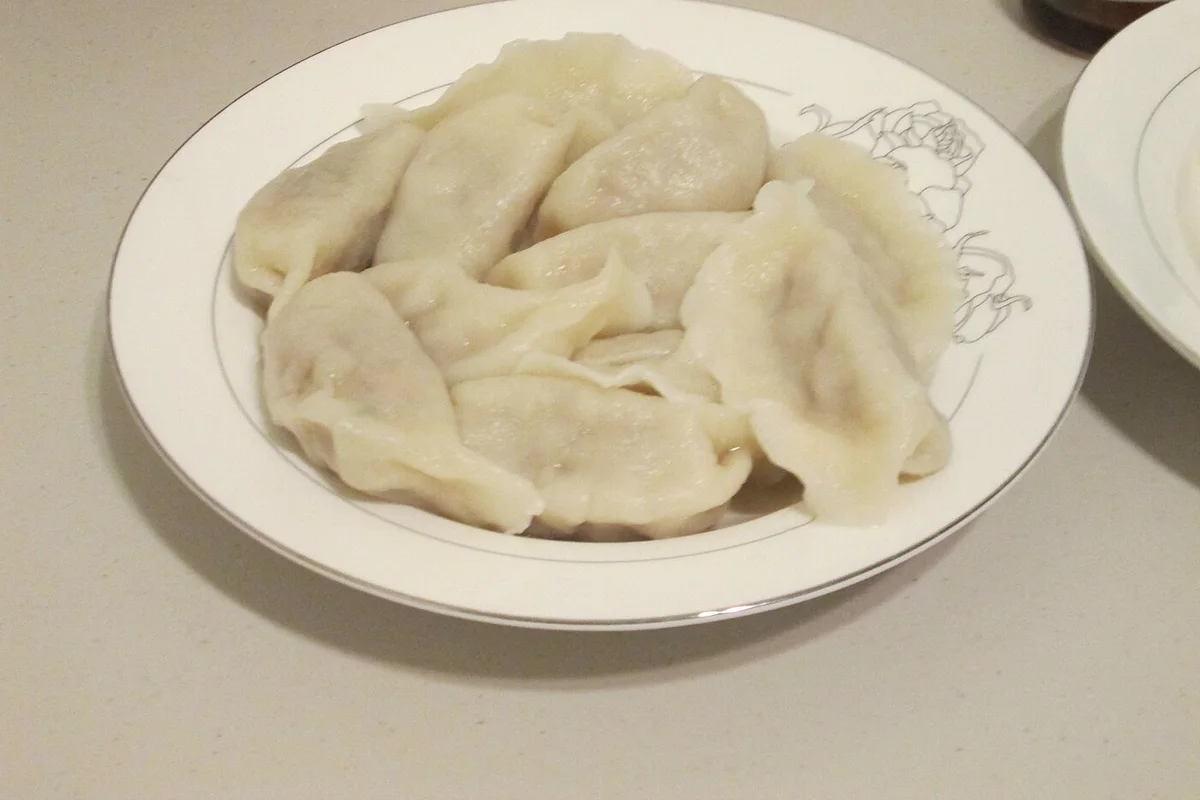
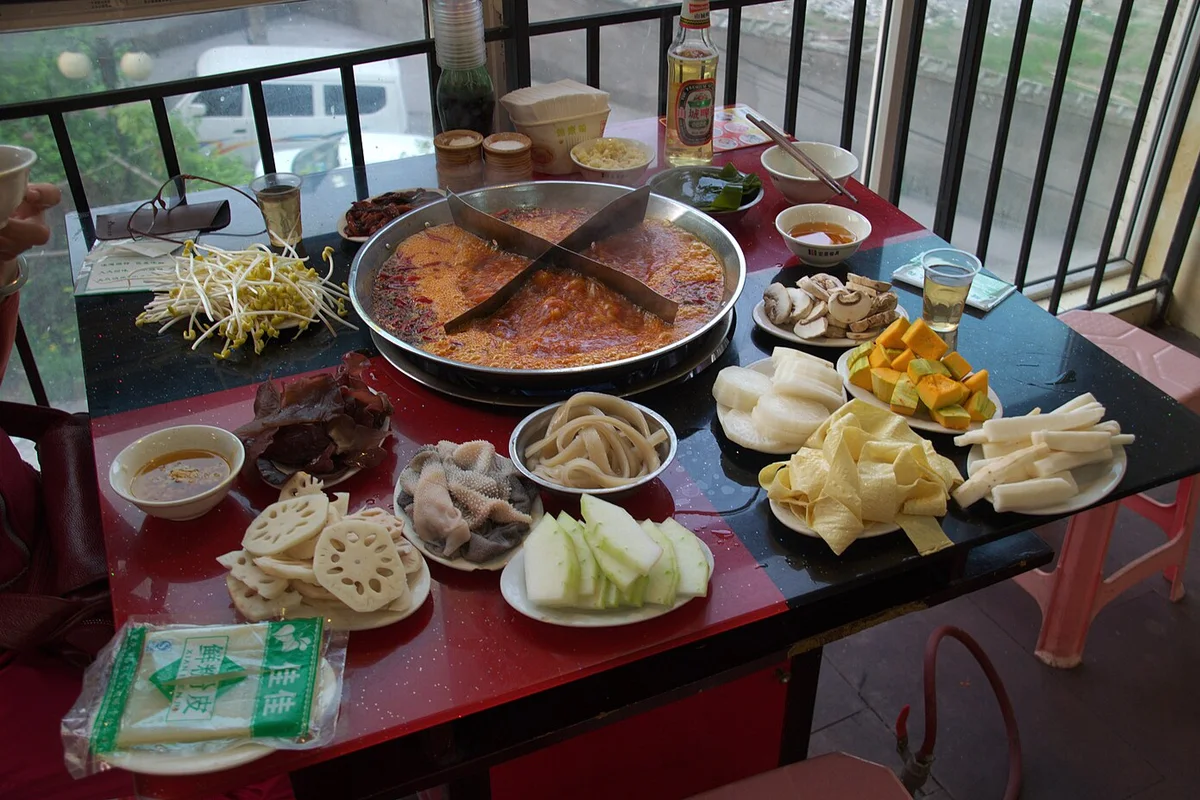
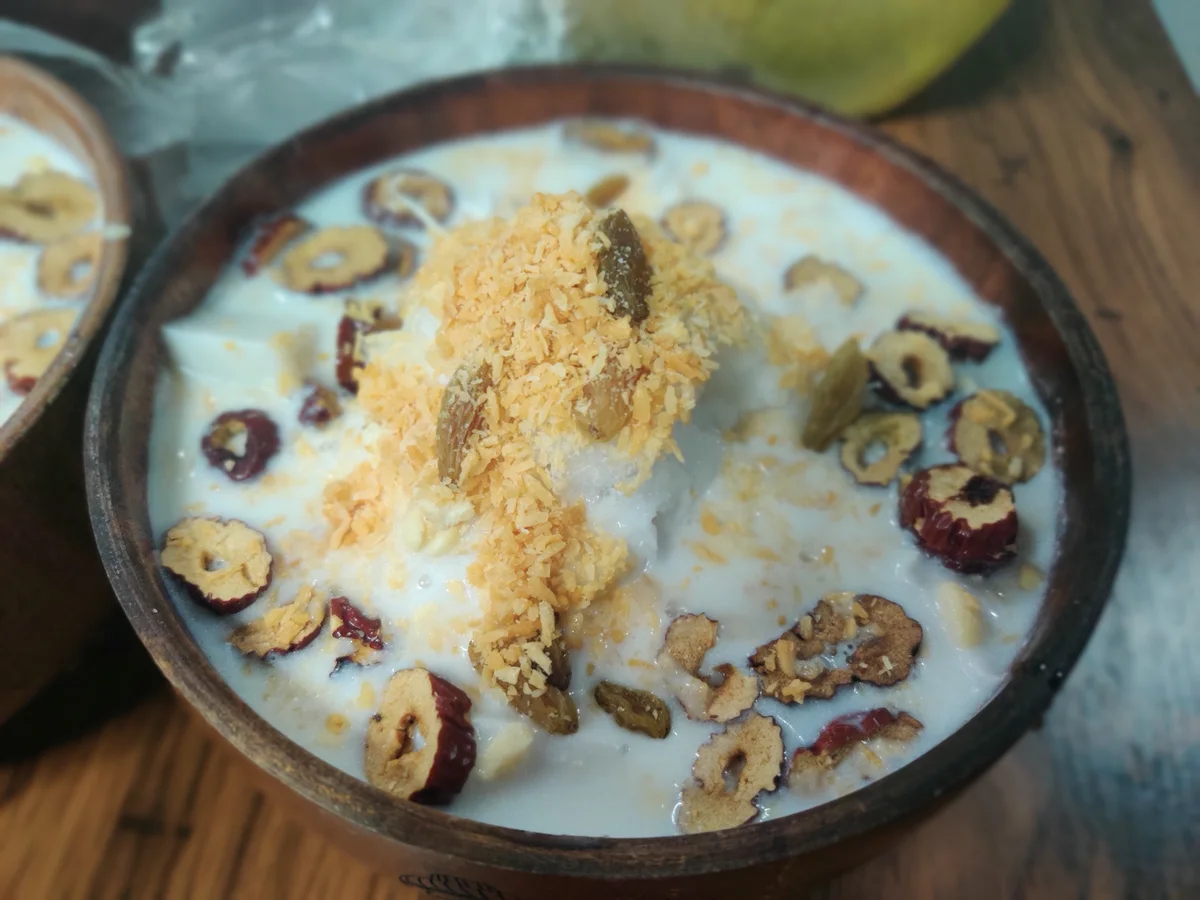
Sauerkraut dumplings, Sichuan hot pot and qingbuliang
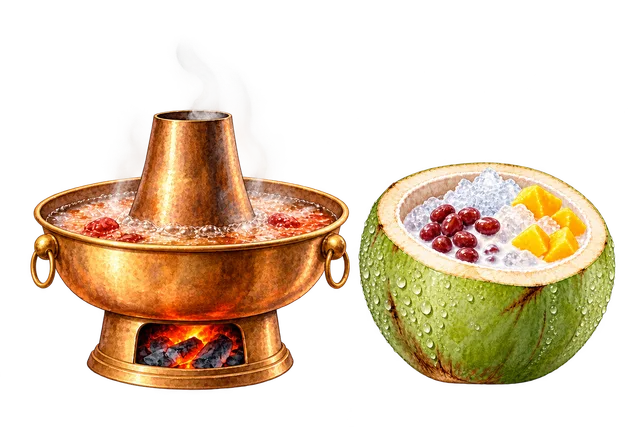
One dish from each end of the climate: northeastern sour cabbage put up for winter, the hot pot the Sichuanese say drives out damp, and the cool coconut bowl Hainan eats on summer evenings.
01
Six climates and the food each one makes
Where each kind of weather is found, what it does to the food, and a dish to taste it in.
| Climate | Regions | What the weather does to the food | Dishes to try |
|---|---|---|---|
| Long, frozen winter | Dongbei (the northeast) | Vegetables dried in summer and cellared in autumn; cabbage soured in vats; the winter itself used as a freezer for tofu, dumplings, meat and pears | Sauerkraut dumplings, sha zhu cai, pork and vermicelli stew |
| Cold, dry north | Beijing, Shaanxi | Wheat noodles and breads; chilli used as a dry powder; cabbage stored for winter; roast and boiled mutton from the start of autumn | Biangbiang noodles, liangpi, copper pot mutton |
| Damp, cloudy basin and hills | Sichuan, Chongqing, Hunan | Chilli and Sichuan pepper eaten “to drive out damp”; pork salted and smoked; vegetables pickled in jars | Sichuan hot pot, twice-cooked pork, steamed Hunan cured meats |
| Sunny plateau with a rainy summer | Yunnan | Chillies dried and charred rather than pickled; hams salted in winter; wild mushrooms from June to September | Xuanwei ham, wild mushroom hot pot |
| Hot, humid south | Guangdong | Herbal tea, soups and sweet soups chosen by season to “clear heat” and “remove damp”; very little chilli | Double-skin milk, white-cut chicken |
| Tropical island | Hainan | Light seasoning, coconut water, cooling bowls eaten at night, meals timed around the heat of the day | Qingbuliang, coconut chicken hot pot |
02
One line on the map: wheat to the north, rice to the south
The clearest climate line in Chinese food runs along the Qinling mountains and the Huai River.
Chinese geographers draw the country’s north–south boundary along the Qinling range in southern Shaanxi and the Huai River east of it. The line follows the 800 mm rainfall line, which divides humid land from semi-humid land, and the 0°C line for January: south of it the January average is above freezing and rivers rarely ice over; north of it they usually do. It also divides the crops. South of the line the main grain is paddy rice and the oil crop is rapeseed; north of it the grain is wheat and the oil crops are peanuts and soybeans. The geographer who explained the line to People’s Daily in 2022 noted that the Qinling are more than a hundred kilometres deep, so the line is really a belt where one kind of farming gives way to the other.
That is why distance on a north–south axis changes a meal much faster than distance east to west. The historian Cao Yu points out that Zhengzhou and Wuhan are only about 500 km apart, yet one eats wheat and the other rice, while Jinan and Xi’an are nearly 1,000 km apart and eat in much the same way. Places on the same latitude share a climate, so they grow the same crops and end up eating alike.
The line even sorts the chilli. Cao Yu found that chilli north of the Qinling is ground to a dry powder, while south of it in the Hanzhong and Sichuan basins it is mostly pounded into pastes and pickled; along the flatter Huai River the two forms meet, and the closer to the Yangtze, the less powder is used. Powder suits a dry climate and a wheat diet, where it is sprinkled on or splashed with hot oil; pastes and pickled chillies go with rice. Shaanxi shows the northern side clearly. The local food writers Su Yuhai and Cheng Peng put its noodle culture down to a continental climate whose main crop is wheat: hundreds of kinds of noodle, from belt-wide biangbiang to Qishan saozi noodles, with chilli oil made by pouring smoking oil over the dry powder.
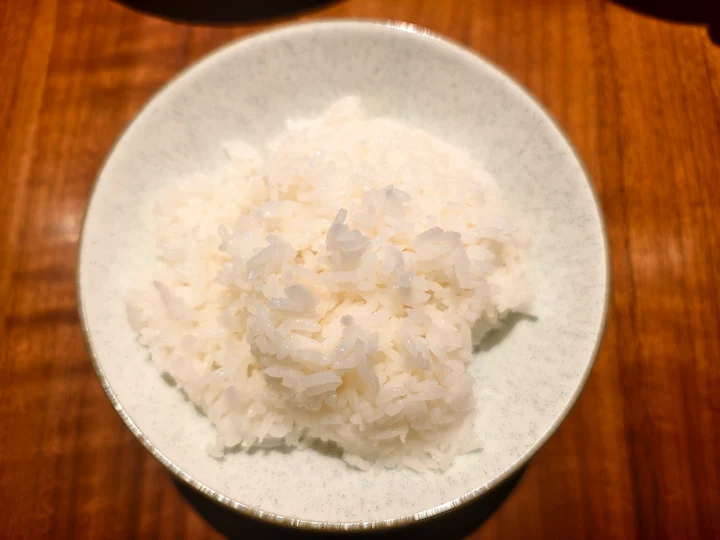
Steamed rice
The plain bowl of rice that anchors a meal south of the line.
Biangbiang noodles
Guanzhong’s belt-wide wheat noodles, dressed with dry chilli and smoking oil.
Read the biangbiang guide →Chinese noodles by region
Fourteen bowls from Lanzhou to Haikou, wheat in the north and rice in the south.
Open the noodle map →03
Long winters in the north: cellars, sour cabbage and frozen pears
In the northeast, the food year is organised around a winter in which nothing grows.
Leng Houcheng and Liao Xiaoqing, historians of northeastern food, describe a frost-free season of only about four months in parts of Dongbei. Families answered it in two steps. In summer and early autumn, when vegetables were plentiful and cheap, they dried large amounts of them. In autumn they put cabbage, radish and potatoes into cellars, filled vats with sour cabbage and salted many kinds of pickle. Both habits are still kept in towns and villages across the region, and sour cabbage is still the base of the northeast’s dumplings and stews.
Then the cold itself became the larder. The same authors call the northeastern winter a vast free cold store: meat was buried in snow or dipped in water until it wore a coat of ice, vegetables kept their colour under snow, and households froze tofu, milk, dumplings, steamed buns, sticky rice cakes and fruit. Frozen persimmons, frozen autumn pears and frozen apples are rock hard and have to be soaked in cold water before they can be eaten. The trick is at least nine centuries old. Pang Yuanying, a Song official, recorded that on an embassy to the Liao in the coldest month he was served pears frozen too hard to eat; his Khitan host soaked them in cold water until a shell of ice formed on the outside, knocked it off, and the fruit inside had thawed.
Beijing lived by stored cabbage too. In the planned-economy decades, Wan Jianzhong and Jiang Wenhua write, the city’s vegetables came in one at a time, summed up in a rhyme: spinach in spring, gourds in summer, and in winter cabbage runs the house. Each November the city set up offices to move the winter-storage cabbage, and families queued for hours in the cold to carry home several hundred jin (a jin is half a kilo) to last until spring. The other side of the northern year is putting weight back on. Wang Zengqi, who lived in Beijing for decades, wrote that after a summer of plain sesame noodles and mung-bean porridge, people’s appetite returned with the first autumn wind, and that in Beijing this “putting on autumn fat” meant eating roast meat. An old rule in the city kept grilled meat and copper pot mutton off the menu until Liqiu, the solar term that begins autumn in early August.
Sauerkraut dumplings
Northeastern jiaozi filled with sour cabbage fermented through the winter and fatty pork.
Read the sauerkraut dumpling guide →Sha zhu cai
The pork, blood sausage and sour cabbage cooked on the winter day a family kills its New Year pig.
Read the sha zhu cai guide →Copper pot mutton
Beijing’s charcoal hot pot of hand-cut lamb, eaten from autumn until spring.
Read the copper pot guide →04
Does damp weather explain Sichuan and Hunan chilli?
Ask in Chengdu or Changsha why the food is so hot and the answer is usually the weather. The historians are less sure.
The local explanation is old and sincere. Fuchsia Dunlop, who trained as a chef in Chengdu, writes that most Sichuanese put their spicy food down to the muggy climate. In Chinese medicine damp is unhealthy because it weakens the body’s yang and makes people sluggish, and warming foods such as chilli, ginger and Sichuan pepper drive it out, so people feel bound to eat chilli in winter, against a damp that seeps through every layer of clothing, and in summer, to make them sweat. Chongqing, steamier still and known as one of China’s “furnace cities,” is said to eat even more. Sichuan hot pot is thought of as a winter dish that drives out the creeping damp of the Sichuan winter.
The geographer Lan Yong gave the idea a scholarly form in 2001. In his account, the upper and middle Yangtze have cold, wet winters with little sunshine and much fog, so the food there is very hot; the north is cold but dry and sunny, so its food is mildly hot; and the southeast coast, though damp in winter, is warm and sunny, so its food is mild. Migrants who carried a taste for chilli with them were his second cause.
Cao Yu, who wrote a 2019 history of chilli eating in China, thinks the sunshine theory fails. Worldwide, the places that eat the most chilli, India, Mexico and Southeast Asia, are hot and sunny, while northern Europe and Canada, short of sun and cold, eat little. The earliest Chinese record of chilli as food, a Guizhou gazetteer of 1721, says the local Miao and other peoples used it “in place of salt”: Guizhou had no salt of its own and poor roads, so salt was dear. Cao Yu argues that chilli spread as a cheap seasoning that made a lot of rice or maize go down with very little else on the table, which Chinese calls 下饭. The medical reasons came with it. A pharmacopoeia of 1765 already described chilli as hot and able to drive out water and damp.
His fieldwork in Guangdong shows how flexible those reasons are. Cantonese people he interviewed avoided chilli because it causes “heat” (热气) in a hot, damp place; migrants from inland who kept eating it said chilli removes damp, which Guangdong has plenty of. Both, he concludes, were using Chinese medicine to justify what they already liked. Guangdong also has its own exception: Nanxiong, in the hills on the Jiangxi border, has damp winters that chill to the bone, and it eats chilli as fiercely as Sichuan, in a stew of old goose and lotus root.
Climate still matters on a larger scale. A 1998 study by the biologists Jennifer Billing and Paul Sherman, using 4,578 meat recipes from 36 countries, found that the hotter a country’s climate, the more spices its recipes use, and argued that spices help keep food from spoiling. China fits that pattern only loosely: its hottest provinces, Guangdong and Hainan, use the least chilli. Weather sets the stage, but salt, trade routes, cheap seasoning and migration decided who ended up eating chilli.
Hunan vs Szechuan
How Sichuan’s numbing heat and Hunan’s fresh and pickled chilli differ.
Compare the two cuisines →Sichuan hot pot
Beef tallow, chilli and Sichuan pepper, the winter meal said to drive out damp.
Read the hot pot guide →05
Smoke, salt and jars in the damp southwest
Where winters are damp and grey, food that has to last is dried with smoke.
In northern Europe and northern China, cold air can dry a ham. Sichuan and Hunan have damp winters, and there most cured meat goes over a fire. A meat-processing handbook edited by Wang Wei and Zhang Jiamin lists what the smoke does: it takes away gamey smells, adds flavour and a dark colour, dries the meat, kills bacteria and slows the fat from turning rancid. Many Sichuanese, even in cities, still salt and smoke their own pork and make air-dried sausages in winter, and that the style varies: in Chengdu the meat is smoked until the fat is golden, on Qingcheng Mountain until it is black. On sunny days in May, she writes, Chengdu seems hung with cabbage leaves drying to be packed in jars with salt and Sichuan pepper, and a small dish of pickles ends almost every meal.
The damp reached even the rice. Lan Yong quotes Chen Nieheng, an early Qing writer, on Sichuan: rice there was cheap and plentiful, but the earth breathed damp, so households stored their grain and roasted it over a fire as they needed it. This “fire rice” kept without weevils, though it did not taste good.
What a region keeps also depends on salt. Cao Yu maps China’s relishes eaten with rice: the coast, which made sea salt, had shrimp paste, salted fish, bean pastes and salted vegetables, as Chaozhou still does; Hunan and Jiangxi, far from the sea but on busy rivers, got salt easily and kept pickled vegetables, salted fermented black beans and fermented tofu; Guizhou, with no salt and few roads, turned to chilli and sour flavours instead.
Steamed Hunan cured meats
Smoked pork, fish and chicken from the winter curing, steamed together in one bowl.
Read the cured meats guide →Twice-cooked pork
Sichuan’s boiled-then-fried pork with fermented broad-bean paste.
Read the twice-cooked pork guide →06
Yunnan: dry sunshine, a rainy summer and its mushrooms
Yunnan sits next to Sichuan and Guizhou but has a different sky, and its chilli shows it.
Cao Yu notes that Yunnan gets more sunshine and is drier than Sichuan and Guizhou, which makes chillies easy to dry and keep, and that its trade went over mountain paths, where dry goods travel far better than wet ones. So where Sichuan and Guizhou mostly use chilli wet, pounded into pastes and pickled, Yunnan dries it, toasts or chars it, and mixes it with other seasonings into dipping sauces, a combination he calls the province’s own dry, compound style of heat.
The same plateau has a wet season every summer, and it brings the mushrooms. Wang Zengqi, who studied in Kunming in the 1940s, remembered that when the rains came, every kind of mushroom came up, the air smelled of them, and rich and poor alike ate them. Fresh wild mushrooms still fill Kunming’s markets from about June to September, which is when the city eats mushroom hot pot. Winter is for curing: Xuanwei ham is salted in the coldest weeks and hung through the rainy season to ripen.
Wild mushroom hot pot
Kunming’s rainy-season pot, with a timer on the table before anyone eats.
Read the mushroom hot pot guide →Xuanwei ham
Northeastern Yunnan’s dry-cured leg, salted in winter and aged through the summer rains.
Read the Xuanwei ham guide →07
Guangdong: herbal tea, soups and sweet soups against heat and damp
Guangdong answers its heat and damp with what it drinks and simmers, not with chilli.
Herbal tea (凉茶) is the clearest example. When it was put on China’s first national list of intangible heritage in 2006, nominated by Guangdong together with Hong Kong and Macau, the listing described it as a drink the people of the three places developed to suit their climate and soil: brewed from medicinal herbs, guided by Chinese medical ideas about health, and drunk to clear heat, quench thirst and remove damp. Sixteen herbal-tea makers and fifty-four of their formulas were recognised. Sheng Hui, a writer from Jiangsu who has lived in Guangdong for eighteen years, says the one drawback of the region is how easily you get “heated,” and that the cure is either herbal tea as bitter as bile or a few bowls of salty pork-bone congee.
Soup does the same work every day. For a long time a good Lingnan housewife was judged by her slow-boiled soups, each cut of pork matched to a purpose: pork bones with sweet corn, carrot and water chestnut to refresh and remove damp; pork lung with dried bok choy and apricot kernels for a cough; pork tongue with self-heal to clear heat. Sweet soups follow the seasons too: wolfberry in spring, kelp and mung bean or water-chestnut sago in summer, papaya with fritillary and pear with white fungus in autumn, black sesame paste and longan and red-date soup in winter.
Behind this lies an old picture of the south as hot, damp and unhealthy. Cao Yu points out that northern writers long saw Lingnan as a land of miasma, and that drinking herbal tea against “damp heat” became part of how southern families who traced their roots to the Central Plains set themselves apart. The medicine describes the climate as much as it treats it.
Double-skin milk
Shunde’s steamed buffalo-milk pudding, one of the sweets Guangzhou eats through the hot months.
Read the double-skin milk guide →White-cut chicken
Poached chicken with ginger and scallion, Cantonese cooking at its lightest.
Read the white-cut chicken guide →08
Hainan: light food, coconut and a cooling bowl at night
On China’s tropical island, the heat decides when people eat as much as what.
Su Shi, the Song poet exiled to Danzhou in Hainan, wrote in 1098 that the climate of Lingnan was low and damp and the air steamed, and that Hainan was the worst of it: by the turn of summer to autumn, nothing escaped rot. Hainan food is still made for that heat. Yun Daxin, a Hainan food writer, explains the island’s light, plain cooking partly by its climate: in tropical heat the body cannot take food heavy with salt, oil, sauce or chilli. Summer can reach 40°C, and coconut water, rich in potassium, is the everyday cooler.
The heat also sets the timetable. In Hainanese, people speak of four meals: one at sunrise, one at midday, one at about three or four in the afternoon “when the sun leans west,” and one at dusk. In summer, villagers go back to the fields only after the afternoon meal, while townspeople take afternoon tea in the old “daddy tea” shops. When the sun goes down in Haikou, residents walk out to stalls on street corners for a bowl of qingbuliang, coconut milk with beans, fruit and jellies, to cool off. Long, warm evenings also make the late-night meal a fixture: in Ding’an, crowds arrive at the beef stalls of Xiangou after ten at night.
Qingbuliang
Hainan’s evening bowl of coconut milk, beans, fruit and jellies.
Read the qingbuliang guide →Coconut chicken hot pot
Chicken simmered in fresh coconut water, a dish that grew from Hainan’s coconut cooking.
Read the coconut chicken guide →09
Eating with the weather: when to go where
Each of these foods is best in the season that made it.
Go to the northeast in the depth of winter. The pig-killing feasts start once it is cold enough for meat to freeze outdoors, mostly in the twelfth lunar month, and frozen pears and persimmons are sold on the street, to be soaked in a bowl of cold water until the ice shell can be knocked off. In Beijing, copper pot mutton and grilled meat belong to the cold half of the year, from early August’s Liqiu onward.
Go to Kunming in the rainy season, from about June to September, for fresh wild mushrooms, and eat only in restaurants that cook them through. In Sichuan and Hunan, winter is when pork and sausages hang to cure and smoke; the steamed cured meats are on menus all year. In Guangdong, summer is the season for herbal-tea shops and for soups simmered for hours; in Hainan, eat early, rest through the hot afternoon, and go out for qingbuliang after dark.
FAQ
Frequently asked questions
Why do northern Chinese eat wheat and southern Chinese eat rice?
Because of the climate along the Qinling–Huaihe line. North of it, rainfall is under about 800 mm a year and January is below freezing, which suits wheat; south of it the land is wetter and warmer, which suits paddy rice.
Why is Sichuan food so spicy?
Sichuanese people usually say chilli drives out the damp of their cloudy, humid climate. Historians such as Cao Yu argue that chilli spread mainly as a cheap seasoning that helped people eat a lot of rice with little else, and that the damp explanation came from Chinese medicine afterwards.
Why don’t Cantonese people eat spicy food?
Many Cantonese believe chilli causes “heat” (热气) in a climate that is already hot and damp, so they cool down with herbal tea, soups and sweet soups instead. Chilli was also never a cheap staple seasoning there, since salt and other relishes were easy to get.
Why does northeast China eat so much sour cabbage?
The frost-free season is only about four months in parts of the northeast, so families soured cabbage in vats each autumn, cellared vegetables and froze food outdoors to last the winter.
What is the Qinling–Huaihe line?
China’s conventional north–south boundary, along the Qinling mountains and the Huai River. It roughly follows the 800 mm rainfall line and the 0°C January temperature line, and divides rice and rapeseed farming in the south from wheat, peanuts and soybeans in the north.
Sources
Sources and further reading
- 1 Cao Yu, Zhongguo Shila Shi (中国食辣史, A History of Chilli Eating in China), ch. 1 §3 “Can Chinese people really take heat?”, §6 “Chilli enters the Chinese diet”, §7 “Why chilli was first eaten in Guizhou”; ch. 2 §3 “Chinese medicine and chilli”, §4 “Shanghuo and qushi”, §7 “North and south” (in Chinese)Beijing United Publishing (2019)
- 2 Lan Yong, Zhongguo Chuancai Shi (中国川菜史, A History of Sichuan Cuisine), ch. 2 §2: Sichuan food from the Tang to the Ming, and Chen Nieheng on “fire rice” (in Chinese)Sichuan Literature and Art Publishing House (2019)
- 3 Land of Plenty: A Treasury of Authentic Sichuan Cooking, pp. 6, 13, 57–58 and 345: the climate, pickles and cured pork, and hot pot in winterFuchsia Dunlop, W. W. Norton (2003)
- 4 Leng Houcheng and Liao Xiaoqing, Dongbei Yinshi Wenhua (东北饮食文化, The Food Culture of Northeast China), preface, ch. 4 “The Khitan diet” and ch. 12 on frozen fruit (in Chinese)Social Sciences Academic Press (2018)
- 5 Wenchang zalu (late 11th century), juan 1: frozen pears on an embassy to the Liao (in Chinese)Pang Yuanying; Chinese original on Wikisource ↗
- 6 Wan Jianzhong and Jiang Wenhua, Beijingren de Yinshi Shenghuo (北京人的饮食生活), ch. 2 §1 on rationing and winter-storage cabbage, and ch. 7 “Seasonal food” (in Chinese)Beijing Publishing House (2024)
- 7 Wang Zengqi, “A small register of mushrooms” (菌小谱) and “Putting on autumn fat” (贴秋膘), in Renjian Zhiwei: Wang Zengqi Tan Chi (人间至味:汪曾祺谈吃) (in Chinese)China Literature and History Press (2023)
- 8 Sheng Hui, Yuecai Ji (粤菜记), chapters on Meiling goose, soup, morning tea and sweet soups (in Chinese)People’s Literature Publishing House (2023)
- 9 Su Shi, “On the climate and customs of Hainan” (書海南風土), written in Danzhou in 1098 (in Chinese)Chinese original on Wikisource ↗
- 10 Yun Daxin, Hainan Meishi Tanqi (海南美食探奇), introduction and the chapters on coconut chicken soup, Ding’an late-night beef and qingbuliang (in Chinese)Nanfang Publishing House (2024)
- 11 Su Yuhai and Cheng Peng, Shaanren Shaancai (陕人陕菜), “Shaanxi’s noodle culture” (in Chinese)Northwest University Press (2018)
- 12 Wang Wei and Zhang Jiamin (eds.), Zhongguo Chuantong Tese Yanla Rouzhipin Jiagong Jishu (中国传统特色腌腊肉制品加工技术), ch. 1: what smoking does to cured meat (in Chinese)Chemical Industry Press (2019)
- 13 Herbal tea (凉茶), national intangible cultural heritage item Ⅷ-89 (2006) (in Chinese)China Intangible Cultural Heritage Network ↗
- 14 Jennifer Billing and Paul W. Sherman, “Antimicrobial functions of spices: why some like it hot” (1998)The Quarterly Review of Biology, via PubMed ↗
- 15 What kind of line is the Qinling–Huaihe line? (2022) (in Chinese)People’s Daily ↗
Last updated November 2026